
Stone CNC Machines
Showing the single result
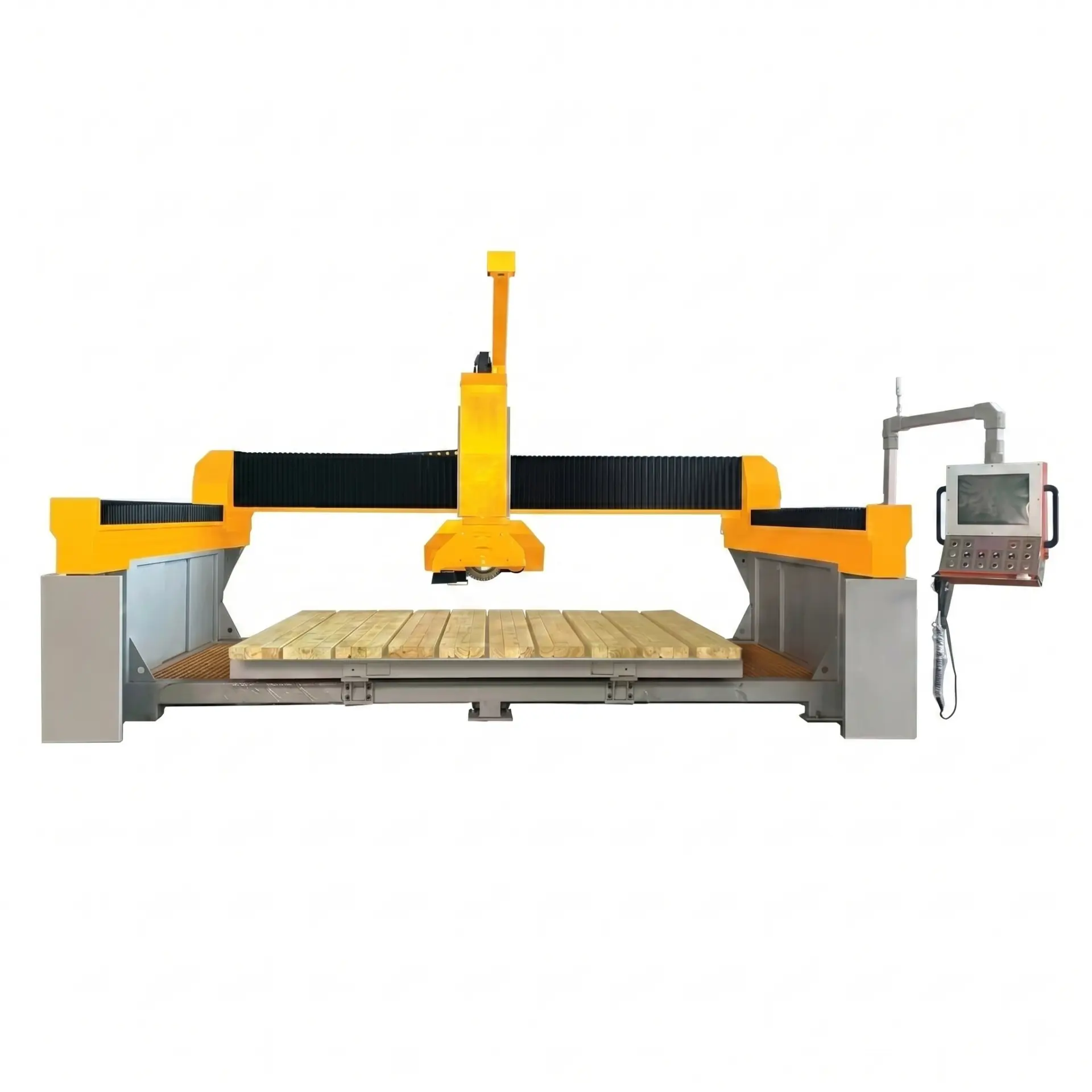
Stone CNC Machines for Quartz, Marble, and Granite Fabrication
In stone fabrication, the real challenge is not simply cutting a slab. The real challenge is moving from raw material to finished part with stable accuracy, repeatable edge quality, and a workflow that does not collapse under complex geometry or rising order volume. Manual methods can still play a role in certain shops, but once production requires reliable chamfers, copied shapes, edging consistency, polishing preparation, and repeatable output across quartz, marble, granite, and sintered stone, process control becomes a decisive factor.
Stone CNC machines are designed to bring that control into the fabrication process. For countertop production, architectural stone work, and shaped-part manufacturing, they help reduce variation, improve profile consistency, and make it easier to scale quality instead of chasing it manually on every job.
What Stone CNC Machines Solve in Real Production
Stone fabrication often looks straightforward from the outside: cut the slab, shape the part, finish the edge, and move on. In practice, each stage introduces opportunities for deviation. A small angle error at the cutting stage can create downstream fitting problems. Inconsistent edge handling can increase polishing time. Repeated manual corrections can slow the line and make scheduling harder to control.
Stone CNC machines address these issues by turning critical fabrication steps into a more controlled and repeatable process. Instead of depending entirely on manual adjustment, shops gain a platform that is better suited to:
- Repeated part accuracy across production batches
- More consistent profile and chamfer execution
- Better handling of complex shapes and copied geometry
- Lower dependence on manual trial-and-error during finishing preparation
- Stronger process stability when working across multiple stone materials
This matters especially when a shop is balancing standard countertop work with custom pieces, decorative profiles, or project-based architectural fabrication.
Where Stone CNC Machines Fit in the Workflow
The value of a stone CNC machine becomes clearer when viewed as part of the broader fabrication sequence rather than as a stand-alone cutting asset.
| Workflow Stage | CNC Contribution | Why It Matters |
|---|---|---|
| Slab Cutting And Sizing | Supports controlled cutting on standard plates and shaped parts | Improves dimensional consistency before downstream processing |
| Profile And Angle Processing | Helps execute chamfers, curves, copied forms, and special geometries | Reduces rework on complex jobs and improves fit quality |
| Edge Preparation | Supports edging-related process consistency | Makes polishing and finishing more predictable |
| Carving And Decorative Work | Enables controlled shaping for architectural or custom applications | Expands the range of jobs a shop can take on with confidence |
| Repeat Batch Production | Maintains process repeatability across similar parts | Improves scheduling, labor efficiency, and output stability |
For many fabricators, the key point is not that CNC replaces every manual operation. The key point is that CNC reduces the number of critical operations where manual inconsistency creates waste, delay, or downstream correction.
Material Fit Across Quartz, Marble, Granite, and Sintered Stone
Different stone materials place different demands on the fabrication process, which is why machine selection should always be tied to the actual material mix in the shop.
Quartz fabrication usually demands a clean, repeatable process because the finished product often goes directly into visible residential or commercial installations where fit and edge appearance matter. Marble processing places a premium on controlled shaping and finish-sensitive handling, especially when decorative or high-appearance work is involved. Granite fabrication tends to reward robust process stability and consistent cutting performance on harder material. Sintered stone, increasingly common in modern surface applications, benefits from precise, well-controlled machining when part accuracy and edge definition are important.
This is where the category logic of Pandaxis product catalog matters. Stone CNC equipment should not be selected as a generic “stone machine.” It should be selected according to the actual combination of material behavior, part geometry, finish expectations, and production rhythm inside the shop.
Why Five-Axis Capability Matters in Stone Processing
In many fabrication environments, the difference between a basic cutting platform and a more capable CNC system appears when the job moves beyond straight lines and simple rectangular output. A five-axis bridge saw configuration is valuable because it supports more complex processing logic without forcing the shop into excessive secondary setups.
On the current Pandaxis stone machinery offering, the representative 5-axis CNC bridge saw is designed for both standard plates and specialized shapes. It is positioned for complex profile cutting and copying, including polygons, triangles, fans, table panels, ovals, diamonds, circles, ogee edges, and arbitrary-angle chamfering. Its automatic A-axis movement from 0° to 90° and C-axis rotation of ±365° help explain why this kind of platform is relevant when shops need more than basic slab division.
From a production standpoint, that kind of capability matters for three reasons. First, it improves flexibility when the order mix includes varied shapes instead of repetitive straight cuts alone. Second, it helps reduce the number of times a part must be repositioned for angle or profile work. Third, it allows shops to approach decorative, engineering, or premium residential applications with a more stable processing method.
For stone businesses serving engineering projects or high-end home decoration, this is often the point where CNC capability stops being a convenience and becomes a competitive requirement.
What Buyers Should Evaluate Before Choosing a Stone CNC Machine
The right machine is not defined only by whether it can cut stone. It is defined by whether its configuration matches the shop’s production reality.
| Evaluation Point | What To Ask | Why It Matters |
|---|---|---|
| Part Geometry | Are most jobs straight cuts, or do they include copied shapes, curves, and angle work? | Determines how much multi-axis flexibility the shop really needs |
| Material Mix | Is the shop focused on quartz, marble, granite, sintered stone, or a mix? | Affects the need for process stability across different fabrication demands |
| Production Volume | Is output built around one-off custom jobs, repeat batches, or project-scale throughput? | Helps define whether flexibility or repeatability is the higher priority |
| Edge And Finish Expectations | Is the business competing on visual finish quality and profile consistency? | Strongly influences the value of better edge-processing control |
| Working Envelope | What slab sizes and part dimensions are common in production? | Prevents under-sizing or over-buying relative to actual jobs |
| Function Configuration | Which functions are standard, and which are optional? | Clarifies whether the machine matches the intended workflow from day one |
This last point is especially important. On the Pandaxis 5-axis CNC bridge saw page, the camera function is listed as standard, while functions such as knife, thickness, chuck, and cutter are described as optional. That kind of configuration detail should always be tied back to the shop’s real production plan rather than treated as a checklist of features to collect.
When a Stone CNC Machine Makes the Strongest Operational Sense
Not every shop reaches the CNC decision at the same stage. In some cases, the trigger is labor pressure. In others, it is rising design complexity, higher finish standards, or the need to handle more repeat work without quality drift.
Stone CNC machines make the strongest operational sense when a fabricator is dealing with one or more of the following conditions:
- A growing mix of custom shapes and angle-dependent work
- Repeated demand for consistent edge and profile output
- Higher-value residential or commercial projects where fit quality matters
- Pressure to reduce manual correction and downstream rework
- The need to process quartz, marble, granite, or sintered stone with greater workflow stability
In these environments, the machine is not just a cutting asset. It becomes a process-control asset that helps stabilize production quality and make output more predictable across both standard and custom work.
Pandaxis Stone CNC Machines in a Practical Buying Context
Pandaxis positions its stone machinery around heavy-duty CNC processing for routing, carving, edging, and polishing applications in quartz, marble, granite, and other countertop-oriented stone work. That makes the category relevant for buyers who are not merely looking for slab cutting, but for a more complete approach to shaped fabrication and finishing-related process control.
Within that context, a 5-axis CNC bridge saw is especially relevant for shops that need to combine straight cutting with more advanced profile handling, copied geometry, and angle processing. Instead of forcing a separate logic for every unusual part, it gives the shop a stronger central platform for varied stone jobs.
The important decision is not whether CNC sounds more advanced than manual fabrication. The important decision is whether a stone CNC platform matches the part complexity, finish expectations, and throughput logic of the business. When it does, the payoff is usually seen in cleaner execution, more consistent output, and a workflow that is easier to scale with confidence.
Stone fabrication becomes more demanding as materials diversify, job geometry becomes less standard, and customers expect better finish quality with shorter lead times. In that environment, stone CNC machines matter because they help convert precision from an operator-dependent outcome into a more repeatable production method. For shops working in quartz, marble, granite, and sintered stone, that shift can be the difference between staying reactive and building a fabrication workflow that is ready for higher-value work.