
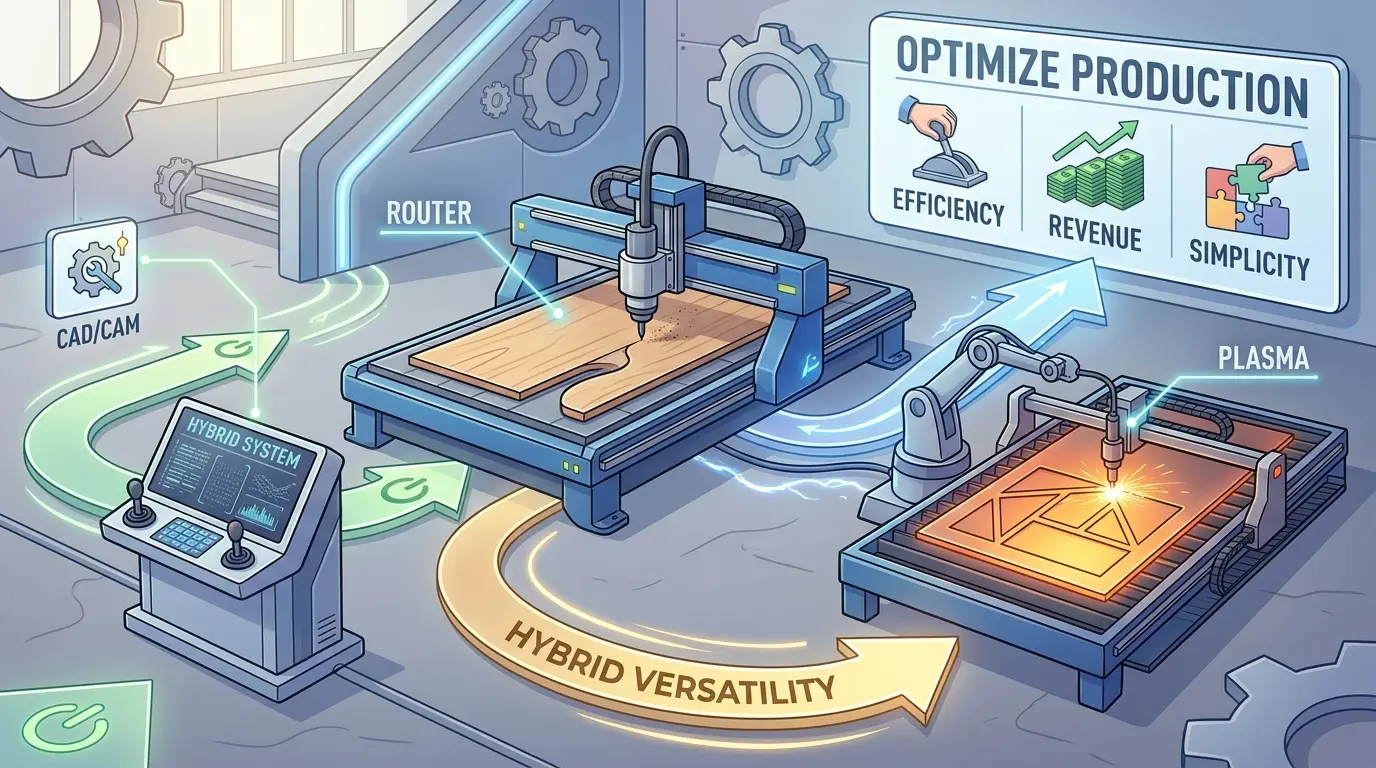
A 4×8 footprint can make several machine types look deceptively similar. A router table, a plasma table, and a hybrid concept may all occupy roughly the same floor area, but they are built around different materials, different housekeeping rules, different edge expectations, and different downstream work.
The right question is not which machine fits the footprint. It is which process family the business depends on most of the time.
Start With The Workload That Pays The Bills
The cleanest split is to ask what the machine will actually process during normal weeks.
If recurring work is plywood, MDF, acrylic, plastics, composites, foam board, or similar non-metal sheet, router logic should lead.
If recurring work is conductive sheet or plate inside a metal-fabrication flow, plasma logic should lead.
If both appear often enough to matter, then a hybrid can be examined, but only after admitting that two process families on one footprint usually introduce compromise rather than removing it.
A Router Solves A Non-Metal Sheet Problem
A 4×8 router is usually the stronger answer when the business needs controlled mechanical cutting, pockets, grooves, drilled patterns, and predictable edge quality on non-metal sheet goods.
Typical signs that router logic should anchor the purchase:
- Most Orders Are Non-Metal Sheet Materials.
- Edge Quality Matters Beyond Simple Separation.
- The Work Includes More Than Profile Cutting.
- Tooling, Hold-Down, And Dust Extraction Already Fit The Operating Model.
- The Shop Needs Repeatable Mechanical Features, Not Just Fast Separation.
In panel and furniture environments, this often expands into a broader look at CNC nesting machines once material utilization, drilling logic, and part flow begin to overlap.
Plasma Solves A Different Factory Problem
Plasma becomes the more honest answer when the business is fundamentally solving a metal-fabrication problem.
The buyer should then judge more than cut speed. Plate loading, fume control, consumables, post-cut cleanup, and the next fabrication step all matter.
Plasma logic usually belongs at the center when:
- Metal Work Is The Recurring Revenue Driver.
- Thermal Cutting Throughput Matters More Than Routed Detailing.
- The Shop Can Support Fume Control And Heavier Handling.
- Secondary Cleanup Fits The Labor Model.
- The Next Operations Already Expect Thermally Cut Parts.
Plasma is not the right answer because it shares a 4×8 table size with routing. It is right when the whole workflow is already shaped around metal fabrication.
Hybrids Only Make Sense When Both Process Families Are Truly Real
Hybrid tables sell well because they appear to solve a space problem and a budget problem at the same time.
One footprint, broader flexibility, fewer purchasing decisions.
That concept is attractive. The operating burden is usually underestimated.
A hybrid only makes sense when both process families are genuinely recurring and the shop can support disciplined switching between them.
That means tolerating:
- More Housekeeping Between Unlike Jobs.
- Stronger Contamination Control.
- More Changeover Discipline.
- Wider Operator Training Demands.
- A Machine That May Be Less Ideal For Each Process Than A Dedicated Route.
If one process family clearly dominates, the hybrid argument usually weakens fast.
Compare Routine Burden, Not Just Capability Claims
| Dominant Issue | Router Tends To Fit Better | Plasma Tends To Fit Better | Hybrid Only Fits If |
|---|---|---|---|
| Main material family | Non-metal sheet processing | Conductive metal cutting | Both are genuinely recurring |
| Housekeeping burden | Dust, chips, spoilboard, tooling discipline | Fumes, sparks, consumables, slag cleanup | The shop can manage both worlds calmly |
| Downstream expectations | Cleaner geometry for assembly or finishing | Fabrication flow with accepted cleanup | The downstream line can absorb both part behaviors |
| Main buying risk | Treating routing as universal | Underpricing cleanup and handling | Buying flexibility that adds friction every day |
The right machine is usually the one with the lower everyday burden for the dominant workload.
Downstream Work Clarifies The Choice Faster Than The Demo
The cutting demo is rarely the deciding proof. The more useful question is what the part must do next.
If the part needs clean mechanical features and direct handoff into assembly or finishing, router logic becomes easier to justify.
If the part is headed into deburring, bending, welding, and fabrication flow where thermal cutting is normal, plasma becomes easier to justify.
If the next steps constantly alternate between those worlds, then hybrid may deserve real consideration, but only if the shop has the staffing and housekeeping discipline to support it.
Do Not Mix Router Versus Plasma With Router Versus Laser
Some buyers think they are deciding between router and plasma when they are really solving a non-metal detail or decorative problem.
In that case, plasma may not belong in the comparison at all. If the work is wood, acrylic, or similar materials and the deciding issue is detail, engraving, or non-contact cutting behavior, the more relevant comparison may be whether laser cutters and engravers fit the job better than routing.
Use Recent Orders As The Filter
The cleanest selection method is to review recent orders and map them against the three process options.
Ask:
- Which material family actually dominated the last several months?
- Which jobs created the most handling, cleanup, or quality friction?
- How often would the business truly need to switch process families on one shared table?
- Which downstream steps are most sensitive to edge behavior, contamination, or sorting burden?
- If one process disappeared tomorrow, which machine would still stay busy?
That ties the purchase to the real workload instead of to machine marketing.