
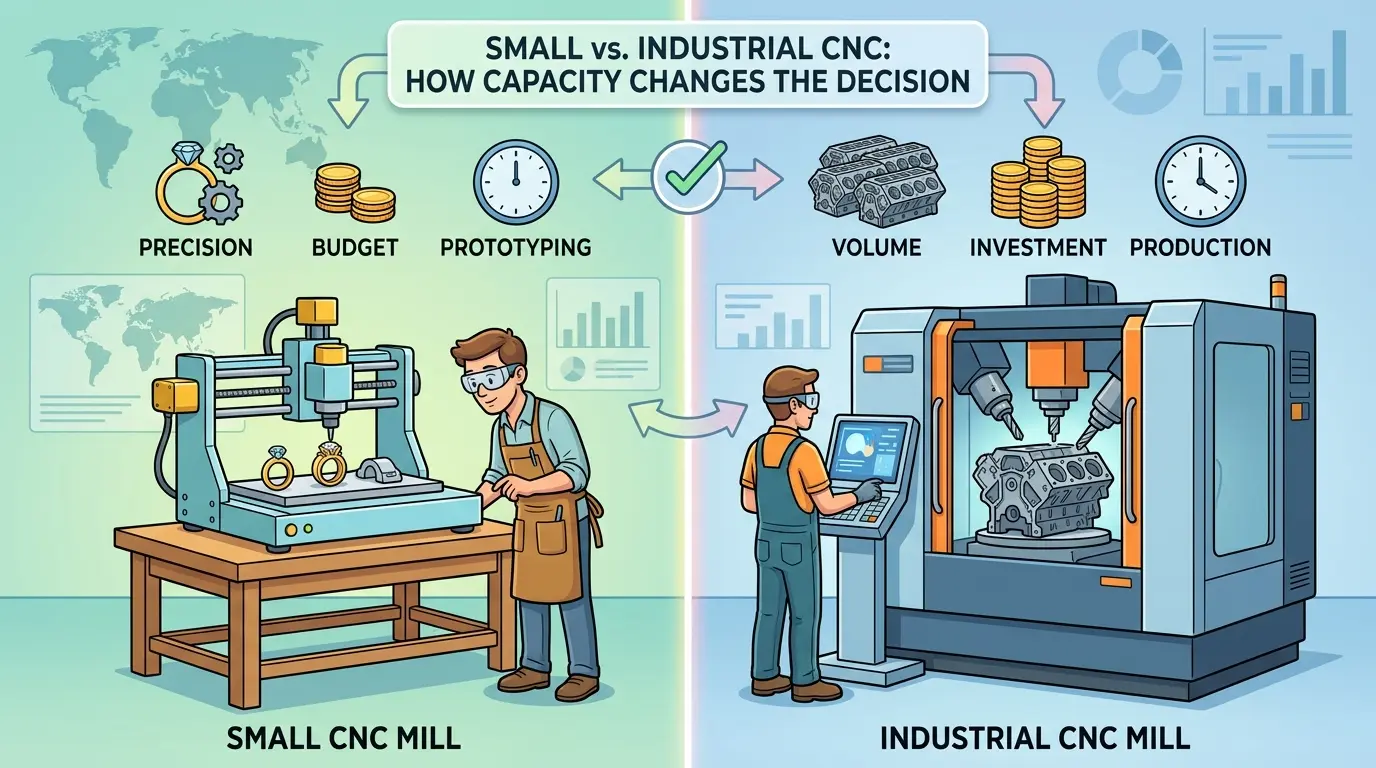
The difference between a small CNC mill and an industrial CNC mill is not only physical size. Capacity changes how the machine behaves under load, how the shop staffs it, what materials it can process calmly, and what kinds of jobs can be quoted with confidence. Small mills can be genuinely useful for prototypes, fixtures, repair parts, and controlled low-volume work. Industrial mills exist because some work needs more than access to a cutter. It needs structure, duty cycle, thermal control, containment, and repeatability that survive real production pressure.
That is why buyers should compare by job family rather than by aspiration. A small mill can be the right answer when part size, budget, material mix, and labor expectations are aligned. An industrial mill becomes necessary when the business needs broader process stability across longer hours, heavier loads, tighter tolerances, or more repeatable output from more than one operator.
The decision changes because capacity changes the whole operating model around the machine.
Capacity Is Not Just More Travel. It Is A Wider Process Window.
Many buyers hear “industrial” and think first about size: larger table, bigger enclosure, longer axes. Those things matter, but they are only the visible layer. The real difference is that industrial capacity usually widens the process window.
On a small mill, the workable range for tooling, workholding, material removal, and finish control is often narrower. The machine may reach the geometry, but only with more careful toolpaths, lower engagement, more operator attention, and a tighter margin for error. Industrial mills usually widen that usable range. They let the shop hold a more stable cut, support heavier workholding, manage heat more consistently, and recover from routine production pressure with less drama.
This is why two machines can both “make the part” and still belong to different commercial categories. One makes the part carefully. The other makes the part repeatedly, across shifts, without asking the operator to constantly rescue the process.
Small Mills Usually Win On Entry Cost, Simplicity, And Controlled Scope
Small mills are attractive for good reasons. They reduce capital exposure, take less floor space, and can often be integrated into a toolroom, prototype area, educational setting, or small fabrication business without a full production-engineering department behind them. For many teams, that lower barrier matters more than raw performance.
In the right context, a small mill is not a compromise. It is the correct machine. Internal fixtures, repair parts, modest aluminum work, engineering changes, one-off brackets, and pilot geometry can all fit well on a small platform if the process expectations are honest.
This is where many buyers get real value. They are not trying to replace a production machining department. They are trying to bring fast, local, controlled machining inside the business without taking on the cost structure of industrial metalworking from day one.
Industrial Mills Win When The Business Needs Less Fragility
Industrial mills justify their cost when the job mix stops tolerating fragility. That fragility may show up as chatter, frequent proving time, fixture congestion, warm-up drift, tool-life inconsistency, or too much operator babysitting. At some point the issue is no longer whether the spindle reaches the material. The issue is whether the process remains calm enough to support quoting, scheduling, and quality control.
Industrial mills are built for broader responsibility. They usually support heavier and more repeatable workholding, more stable thermal behavior, better chip and coolant management, stronger enclosure discipline, and longer-running workloads. Those characteristics do not matter equally for every part. They matter a great deal once the business starts depending on the machine rather than merely benefiting from it.
That is the core distinction. A small mill helps. An industrial mill carries responsibility.
Duty Cycle Changes The Economics More Than Buyers Expect
One of the biggest hidden differences is duty cycle. A small mill may perform very well for a few carefully managed jobs each day. It can become a different machine once it is expected to run continuously, shift after shift, across a wider material mix and a more demanding schedule.
Duty cycle affects heat, tool management, maintenance rhythm, operator fatigue, and schedule confidence. A machine that looks accurate in intermittent use may become harder to control in continuous production. This is one of the reasons buyers sometimes feel a small machine “should be enough” and later find that enough is not the right measure. The machine can do the work. It just cannot do the work with the required calm, pace, and repeatability.
Industrial mills are often purchased not because the shop suddenly needs larger parts, but because it needs the same parts with less operational strain.
Workholding And Part Weight Usually Expose The Real Difference Quickly
Travel numbers are easy to compare. Workholding reality is harder to ignore once the machine is in service.
A small mill may technically fit the part but still struggle once the fixture, vise, rotary unit, clamp envelope, probe clearance, or multiple-part setup is added. Part weight and setup mass also matter. The more the workholding stack grows, the more the buyer needs machine structure, axis confidence, and enough usable space to set the job safely.
Industrial mills handle this with more margin. They do not merely provide more table room. They provide more credible space for stable setups. That changes how many parts can be held, how easily the job can be loaded, and how much confidence the programmer has in safe movement.
The important lesson is simple: capacity lives in the fixture stack as much as in the axis travels.
Material Mix Is Often The True Divider
If the work is mostly aluminum, softer nonferrous materials, occasional mild steel, and light-duty prototype geometry, a small mill may remain a sensible long-term asset. If the business is increasingly moving into harder steels, denser parts, heavier depths of cut, or more surface-critical work, the pressure to move up becomes stronger.
Material mix matters because it determines how brutally the machine’s structure, spindle behavior, and thermal control will be tested. The same platform that looks excellent on light aluminum work can feel economically narrow when stainless, tougher steels, or more repetitive production enters the quote stream.
This is why machine selection should start from the real revenue mix rather than from generic statements about “machining metal.” Metal is not one thing. The shop’s material reality will reveal the right machine class faster than a feature list will.
Staffing Changes With Machine Class Too
Small mills usually ask more of the operator. They often require more cautious proving, more setup attention, more awareness of tool loading, and more manual recovery discipline when things drift. That is not necessarily a defect. In many small shops, the machine is paired with a capable operator or engineer who can supply that judgment.
Industrial mills reduce some of that sensitivity. They still require skill, but they usually make the process less dependent on constant manual correction. That matters when the business needs the machine to be more transferable between operators, more stable through shift change, or more tolerant of routine production pressure.
So the comparison is not only machine versus machine. It is also labor model versus labor model. A small mill plus a very attentive operator can do valuable work. An industrial mill often costs more precisely because it reduces how much that individual attentiveness must carry the whole process.
A Practical Comparison Table For Real Shop Decisions
| Question | Small CNC mill | Industrial CNC mill |
|---|---|---|
| Best fit | Prototypes, fixtures, repair parts, controlled low-volume work | Repeated production, heavier materials, stronger tolerance discipline, longer duty cycles |
| Process window | Narrower, more operator-sensitive | Wider, more stable under production pressure |
| Workholding flexibility | Often limited by usable space and mass | Better support for heavier and more complex setups |
| Duty-cycle tolerance | Better for intermittent or carefully managed workloads | Better for sustained daily production responsibility |
| Labor burden | Higher reliance on attentive setup and careful proving | Lower dependence on constant operator rescue |
| Capital burden | Easier entry cost | Higher upfront spend, lower fragility in the right workload |
| Material escalation | More likely to narrow quickly as work gets tougher | Better suited to broader and more demanding material mixes |
The table is useful because it keeps the conversation on workflow rather than pride. The wrong choice is often made when the buyer tries to defend a machine class emotionally instead of matching it to the actual production burden.
When The Small Mill Stops Saving Money
Small mills usually stop saving money at the point where labor and risk rise faster than capital savings fall. That point arrives differently in every business, but the pattern is consistent. The operator spends more time proving than expected. Tool life becomes unpredictable. Delivery promises require too much caution. The machine can still do the work, but every quote starts carrying more uncertainty than the business wants.
This is the moment many buyers misread. They think the problem is that the small machine is “bad.” More often the machine has simply reached the edge of the workflow it was built to support. The business has changed. The machine class has not.
If that inflection point is already visible, stretching the small mill further may be more expensive than stepping up. This is especially true when the shop keeps solving the same instability with extra labor rather than better structure.
When The Industrial Mill Is Too Much Machine
The opposite mistake happens too. Some buyers move toward industrial mills because they want the safety of overcapacity, even though the real work does not justify it. If the part mix is still light, the runtime intermittent, the materials forgiving, and the business primarily values local flexibility, a heavier industrial platform can create unnecessary capital strain without enough operating benefit.
This is why “buy the biggest machine you can afford” is weak advice. Bigger only helps when the added capacity protects a real workflow problem. If the business does not need the extra duty cycle, fixture mass, or process margin, the heavier platform may tie up capital that would have been more useful in tooling, metrology, inspection, or process engineering.
The correct target is not maximum size. It is adequate process margin.
This Comparison Is Usually The Next Step After Asking What A Small Metal Machine Can Really Do
Many buyers arrive at this topic only after first asking what they are overlooking on compact metal machines. That is the right sequence. Once the hidden limits of a small machine become clear, the next decision is whether the workload still fits the smaller class or has already crossed into industrial territory.
If the earlier question is still unresolved, it helps to review what buyers miss when choosing a small CNC machine for metal before forcing a larger-machine decision. The point is not to push every buyer upward. It is to place the transition where the economics really change.
Buying Discipline Still Matters Regardless Of Machine Class
Whether the business chooses small or industrial, the same procurement discipline still applies. The buyer should not compare only base machine price. Workholding, tooling, probing, coolant strategy, chip control, service access, installation burden, maintenance plan, and training all matter. These are not optional extras attached after the decision. They are part of the decision.
That is especially important because industrial mills are often purchased with broader expectations attached to them. If management expects the heavier platform to stabilize quality, reduce setup strain, and support firmer delivery promises, then the surrounding process support has to be adequate too. A stronger machine cannot rescue a weak inspection routine or careless setup culture on its own.
Choose The Smallest Mill That Still Protects The Workflow
That remains the most practical rule. Buyers should choose the smallest machine class that still protects the intended workflow, not the smallest machine that can be defended optimistically and not the largest machine that flatters the capital request.
Capacity changes the decision because it changes the real work the machine can support calmly. A small mill is often the right answer when scope is controlled, the part family is honest, and labor can carry the extra sensitivity. An industrial mill becomes the right answer when the business needs more than access to the geometry. It needs wider process margin, more stable daily output, and less reliance on operator rescue.
That is what “capacity” really means in this comparison. It is not just axis travel or spindle specification. It is how much production pressure the machine can absorb before the process starts feeling fragile. Buyers who keep the decision at that level usually choose better than buyers who compare only size, price, or prestige.