
Shops almost never develop an abstract interest in bushings. The question usually appears when a machine becomes harder to trust. An axis develops vague roughness. A moving assembly gains play. Surface finish changes without an obvious tooling reason. Noise grows, but nothing looks catastrophic enough to explain the drop in repeatability. That is when maintenance teams start tracing the problem backward and discover that a simple wear interface is carrying far more responsibility than the purchase price suggests.
That is the practical role of CNC bushings. They are not glamorous parts. They are protective interfaces that help motion stay controlled, friction stay manageable, and surrounding components avoid unnecessary direct wear. If they are well specified and kept healthy, the machine feels calmer than the component itself would ever imply. If they are ignored, wear spreads into accuracy, vibration, premature damage to adjacent parts, and a maintenance trail that looks more complicated than the root cause really is.
Think Of A Bushing As A Deliberate Wear Zone
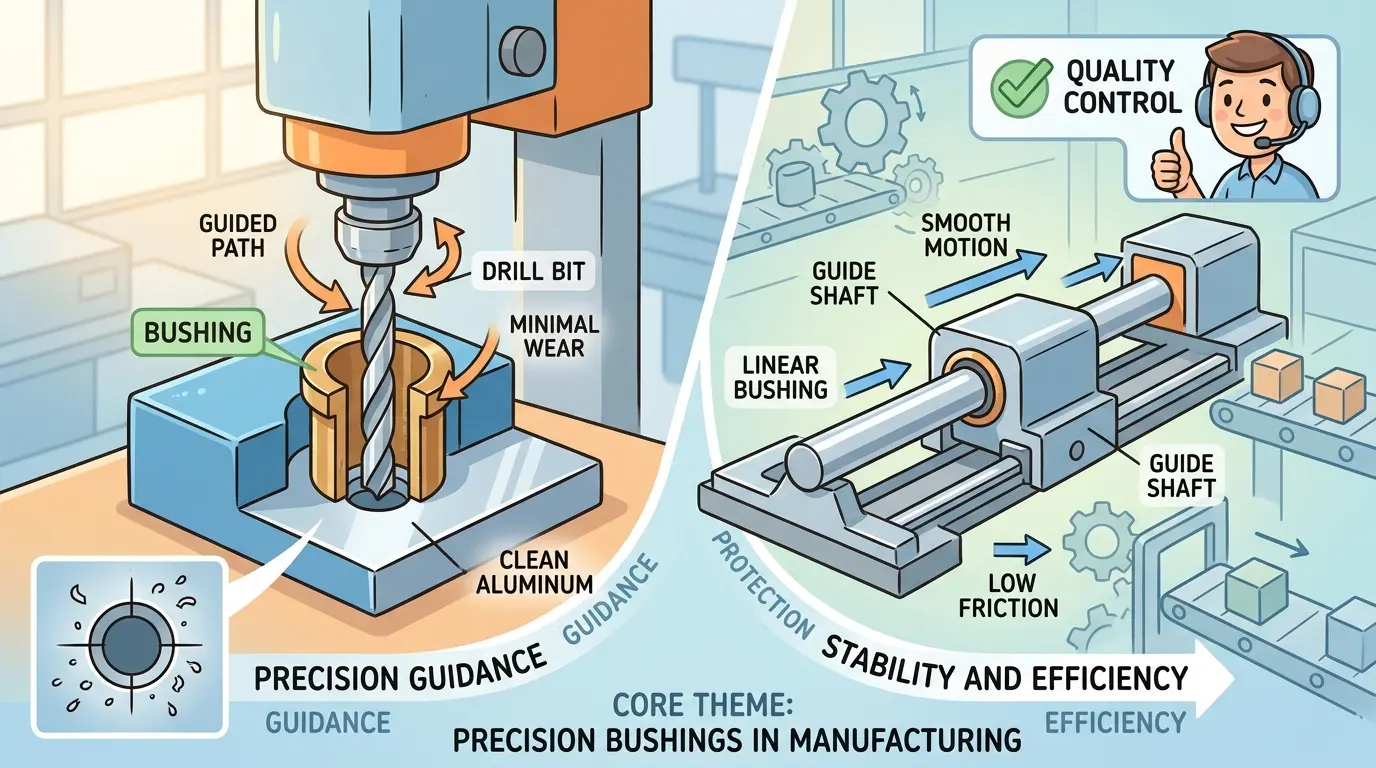
The easiest way to understand a CNC bushing is to stop treating it as a generic spare and start treating it as a deliberate wear zone. In many applications, the bushing exists so something else does not wear first. It guides movement, supports a shaft or sliding member, reduces friction between surfaces, and takes wear in a controlled way so the surrounding assembly does not suffer prematurely.
That matters because direct metal-to-metal or poorly controlled sliding contact is expensive when it happens in the wrong place. Replacing a bushing is usually cheaper and easier than replacing the shaft, housing, bore, or machined support structure the bushing was meant to protect. In that sense, the bushing is rarely the star of the mechanism. It is the part that quietly keeps the expensive parts alive.
This also explains why bushing-related problems are often misread. When motion gets noisy or less stable, teams may blame the servo, the ballscrew, the guideway, the bearing pack, or the operator. Sometimes the problem is much simpler: the sacrificial interface has worn enough that the machine no longer behaves like the program expects.
What Bushings Are Actually Used For In CNC Machines
In practical CNC terms, bushings are used for four main jobs.
First, they help guide movement. When one element must move relative to another in a controlled way, the interface needs to stay predictable. A bushing helps keep that relationship stable.
Second, they help distribute load. Instead of forcing stress into a small contact zone, the bushing spreads that load more sensibly across the interface.
Third, they help control friction. Motion that feels smooth and consistent is not accidental. It usually depends on an interface designed to avoid drag, grab, or erratic contact.
Fourth, they help manage wear. When a machine cycles repeatedly, something will eventually wear. A bushing allows that wear to happen in a replaceable part instead of in a more expensive structural component.
That combination is why bushings show up in so many supporting roles across machines. They may sit in sliding relationships, rotating support points, actuator-related assemblies, spindle-adjacent hardware, tool-change mechanisms, support arms, covers, or secondary guided movements. The exact location changes. The function does not: protect the interface, stabilize the relationship, and make wear controllable.
Bushings Are Small, But They Influence Machine Confidence
Their value usually appears indirectly. Motion feels smooth. Noise stays controlled. Assemblies do not gain play too quickly. Operators do not have to work around vague mechanical behavior. Maintenance teams do not spend every week chasing a slightly different version of the same instability.
That is why bushings matter even when nobody sees them. A CNC machine is not only a collection of major headline components. It is a network of controlled relationships. Every time one of those relationships gets weaker, the machine becomes harder to trust. Bushings are often one of the quiet reasons that trust survives normal duty.
This is also why they should never be judged only by dimensions. Material, fit, lubrication assumptions, contamination exposure, duty cycle, and load direction all influence whether a given bushing will actually work in the plant where it lives.
Wear In A Bushing Often Looks Like A Much Bigger Problem
One reason bushing problems become expensive is that they rarely announce themselves cleanly. They appear as side effects.
- The machine drifts slightly.
- A finish changes.
- A repeated position feels less consistent.
- A mechanism begins to chatter, bind, or move less confidently.
- Adjustment becomes more frequent.
Because these symptoms overlap with other causes, teams sometimes chase the wrong diagnosis first. A worn interface can look like backlash, weak tuning, bad tooling, poor workholding, or inaccurate offsets. In reality, the process may simply be asking a worn support point to behave like a healthy one.
That is why bushings deserve a failure-mode mindset. When they wear, they change clearance, support quality, friction, and alignment behavior. Those changes then spread into the rest of the machine. The best maintenance teams ask early: which protected interface may now be outside its useful range? That question often shortens diagnosis more effectively than replacing larger components first.
Bushings Are Not Bearings, And They Are Not Locating Hardware
It also helps to separate bushings from nearby component categories because shops sometimes blur these ideas during troubleshooting. Bushings often support or guide a moving relationship and protect it from direct wear. Bearings usually serve a more specialized rotational support role. CNC locating pins do something different again: they put a workpiece, pallet, or fixture back in the same place repeatedly.
All of these parts can affect repeatability, but they do it in different ways. A worn bushing can let a mechanism move poorly. A damaged locating strategy can let a part seat inconsistently. A failing bearing can change rotational smoothness or support quality. Good diagnosis depends on knowing which relationship is weak.
That difference matters especially in fixture-rich environments. A motion-interface problem should not be repaired like a datum problem, and a datum problem should not be blamed on motion hardware without evidence.
Material, Lubrication, And Contamination Decide Whether The Bushing Has An Easy Life Or A Short One
Two bushings with similar dimensions can behave very differently because their real life is shaped by environment and service assumptions. Material choice matters. Lubrication expectations matter. Contamination matters. A clean, lightly used interface does not live the same life as one exposed to dust, coolant, abrasive fines, or continuous cycling.
This is why replacement decisions should be made with context. If a machine runs around fine dust, chips, abrasive debris, or inconsistent lubrication, the buyer should ask whether the original specification still matches the actual job. Replacing the part with the same nominal component may restore function briefly while leaving the real weakness untouched.
The commercial lesson is simple: low purchase price is not the same as low ownership cost. A cheap bushing that accelerates wear elsewhere or increases technician time is not really cheap. A more durable option that protects adjacent surfaces and reduces repeat failure may be the better value even if the unit price is higher.
Read The Wear Pattern, Not Just The Part Number
When a bushing is worn, the obvious temptation is to replace it and move on. Sometimes that is correct. Sometimes it only resets the clock without solving the cause. The wear pattern itself usually tells a more useful story.
If the bushing is wearing evenly at a predictable service interval, it may simply be doing its job. If wear is one-sided, unusually fast, or repeatedly tied to the same contamination buildup, then the surrounding geometry or environment may already be weak. The right question is not only “What wore out?” but “Why does the wear look like this?”
That question separates maintenance from real correction.
- Is the shaft damaged?
- Is alignment off?
- Is the load different from what the original design assumed?
- Is debris entering the interface?
- Is lubrication unrealistic for actual duty?
Without those questions, the shop ends up repeating folklore instead of solving the pattern.
Bushings Deserve The Same Root-Cause Discipline As Larger Components
Because bushings are relatively inexpensive compared with major assemblies, some plants underthink them. Others overstock them without a clear rule. The better approach is to treat them according to consequence.
If a worn bushing can stop a critical machine, damage expensive downstream parts, or quietly degrade high-value production, then its inspection and replacement path should be clear and documented. If it sits in a lower-risk location, the stocking logic can be lighter. Either way, the decision should come from consequence, not habit.
Specification should follow the same discipline. Match the bushing to the load, environment, lubrication reality, and cost of failure. That is much more useful than buying whichever option looks standard or cheapest on a supplier list.
In high-repeatability departments, this overlaps with the broader logic of stronger workholding and fixture discipline. The lesson is consistent across the plant: small support elements deserve serious thinking when the cost of variation is high.
What Shops Should Watch For Before Failure Becomes Expensive
Bushings often fail quietly before they fail obviously. Teams should therefore learn to watch for subtle warning signs early.
- Motion that feels rougher than before
- Unexplained noise near a guided interface
- Repeated adjustment needs
- Localized heat
- Visible wear patterns or debris accumulation
- Inconsistent mechanical response from the same assembly
The important thing is to connect the symptom to the moving relationship, not only to the finished part. If surface finish changes, ask which interface may now be less stable. If alignment gets harder to hold, ask whether the protective element is still protecting anything. If the same area keeps wearing repeatedly, ask whether the bushing is the root cause or the first visible victim of a deeper problem.
Bushings Matter Because Trust In Motion Is A Production Asset
CNC bushings are used to guide movement, reduce wear, and preserve controlled relationships between machine elements. That sounds modest, but the effect is not modest at all. A machine that cannot trust its support interfaces becomes slower to diagnose, harder to schedule, and more expensive to own. A machine with healthy support interfaces behaves calmly enough that operators and technicians can focus on production instead of vague mechanical uncertainty.
The practical rule is straightforward. Treat bushings as protective motion parts, not as afterthoughts. Inspect them when symptoms appear. Replace them with context, not by reflex. And if the same failure returns, investigate the surrounding condition instead of blaming the part alone. That is what turns a small component into what it really is: one of the quiet reasons the larger machine stays dependable.