
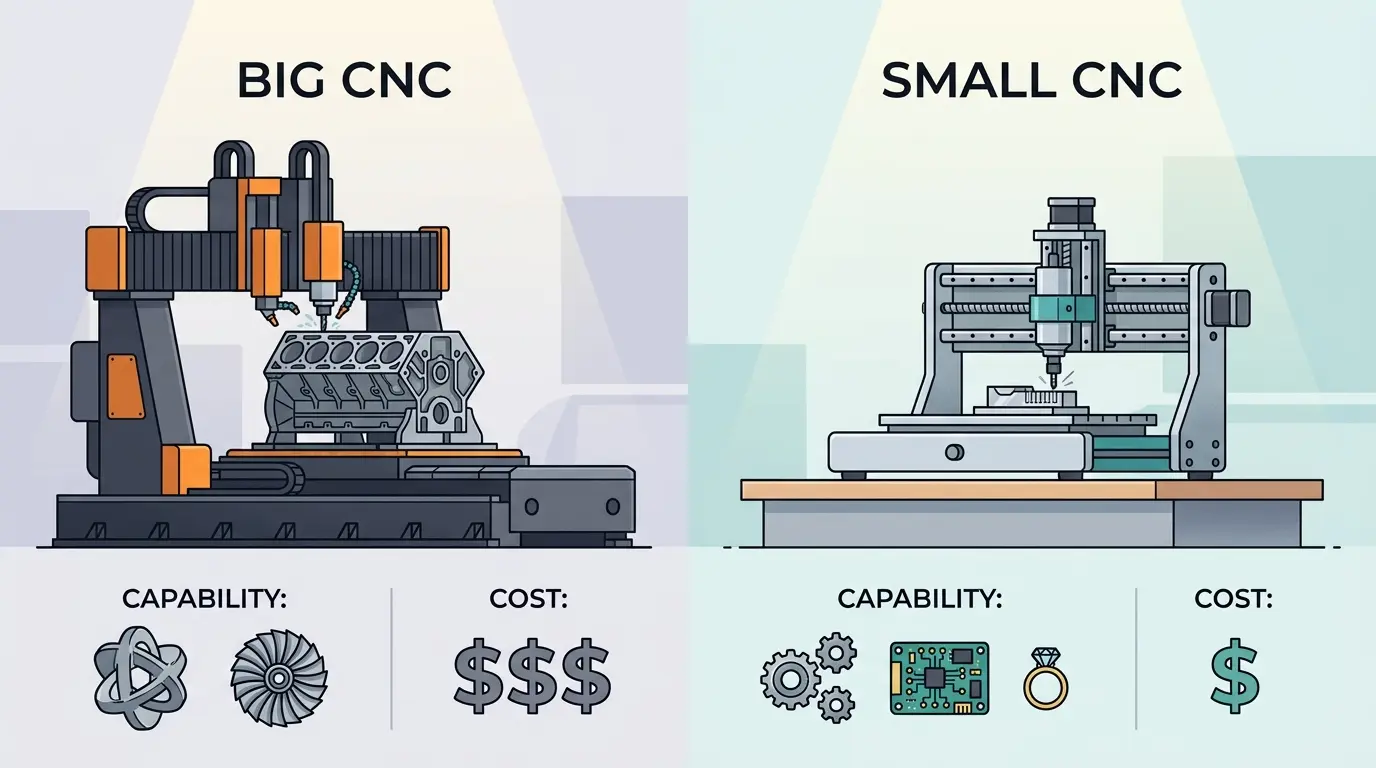
When buyers compare a big CNC machine with a small CNC machine, they usually start with travel. That is only part of the story. Machine size changes staging, loading, walking distance, workholding, unload logic, and the amount of surrounding discipline the shop must build to keep the machine productive.
So the real comparison is not big part versus small part. It is large operating model versus compact operating model. A bigger machine can remove extra setups and awkward handling, but it also asks for more floor planning and more material-flow discipline. A smaller machine can lower cost and activation burden, but it becomes expensive when profitable work keeps colliding with its envelope.
First Decide Which Waste You Are Trying To Remove
Size decisions make more sense when buyers stop asking which machine is more capable and start asking which machine removes more of the waste hurting the business now.
A larger machine usually removes waste tied to:
- Full Sheets Or Oversized Parts That Do Not Fit Naturally.
- Repeated Repositioning.
- Extra Setups On One Logical Job.
- Tolerance Exposure From Multiple Reference Changes.
- Awkward Handling Of Long Or Wide Workpieces.
A smaller machine usually removes waste tied to:
- Long Setup And Startup Burden.
- Tight Floor Space.
- One-Person Operation.
- Prototype Or Mixed Low-Volume Work.
- The Cost Of Owning More Envelope Than The Work Requires.
That is the real split. Big and small machines remove different categories of friction.
A Big Machine Buys More Than Travel
A larger CNC machine rarely arrives as a simple upgrade. It changes how the shop has to behave around the cut.
Raw stock takes more space. Service clearance matters more. Loading and unloading routines become more important. Walking paths get longer. Finished parts and offcuts need a cleaner sorting plan. If the machine is sheet-oriented, staging and remnant handling become daily operating questions rather than occasional annoyances.
That is why buyers should see larger machines as system purchases. The shop is not only buying travel. It is buying a stronger requirement for layout discipline, material flow, and support planning.
A Small Machine Wins When Activation Burden Matters More Than Maximum Envelope
Compact machines have their own kind of strength. They are easier to place, easier to supervise, easier to clean around, and easier for one person to run without help. That matters in prototype spaces, compact workshops, training settings, and gradual CNC adoption.
The real advantage is not simply lower price. It is lower activation burden. A machine that can be started, loaded, and reset with less drama often creates more usable value than a larger platform that feels heavy except on occasional oversized jobs.
This is why compact machines can be the better commercial choice even when their envelope looks modest. If the recurring work fits naturally, simplicity becomes a productivity tool.
Big Machines Pay Back When The Work Keeps Fighting The Current Envelope
Larger machines usually make sense when good jobs are already being distorted by size limits. Typical examples include:
- Full-Sheet Routing Or Sheet Processing.
- Long Templates, Fixture Plates, Or Structural Parts.
- Oversized Signs Or Display Components.
- Parts That Become Risky Or Slow When Repositioned.
- Jobs Where Split Setups Are Creating Measurable Labor Or Tolerance Loss.
In these cases, more size is not decorative. It protects process integrity. The gain is not merely that the part fits. The gain is that one logical job can be run with fewer transfers, fewer reference changes, and less handling risk.
If the real workload is drifting toward sheet-based production, buyers should also ask whether the better answer is a different category such as CNC nesting machines rather than simply a larger generic frame.
The Hidden Cost Of A Big Machine Appears Around The Machine
Buyers usually see the higher capital cost first. The surrounding cost is easier to miss.
Larger machines often increase:
- Floor-Space Opportunity Cost.
- Material Staging Requirements.
- Unload And Sorting Burden.
- Extraction Or Chip-Handling Complexity.
- Service Access Demands.
- Layout Sensitivity.
- The Cost Of Weak Organization.
None of these automatically make the machine a bad choice. They simply mean the business should not evaluate size by purchase price alone. Bigger equipment rewards planning. It does not reward vague optimism.
The Hidden Cost Of A Small Machine Appears Through Repetition
Smaller machines create the opposite problem. They can look efficient at first and grow expensive slowly.
The usual pattern is familiar:
- Parts Get Split Into Extra Setups.
- Long Jobs Become Multiple Smaller Jobs.
- Reference Transfer Adds Checking Time.
- Operators Reposition Material Repeatedly.
- Fixtures Become More Complicated Than They Should Be.
- More Labor Goes Into Protecting Process Integrity Than The Lower Purchase Price Saved.
That is the real cost of underbuying. The machine stays affordable on the quote and becomes expensive through labor, time, and inconsistency.
Size Also Changes Workholding Logic
Machine size affects how the part is supported through the cut. A bigger machine may allow full parts or full sheets to sit in a more natural orientation. A smaller machine may force extra fixtures, creative support, or mid-process repositioning.
That matters because workholding is not neutral labor. It influences operator time, recovery risk, and quality confidence. If the smaller machine repeatedly needs tricks to support ordinary profitable work, its compactness is no longer an advantage.
At the same time, a very large table can be wasteful when the shop mostly processes small work. In that situation the operator may be managing too much table and too much walking for too little gain. Size only helps when it improves the real route.
Match Machine Size To The Labor Structure You Actually Have
A larger machine often assumes stronger support around loading, unloading, scheduling, and housekeeping. A smaller machine fits better when one person or a very small team must run the full cycle.
This is why size should be judged against the labor the shop truly has, not the labor model the brochure quietly assumes.
If the business has the space, material flow, and staffing discipline to keep a large machine productive, larger format may be the right answer. If the business is still highly owner-operated or compact, a smaller machine may protect daily reality better.
Growth Should Be Measured By Recurring Work, Not By Hope
Many size mistakes come from using occasional opportunity as if it were recurring demand. One oversized project or one future ambition starts driving the purchase even though the business still earns most of its money from smaller work.
The safer question is what work repeats often enough to justify the larger operating model. If oversized or full-sheet jobs are already common, the case is real. If they are still mostly hypothetical, the bigger machine may be carrying future hope more than present revenue.
The reverse mistake matters too. Some shops stay too small for too long because the machine still “works” while quietly forcing extra setups and extra handling across jobs that have clearly become routine.
Use A Situation Table, Not A General Opinion
| Shop Situation | What A Bigger Machine Usually Improves | What A Smaller Machine Usually Protects |
|---|---|---|
| Full-Sheet Or Oversized Recurring Work | Fewer Setups, Cleaner Material Flow, Less Repositioning | Very Little If The Current Work Already Fights The Envelope |
| Mixed Prototype And Low-Volume Work | More Room, But Often More Daily Burden Than The Mix Justifies | Faster Activation, Easier Supervision, Lighter Operating Model |
| Tight Floor Plan With Limited Handling Support | Capacity Only If Layout Discipline Is Strong | Easier Placement And Lower Surrounding Complexity |
| Owner-Operated Or Very Small Team | Better Only If The Work Clearly Needs The Size | Often Better Because The System Asks Less From Labor |
| Growing Panel Or Sheet Workflow | Better If The Business Is Truly Moving Toward Integrated Sheet Processing | Risk Of Hidden Labor If Good Jobs Keep Getting Split |
This comparison is much more useful than asking whether big or small is “better.” The correct answer depends on which kind of waste the shop needs to stop paying for.
Good Size Decisions Usually Start Outside The Spec Sheet
Before deciding, map the route:
- How Do Materials Enter The Shop?
- What Part Sizes Actually Repeat?
- How Many People Touch The Machine?
- What Happens Immediately After Cutting?
- Where Will Raw Stock Wait?
- Where Will Finished Parts Go?
- How Much Access Is Needed For Cleaning, Maintenance, And Unloading?
Once those answers are visible, size becomes a workflow conclusion instead of an emotional preference. It also becomes easier to judge whether the business needs one larger machine, one smaller flexible machine, or a broader strategy across the Pandaxis machinery lineup.
Bigger Machines Deserve Harder Quote Scrutiny
As machine size increases, buying errors become more expensive. Layout assumptions, support equipment, handling expectations, extraction needs, and service access all matter more. That is why larger-machine quotes should be reviewed line by line rather than accepted as simple capital comparisons.
If the proposal leaves too much around installation, handling, or service undefined, the real project cost can drift quickly. Buyers who need a reminder on that point should compare machinery quotes carefully before treating one option as obviously cheaper.
Choose The Size That Removes More Total Waste
That is the cleanest test.
A big machine is right when it removes enough waste from extra setups, repositioning, and oversized-part handling to justify its larger operating burden. A small machine is right when it removes enough waste from floor pressure, one-person handling, and changeover burden to outweigh its tighter envelope.
The strongest decision usually feels clearer once buyers stop asking which machine looks more capable and start asking which size makes the current business model easier to run profitably.