Stone shops usually feel the difference between quartz, granite, and marble long before they describe it in technical terms. One batch runs cleanly, while the next creates more edge touch-up, slower tool progress, or extra polishing time around cutouts and profiles. The material may change, but the production target does not. Parts still need to leave the line with consistent dimensions, clean edges, and a surface condition that does not create problems during finishing or installation.
That is why CNC stone cutting should be evaluated as a workflow decision, not just a cutting-capability question. A machine may be able to process all three materials, but the real issue is whether it can do so repeatably enough to protect throughput, reduce rework, and keep downstream edging and polishing under control.
Why Material Behavior Changes the Cutting Strategy
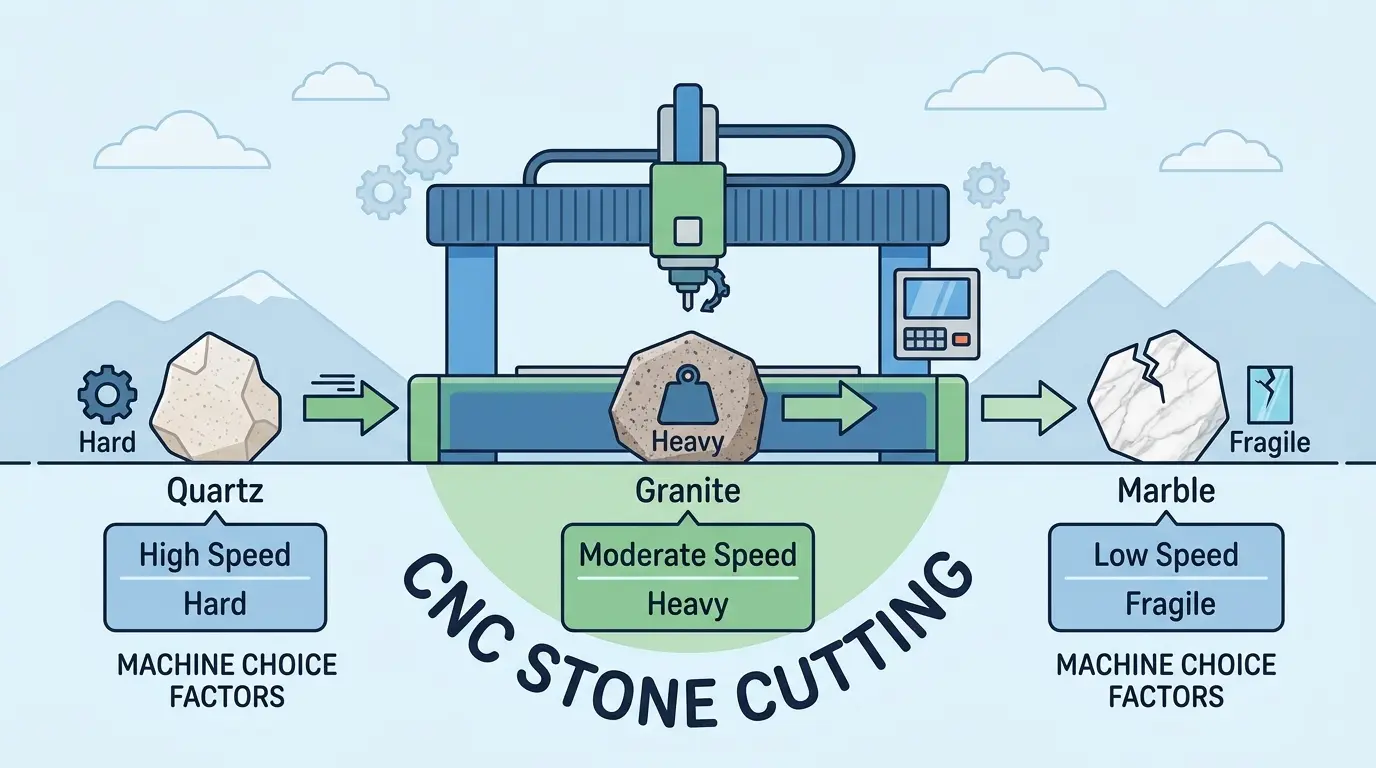
Quartz, granite, and marble all sit inside the same stone fabrication category, but they do not respond to tooling, support, and finishing in the same way. Shops that treat them as interchangeable often end up managing avoidable tool wear, unstable edge quality, or unnecessary manual correction.
| Material | What Commonly Changes in Cutting | Main Workflow Risk | What Shops Usually Need Most |
|---|---|---|---|
| Quartz | High abrasiveness and tight finish expectations on visible work | Faster tool wear and more rework if edge quality drifts | Stable cutting parameters and repeatable finish quality |
| Granite | Higher cutting load and natural variation from slab to slab | Inconsistent edge condition or slower output if the process is not stable | Rigidity, controlled motion, and predictable heavy-duty performance |
| Marble | Lower hardness but greater sensitivity to breakage, veining, and cosmetic damage | Chips, corner damage, or surface-quality loss on delicate pieces | Better support, smoother handling, and cleaner finishing transitions |
The better machine choice is usually the one that matches the shop’s actual mix of materials and part geometry, not the one that looks strongest on paper in only one cutting scenario.
Quartz Cutting Puts Abrasiveness and Repeatability at the Center
Quartz fabrication often looks straightforward until the hidden cost shows up in tool wear, edge cleanup, and repeated fine adjustments. Shops processing quartz commonly need cutting conditions that stay stable through repeated countertop shapes, sink openings, and narrow sections where visible finish quality matters.
In practical terms, CNC performance on quartz is less about aggressive cutting claims and more about process control. Shops usually benefit when the machine helps maintain a stable path, consistent part support, and a cutting environment that does not turn each material change into a new troubleshooting cycle. When that stability is missing, the result is not only slower cutting. It usually appears later as extra hand correction on edges and more time spent recovering cosmetic quality.
For quartz-heavy production, the workflow advantage comes from repeatability. A controlled CNC process helps reduce variation between parts, supports cleaner feature work, and makes it easier to move parts into edging, polishing, or installation prep without carrying hidden defects forward.
Granite Cutting Demands More From Structural Stability
Granite introduces a different challenge. The issue is not only that it is hard. It is that cutting loads, edge response, and slab variation can punish any weakness in process stability. If motion control, support, or tool engagement starts to drift, the effect often appears as inconsistent edge quality, longer finishing time, or lower confidence in repeat runs.
That is why granite work often favors a more stable process foundation. In high-value parts, accuracy is only one target. The other target is keeping the cut consistent enough that edge profiling and finishing do not become a second correction stage. Shops cutting granite for countertops, architectural pieces, and shaped components usually feel the benefit of CNC control when repeated contours, openings, and edge details need to come out with fewer surprises from part to part.
Granite does not automatically require the same process strategy as quartz, but it does raise the value of rigidity, smooth motion, and stable workholding. Those factors translate directly into better repeatability, more predictable finishing effort, and lower risk of losing time to heavy material corrections.
Marble Cutting Requires More Attention to Finish Protection
Marble is often easier to cut than granite from a load perspective, but that does not make it easier to run well. In many marble applications, the real risk is not whether the material can be cut. It is whether the process protects appearance, fragile sections, and finished edges strongly enough to avoid breakage or cosmetic loss.
Veining, edge sensitivity, and decorative expectations can all make marble less forgiving in day-to-day production. A part that reaches size correctly can still become expensive if corners chip, narrow sections lose support, or the surface condition creates more work before installation. For that reason, shops processing marble often place more value on stable part support, clean path control, and a workflow that moves smoothly from cutting into edge treatment and polishing.
In marble work, CNC value often shows up as reduced handling risk. Better control at the machine stage helps protect delicate features, limit downstream touch-up, and keep the finish standard closer to what designers and installers expect.
Where CNC Stone Cutting Fits Best in the Full Fabrication Workflow
Stone fabrication rarely begins and ends with one motion. Shops usually balance rough sizing, contouring, sink and fixture cutouts, edge shaping, and finishing-sensitive operations across several process steps. That is why CNC stone cutting should be viewed in the context of the whole line rather than as an isolated machine function.
In many operations, rough slab breakdown may still be handled separately, while the CNC stage takes over where repeatability matters more: shaped pieces, internal cutouts, profile work, and geometry that needs to stay consistent across repeated jobs. Factories evaluating stone CNC machines are often trying to consolidate those precision-dependent tasks around one more controlled process reference.
That matters because a good CNC fit does more than cut shapes. It helps organize the flow between cutting, profiling, edging, and polishing so that each part reaches the next stage in a more predictable condition. The payoff is usually not one dramatic speed increase. It is a cleaner chain of smaller gains: fewer corrections, more stable dimensions, less manual recovery, and easier scheduling of mixed-material jobs.
What to Evaluate in a Stone CNC Machine for Mixed-Material Production
Shops running quartz, granite, and marble in the same operation usually need to look beyond the simple question of whether the machine can process stone. The more useful evaluation is whether the setup can stay stable when materials, shapes, and finish expectations keep changing.
| Evaluation Factor | Why It Matters in Production | Workflow Outcome |
|---|---|---|
| Structural Stability | Helps the machine stay more consistent under different cutting loads | Cleaner edges and more predictable dimensional repeatability |
| Workpiece Support | Protects narrow sections, cutouts, and delicate pieces during machining | Fewer chips, less breakage risk, and lower rework |
| Programming Flexibility | Makes it easier to move between countertop work, profiles, and custom geometry | Faster changeovers and smoother mixed-job scheduling |
| Process Consistency | Reduces variation between repeated parts and operators | Better throughput planning and more reliable downstream finishing |
| Integration With Edge and Finishing Steps | Helps parts leave cutting in a more usable condition for the next operation | Less manual correction before profiling, edging, or polishing |
| Slurry and Cutting-Zone Control | Supports a cleaner, more stable machining environment | Fewer interruptions and more consistent day-to-day operation |
These factors matter because the best CNC result in stone fabrication is rarely just a cleaner cut. It is a part that reaches the next stage with fewer hidden problems attached to it.
One Setup Does Not Solve Every Stone Shop Requirement
It is a mistake to assume that every stone shop should optimize for the same machine profile. A shop focused on repeat countertop production, for example, may care most about dependable cutouts, edge preparation, and consistent sequencing into polishing. A fabricator handling more custom architectural pieces may place greater value on shape flexibility, geometry control, and reduced manual handling risk on delicate work.
The same logic applies across materials. A quartz-heavy shop may feel abrasive wear and process stability first. A granite-focused operation may care more about machine stability under heavier cutting demands. A marble-oriented workflow may prioritize edge protection and cosmetic control above pure removal rate.
That is why machine choice should follow the production bottleneck. If the main problem is repeated geometry with too much correction after cutting, CNC control becomes easier to justify. If the shop is still dominated by straight breakdown work, the value equation may look different. The stronger decision comes from matching the machine to the point where errors become expensive, not from assuming every stone process should be built the same way.
Practical Summary
CNC stone cutting for quartz, granite, and marble is not one uniform process. Quartz usually raises the importance of abrasion management and repeatable finish quality. Granite places more pressure on structural stability and controlled cutting under higher load. Marble shifts more attention toward support, edge protection, and finish-sensitive handling. All three can be processed within the same shop, but each changes what good machine performance actually looks like.
For buyers and production teams, the most useful question is not which stone is hardest to cut in general. It is where the current workflow loses the most time or quality. If the cost shows up in tool wear, edge inconsistency, cutout quality, or manual recovery before finishing, the CNC decision should be tied directly to that bottleneck. The right setup is the one that helps the shop move parts into the next stage with better repeatability, cleaner edges, and less rework across the material mix it actually runs every day.