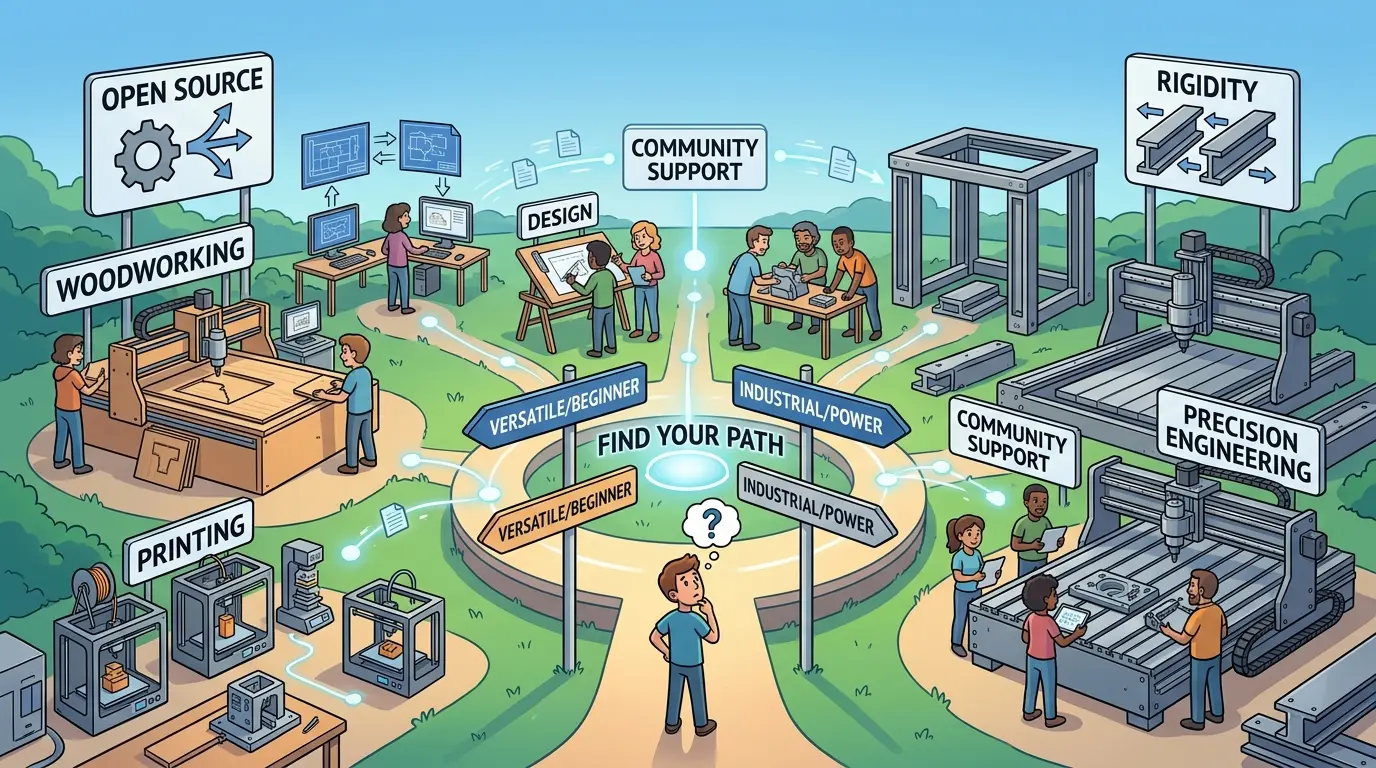
Community-built CNC platforms attract buyers because they offer something commercial products often do not: a feeling that the machine can be understood, adapted, and owned more deeply by the builder. That makes search terms like Root CNC, RS CNC, and PrintNC-style open builds attractive to technically curious users who do not just want to buy a machine. They want to participate in the machine’s development, tuning, and long-term refinement.
The challenge is that these community platforms are not interchangeable. Some are primarily router-oriented community builds. Some appear through regional kit sellers, forks, or reseller packages rather than through one tightly standardized global model. Some appeal to builders chasing a more serious DIY machine with a stronger milling-oriented identity. The correct choice depends less on which community is loudest and more on what kind of project and workload you want to own.
This article compares these open-build paths through that lens.
Start With The Role You Want The Machine To Play
Before you choose a community platform, decide whether the machine is mainly a router for making parts, a technical learning project, or a long-term build aimed at more demanding machining behavior. Those roles overlap, but they are not the same.
If you want a practical machine for wood, signs, templates, jigs, plastics, and custom routing, the best platform may be the one that reaches useful routing work with the least friction. If you want maximum learning and are comfortable with a more project-heavy path, a different platform may feel more rewarding. If you are chasing a more serious DIY structure and are willing to accept much more build effort, the answer shifts again.
The more honestly you define the role, the less confusing the platform comparison becomes. Many buyers do not fail because they chose a bad community. They fail because they asked the community to solve the wrong problem.
These Names Do Not Always Describe One Fixed, Stable Product
One important reality in this segment is that names like Root CNC and RS CNC do not always function like industrial OEM model numbers. Depending on the market, they may refer to design files, community forks, regional kit sellers, seller-specific bundles, or variations built around a recognizable project idea rather than a single locked global specification.
That does not make them untrustworthy. It simply changes how they should be evaluated. The buyer should verify the actual bill of materials, controller path, motion hardware, spindle assumptions, and support logic instead of assuming the name guarantees a certain machine standard.
PrintNC-style builds are also community-driven, but they often feel different because the conversation around them is usually more explicit about build burden, sourcing responsibility, and the expectation that the builder is taking on a serious integration project. That cultural difference matters because it shapes buyer expectations earlier.
Root- And RS-Oriented Paths Often Appeal To Router-First Builders
Open community platforms in the Root CNC and RS CNC orbit often attract builders who want DIY involvement but still keep the machine centered on practical routing work. They may suit users who care about woodworking, custom panels, signs, fixtures, and general maker use more than about chasing a small-mill identity.
The attraction here is often balance. These paths can feel more approachable than the heaviest community builds while still preserving the satisfaction of building and tuning the machine yourself. That makes them appealing for builders who want CNC to stay primarily about making useful routed parts rather than turning the machine itself into the dominant long-term project.
This is not a minor distinction. A router-first builder usually measures success by how quickly the machine becomes useful on actual materials. A machine-building-first user may measure success by how much control and understanding the project creates, even if useful routing comes later.
PrintNC-Style Paths Attract Buyers Who Want More Project Weight
PrintNC-style projects usually attract builders who want something more mechanically ambitious and are willing to accept a much higher build burden to get there. The platform tends to appeal when the user wants a machine that feels more serious than a light router build and is comfortable taking on the sourcing, tuning, and integration responsibility that comes with that ambition.
This is why comparisons between these communities can be misleading. A builder choosing between Root-style openness and PrintNC-style seriousness is not only comparing hardware. The builder is choosing how much project weight they want to carry, how much electrical and mechanical work they expect to own, and whether the reward comes from routing output or from machine-building depth.
For some, that is exciting. For others, it is exactly what makes the path wrong.
Compare By Ownership Model, Not By Hype Density
There are a few practical questions that usually decide the fit.
How much build complexity do you actually want?
What materials and part types will dominate your work?
Do you want a routing-centered machine or a more ambitious DIY machining project?
How much time are you willing to spend refining the system after it first moves?
How much uncertainty are you willing to accept around wiring, grounding, controller configuration, shielding, and later maintenance?
These questions matter because community platforms often look similar from a distance but feel very different once ownership begins. A machine that is perfect for a builder who enjoys long tuning sessions can be a poor choice for someone whose main goal is to make parts next month.
Planning Discipline Matters More Here Than It Does In Retail Machine Categories
Open builds reward planning and punish impulse. Grounding, shielding, controller selection, cable routing, power strategy, limit switching, dust control, spoilboard design, and workholding do not behave like optional details. In community CNC ownership, they are part of the machine.
That means buyers should judge a platform partly by how clearly it supports disciplined planning. Are there documented build paths? Are the usual electronics choices well understood? Can you find recent examples from builders doing the kind of work you plan to do? Are the problem reports specific enough to teach something practical?
Community speed is not the same as warranty protection. Even a fast-moving discussion space does not eliminate downtime. Your labor still has a rate, and your projects still care whether the machine is routing or being rewired.
The Useful Comparison Is Not Which Community Is Smarter. It Is Which One Matches Your Tolerance For Friction.
Every open-build path contains friction. The question is what kind of friction you are willing to accept.
Some buyers enjoy sourcing and integrating parts because the project itself is the reward. Some enjoy tuning motion systems but dislike electrical uncertainty. Some can tolerate a slower path to productivity if the final machine feels more substantial. Others want the fastest path to useful routing and prefer a community that stays closer to practical, repeatable kit-building discipline.
This is why self-awareness matters more than tribal loyalty. The strongest decisions in this space come from matching your patience level to the platform, not from assuming the most ambitious build is automatically the smartest choice.
A Practical Platform-Fit Matrix
| Buyer goal | Root-style or RS-style fit | PrintNC-style fit |
|---|---|---|
| Practical DIY routing for woodworking and custom panel work | Often strong | Sometimes excessive |
| Moderate build effort with strong learning value | Often strong | Higher effort than some builders want |
| Deep machine-building challenge | Good, but not always the most ambitious path | Often strongest |
| Faster route to usable community DIY output | Often more attractive | Usually slower |
| Desire for a more serious DIY machine identity | Possible, depending on the actual package | Often the main appeal |
| Low tolerance for electrical and integration uncertainty | Better only if the seller bundle is well defined | Usually weaker unless the builder wants the burden |
The table does not reduce the decision to simple rankings. It highlights that the right choice follows the kind of builder you are and the kind of work you actually need done.
Where Builders Usually Get Tripped Up
The biggest mistake is underestimating how much of the project is really about time and attention. Community builds reward people who stay engaged. If you want an easier path to immediate productivity, a highly open project can become frustrating.
Another mistake is confusing strong community with easy machine. Strong communities often exist precisely because the machines require active builder participation. Helpful discussion lowers confusion, but it does not eliminate the cost of learning.
The third mistake is using community builds to delay a clearer decision. If the workload is already commercial, repetitive, or throughput-sensitive, the better answer may not be another round of DIY comparison.
There is also a seller-verification mistake common around less standardized names. Buyers assume a regional reseller package is fully supported because it looks complete in photos. In reality, the decisive questions are still basic: what is included, what is documented, what happens after purchase, and what parts path exists if something fails.
If The Machine Must Earn Money Soon, You Need A Harder Screening Standard
Community CNC platforms can absolutely support real work. But once the machine is expected to support scheduled jobs, customer deadlines, or regular shop output, the screening standard needs to rise.
A buyer in that situation should ask whether the platform has enough documentation and shared troubleshooting depth to reduce commissioning risk. They should ask whether the electronics path is one they can support themselves. They should ask whether every unresolved uncertainty now becomes a business delay later.
That is the point where romantic DIY comparison often stops being helpful. Business ownership changes what “fun” means. In a paid environment, every week of unresolved tuning is a cost center.
When It Makes Sense To Move Beyond Community Builds
Community CNC platforms are valuable for learning, customizing, and building serious capability on your own terms. But once the goal shifts toward structured production, support accountability, and faster commissioning, the conversation changes. The builder may need to stop asking which open build is best and start asking which industrial machine category matches the work.
That is why buyers at that transition point may benefit from reviewing the broader Pandaxis shop as a category map. It helps clarify what machine choices start to look like once output, workflow integration, and repeatability take priority over builder ownership.
If the current decision is specifically between a more ambitious steel-frame path and lighter community router paths, PrintNC as a DIY steel-frame mill project is useful context because it makes the build-burden difference concrete.
If the comparison stays inside router-centered DIY ownership, popular DIY router platform comparisons such as OX, Maker CNC, and MPCNC are useful because they force the buyer to think in terms of workload fit rather than community branding.
A Good Self-Screen Before You Commit Money Or Months
One useful self-screen is to decide what kind of frustration you are willing to accept. If you enjoy machine-building frustration more than commercial delay frustration, an open community platform can still be a good fit. If you mainly want reliable output and find ongoing tuning exhausting, a community build may not be the best match regardless of how attractive the concept feels.
It also helps to ask whether the machine is supposed to remain a project or become a dependable tool. Those are different missions. Many disappointing builds come from confusing them.
When that distinction is clear, builders usually choose more confidently and regret the decision less. They also set a more realistic timeline for becoming productive, which alone can save months of avoidable frustration.
The Best Platform Is The One Whose Burden You Still Want To Carry After The First Excitement Ends
Root CNC, RS CNC, and PrintNC-style community platforms suit different builders because they ask for different levels of ambition, patience, and project involvement. Root-style and RS-style paths often make sense for builders who want a practical DIY router with real learning value. PrintNC-style paths often appeal to users who want a more substantial, more demanding machine-building project and are willing to accept a bigger integration burden.
The better platform is not the one with the strongest mythology. It is the one whose ownership burden matches your technical appetite and whose workflow fit matches the parts you genuinely need to make. Once you define those two things clearly, the community comparison becomes much less confusing, and the purchase decision becomes less about identity and more about sustainability.