
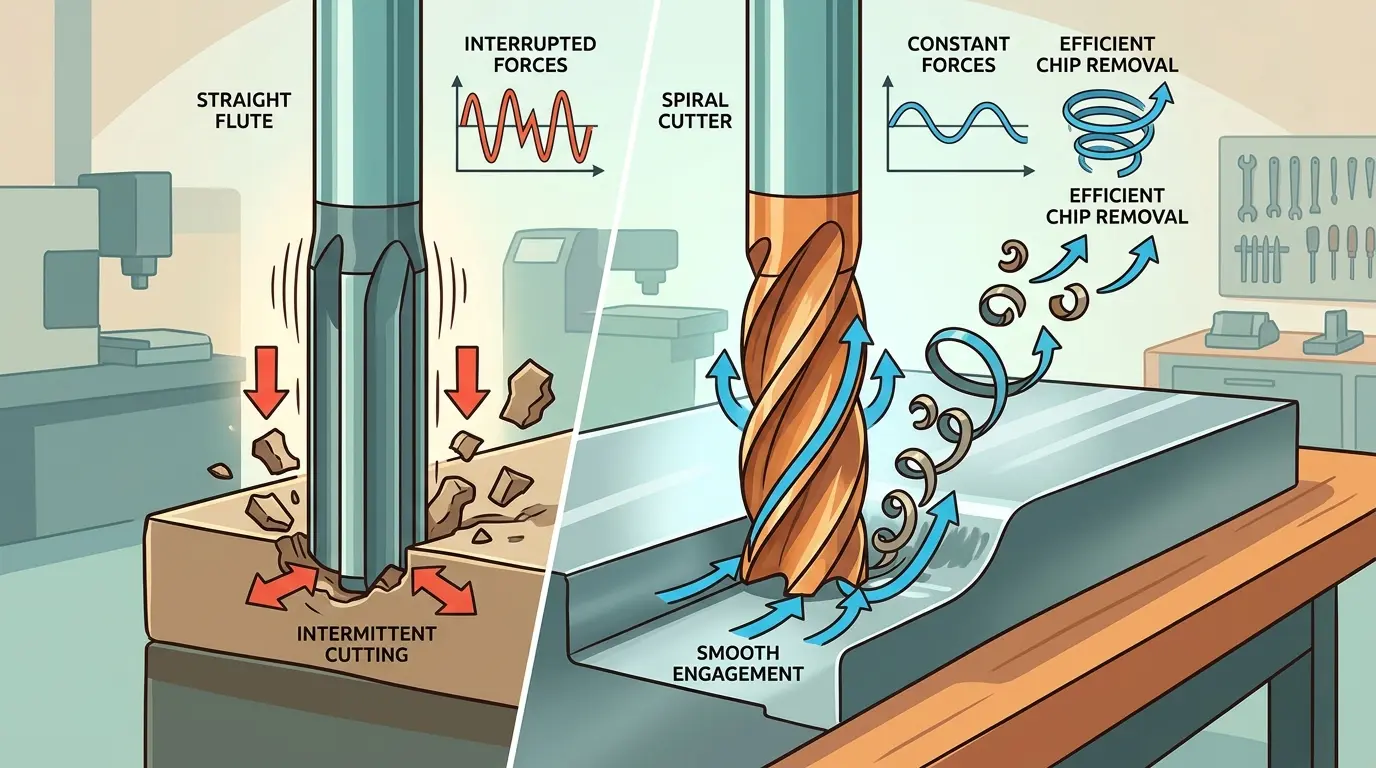
A spiral milling cutter is a milling or router-style cutting tool with helical flutes that shear material and guide chips along the body of the cutter while it works. That basic description is true, but it is not enough to make a good buying decision. The term “spiral milling cutter” describes a family of tools, not a single predictable outcome. Upcut, downcut, compression, flute count, core strength, diameter, and intended material all change how the cutter behaves.
That is why the most useful question is not “should I use a spiral cutter?” In many CNC environments, the answer is often yes at some level. The more useful question is “what kind of spiral behavior does this cut require?” Once buyers start there, the category becomes much clearer and much more practical.
The Category Is Broad Because The Geometry Is Flexible
Spiral geometry became common because it solves real cutting problems well across a wide range of CNC work. The helical flute tends to shear more cleanly than a purely straight geometry in many materials, and it can guide chips out of the cut more effectively when slotting, profiling, or contouring creates debris that would otherwise stay trapped.
That usefulness is exactly why the category becomes dangerous when treated casually. Once a tool family becomes common, people stop distinguishing the versions that matter. They hear “spiral” and imagine that the important decision is already finished. In reality, the most important decisions usually start only after the word spiral has been spoken.
What The Helix Actually Changes
The helical flute changes three things buyers should care about. First, it changes how the cutter shears the material. Second, it changes how chips move away from the cutting edge. Third, it changes how the cut pushes or pulls fibers, chips, and surface quality depending on the direction and application.
Those changes influence finish, evacuation, heat behavior, and how the workpiece edge looks after the operation. This is why two spiral cutters of similar diameter can behave very differently in the same shop. Geometry at this level is not decorative. It is operational.
The Right Way To Read The Name Is As A Starting Point
When a supplier or catalog says “spiral milling cutter,” the buyer should hear that as the beginning of a narrower selection process. The name tells you the tool belongs to the helical-flute family. It does not yet tell you whether it protects the top edge, bottom edge, slot cleanliness, chip evacuation, or a compromise between those priorities.
That is the essential discipline. Spiral is a family label. Application is the actual decision.
Three Practical Questions Decide Most Spiral-Cutter Choices
In many shops, the best spiral-cutter decisions come from three simple questions:
- What material is being cut?
- Which edge or surface matters most after the cut?
- Is the bigger risk poor finish, trapped chips, or weak cutter behavior under load?
These questions sound basic, but they cut through a surprising amount of tooling confusion. Once the buyer knows the material, the visible edge priority, and the dominant process risk, the field of plausible spiral forms gets much smaller.
In Wood And Panel Work, Chip Direction Becomes A First-Class Issue
Woodworking and panel processing often make spiral selection feel more complicated because chip direction directly affects visible edges. A cutter that evacuates material aggressively may protect one side of the panel while leaving the opposite face more vulnerable to tear-out. A cutter that protects the top surface may behave differently in chip evacuation than one chosen for general slot cleanliness.
That is why directional spiral logic matters so much in router-driven work. The helix is not only about cutting smoothly. It is about deciding how the cut treats the surfaces that customers or downstream finishing steps will actually see.
A Practical Comparison Of Common Spiral Behaviors
| Spiral Form | What It Usually Prioritizes | Typical Caution |
|---|---|---|
| Upcut | Strong chip evacuation and cleaner lower-edge behavior in many routing situations | Can be less kind to top-surface appearance in some sheet goods |
| Downcut | Cleaner top-surface behavior in many visible-face operations | Chip evacuation can become more demanding in deeper or debris-sensitive cuts |
| Compression | Balanced edge protection in many laminated or panel applications when used correctly | Needs the cut conditions to engage the tool as intended; not a magic answer to every panel job |
This table is not a substitute for testing or material knowledge, but it captures the central lesson: “spiral” is not one answer. Direction changes the outcome enough that buyers should never stop at the generic category name.
In Plastics And Other Heat-Sensitive Materials, Evacuation Can Dominate The Decision
In plastics and other materials that dislike heat buildup, chip movement often becomes the first thing to watch. A cutter that keeps the path cleaner can reduce the chance of recutting softened debris, rubbing, or dirty edge behavior that looks like a tooling problem but is really a heat-and-evacuation problem.
This is where spiral geometry often earns its reputation. The cutter is not better because the helix looks more advanced. It is better when the geometry actually improves the way the material leaves the cut. If trapped chips are the real problem, the spiral family may offer a practical answer. If the material challenge lies elsewhere, the selection still needs refinement.
Flute Count And Core Strength Still Matter
Another reason the category is broad is that helix direction is not the only variable. Flute count and core strength also affect how the tool behaves. A cutter chosen for cleaner finish and balanced use may not be the same one a shop prefers when stronger, more conservative behavior under load matters more. Likewise, a tool selected for freer evacuation may not be the one chosen when rigidity is the first concern.
This is where buyers often oversimplify. They choose the familiar spiral label and stop asking what the cutter needs to survive. Good tooling decisions still account for spindle power, machine stiffness, material response, and the type of cut being made.
Spiral Does Not Automatically Mean Better Finish
This is one of the most common misunderstandings. Spiral geometry often helps, but it does not erase problems caused by poor machine condition, weak workholding, bad feeds and speeds, excessive tool stickout, or unrealistic depth strategy. A helical flute cannot rescue a process that is failing for more ordinary reasons.
That is why shops should be careful when they use spiral as a synonym for “premium.” In practice, the wrong spiral cutter on the wrong job can still burn material, leave poor edges, or behave unpredictably. Geometry helps only when it matches the job honestly.
The Category Is Especially Useful In Shops That Think In Processes, Not In Part Numbers
Better shops usually do not ask for spiral cutters in the abstract. They ask for a cutter that solves a specific process problem. Maybe the top edge matters most on laminated sheet goods. Maybe the job is full-depth slotting and chip evacuation is the dominant risk. Maybe the cut is general profiling and the shop wants a reliable all-around behavior rather than an edge-optimized specialist.
That process-first mindset is what turns spiral tooling from a broad label into a useful decision framework. The tool category becomes easier to use the moment the buyer describes the job precisely enough.
Where Spiral Milling Cutters Fit In A Pandaxis Workflow
Pandaxis is directly relevant here because spiral cutters sit at the center of many routing, milling, panel-processing, and woodworking CNC discussions. The category matters not just for tool catalogs but for how shops think about machine capability, visible edge quality, and production stability.
If the reader needs broader process context first, it helps to review how milling operations, tooling choices, and application logic fit together in CNC work. If the practical question is more router-specific and tied to woodworking or sheet processing, it also helps to revisit what CNC routers actually do best in wood and panel workflows before tool selection gets overly abstract. The useful Pandaxis habit is to treat cutter choice as part of workflow design, not as a separate catalog exercise.
Common Buying Mistakes Start With Vague Language
The usual spiral-cutter mistake is not buying a bad tool brand. It is buying with language that is too vague. A shop asks for “a spiral bit” or “a spiral milling cutter” without defining whether the visible top edge matters, whether deep-slot evacuation is likely to become a problem, or whether the cut is really general profiling, groove work, or sheet-goods edge finishing.
Once the request is vague, the result is often vague too. The tool may work acceptably in some situations and disappoint in others, which then creates the false impression that spiral tooling is inconsistent. Often the real inconsistency started in the specification, not in the cutter.
A Good Selection Process Looks More Specific Than Most Buyers Expect
A useful selection process usually includes:
- Naming the material family honestly.
- Naming the cut type honestly.
- Naming which surface quality matters after machining.
- Naming whether evacuation, finish, or strength is the main process risk.
- Checking whether the machine can support the cutter choice with stable motion and sensible feeds.
This process sounds almost too ordinary, but that is the point. Good tooling decisions are often less dramatic than buyers expect. They succeed because the application was described clearly enough for the geometry to be chosen intelligently.
When Another Cutter Form May Be Simpler
It is also worth saying that spiral is not mandatory simply because the job exists on a CNC machine. Some operations may be better served by another form when the process is simple, the material is forgiving, or the cut requirement does not actually benefit from what the helix changes. Buyers who understand this are less likely to turn a familiar category into a default answer.
The right discipline is to ask what the cutter must protect. If spiral geometry protects that outcome best, use it. If another form solves the simpler problem more directly, the familiar spiral label should not win by habit alone.
What Better Spiral Selection Produces In Production
When shops choose spiral milling cutters well, they usually see more predictable edge quality, fewer interruptions caused by chip packing or bad finish, and less rework driven by vague tooling choices. The value is rarely that the tool sounds more advanced. The value is that the cutter behavior becomes more aligned with the material and the operation.
In production, that alignment matters because small tooling errors repeat quickly. A cutter chosen with lazy language can create recurring edge cleanup, dustier rework, or unstable results. A cutter chosen with a clearer process description often makes the entire routing or milling sequence feel calmer and more repeatable.
The Best Rule Is To Finish The Thought After The Word Spiral
A spiral milling cutter is a helical-flute tool family used widely in CNC routing and milling because it can shear material cleanly and manage chips effectively across many common jobs. But the phrase only becomes useful when the buyer finishes the thought. Spiral what behavior? Spiral for which material? Spiral to protect which edge? Spiral chosen against which risk?
Once those questions are answered, the category becomes practical. Until then, it stays too broad to guide strong decisions. That is the most honest way to use the term and the safest way to buy from it.