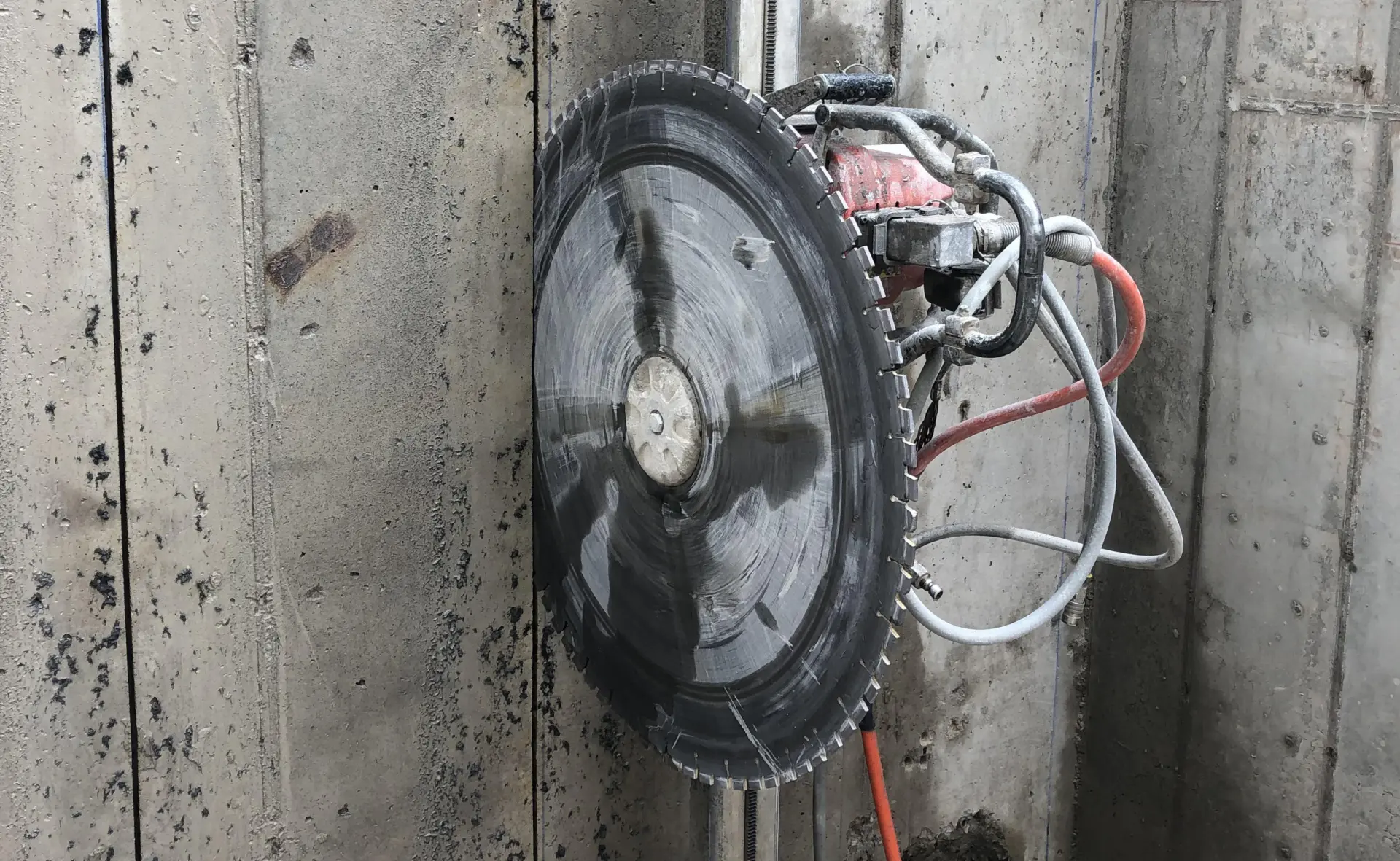
On a wall sawing job, the biggest problems rarely start at full cutting depth. They usually start earlier, when the crew underestimates panel weight, chooses a blade that does not match the concrete and reinforcement, or commits to a cut sequence that releases the section before it is properly restrained.
That is why wall sawing should not be treated as a simple cutting task. It is a control task. Safety setup, blade selection, and cutting strategy all affect each other. A sound blade choice supports straighter, cooler cutting. A sound cutting sequence protects the operator, the structure, and the piece being removed. A sound safety plan makes sure the work can proceed without creating a second problem while solving the first one.
For contractors handling structural openings, demolition preparation, or access-driven cutting, the practical question is not only how to cut. It is how to cut in a way that keeps the wall section stable, the blade productive, and the surrounding work area under control.
Why Safety, Blade Choice, And Cut Order Belong In The Same Plan
Wall sawing is often discussed in separate categories: safety rules, blade type, and field technique. In practice, separating them too much leads to weak planning.
If the panel is too large to remove safely, the cut strategy is wrong even if the blade is technically suitable. If the blade bond is too hard for the material, the operator may push feed pressure to recover speed, which raises heat and vibration risk. If water, slurry, or anchoring is poorly controlled, even a correct cut layout can create site hazards or tracking problems.
The better approach is to plan the work around one operational question: what needs to stay controlled from the first setup step to the final lift or removal?
That usually includes:
- The Stability Of The Remaining Structure
- The Stability And Restraint Of The Section Being Removed
- The Blade’s Ability To Stay Cool, Expose Diamond Properly, And Track Straight
- The Crew’s Ability To Maintain A Clean, Predictable Work Zone
When these conditions are planned together, wall sawing becomes much more predictable.
Start With Site And Structural Control Before Blade Speed
Before discussing blade performance, confirm what is actually being cut and what happens when it separates. For structural walls, suspended sections, or openings near load paths, the cutting plan should be reviewed against the real support condition of the structure rather than assumed from drawings alone.
That review commonly includes wall thickness, likely reinforcement density, embedded services, access for rigging, and the expected weight of each cut section. It also includes a decision about whether the workpiece will be removed as one panel or divided into smaller pieces to reduce handling risk.
For complex or load-sensitive work, the sequence should be validated by competent site supervision and, where required, structural engineering review. That is especially important when the opening changes load transfer, when the cut section is overhead, or when nearby finishes, installed systems, or adjacent structures create extra consequence if the panel moves unexpectedly.
The table below shows the safety controls that usually matter most before the first pass.
| Safety Control | Why It Matters | What Goes Wrong If It Is Missed |
|---|---|---|
| Cut Section Weight Estimate | Determines Lift Plan, Section Size, And Holding Strategy | The Panel Can Shift, Drop, Or Become Unsafe To Remove |
| Reinforcement And Embedded-Item Review | Helps Predict Cutting Resistance And Blade Behavior | Cutting Speed Becomes Unstable And The Blade Can Wander Or Overheat |
| Anchor And Track Setup | Supports Straight, Controlled Saw Travel | Poor Tracking, Inaccurate Cuts, And Mechanical Instability |
| Water And Slurry Management | Helps Cooling, Dust Control, And Site Cleanliness | Poor Visibility, Reduced Cooling, Slip Hazards, And Slower Cleanup |
| Exclusion Zone And Access Control | Protects Nearby Workers And Equipment | Unplanned Exposure To Moving Panels, Slurry, Or Active Cutting Operations |
| Lifting Or Restraint Plan | Keeps The Final Section Controlled During Release | The Last Cut Can Free The Panel Before It Is Properly Secured |
This is also the point where wall sawing should be clearly separated from factory fabrication. A wall saw is designed around in-place cutting and site control, not repeatable shop-floor shaping. That is a different workflow from fabrication with stone CNC machines, where the main priorities are usually repeatability, programmed geometry, and stable downstream finishing.
Choose The Blade For Material Behavior, Not Just Blade Size
Many field problems come from selecting the blade by diameter alone. Diameter matters for depth and machine compatibility, but it does not tell the operator how the blade will behave in a reinforced wall.
The more important factors are material hardness, material abrasiveness, aggregate behavior, and the amount and pattern of steel in the cut path. In diamond tooling terms, hard non-abrasive material generally calls for a softer bond so fresh diamond can be exposed. More abrasive material generally calls for a harder bond so the segment does not wear too quickly. Reinforcement density further changes how the blade needs to balance cutting speed, wear rate, and stability.
That is why a blade that cuts one reinforced wall efficiently may perform poorly in another job that looks similar at first glance. Concrete age, aggregate character, rebar concentration, and moisture conditions can all change how the blade opens up, tracks, and sheds heat.
The practical rule is to choose the blade around the real cutting resistance, not around a generic idea of concrete.
| Job Condition | Blade Selection Priority | What To Watch In The Cut |
|---|---|---|
| Hard, Dense Concrete With Limited Abrasiveness | Softer Bond To Keep Diamond Exposure Active | Glazing, Slow Cutting, And Excessive Heat If The Bond Is Too Hard |
| More Abrasive Concrete Or Material That Wears Segments Faster | Harder Bond To Reduce Premature Segment Loss | Excessive Blade Wear If The Bond Is Too Soft |
| Heavily Reinforced Structural Walls | Blade Designed For Stable Performance Through Steel And Concrete Transitions | Speed Drop, Vibration, And Tracking Variation At Dense Steel Zones |
| Cleaner Masonry Or Lower-Reinforcement Work | Blade Tuned More Toward Base Material Efficiency Than Heavy Steel Exposure | Over-Specifying For Steel Can Sacrifice Efficiency In Lighter Work |
| Long Continuous Cuts With High Heat Load | Cooling Reliability And Segment Stability Become Critical | Slower Performance If Water Delivery Or Slurry Removal Is Poor |
Two field signals are especially useful once cutting starts:
- If the blade begins to polish or slow sharply without obvious mechanical issues, the bond may be too hard for the material behavior.
- If the blade wears too aggressively for the footage completed, the bond may be too soft or the job is more abrasive than expected.
These signals matter because blade selection is not finished when the saw is mounted. It is confirmed by how the blade behaves in the first controlled passes.
Build The Cutting Strategy Around Panel Retention
The best wall saw sequence is not the one that removes material fastest in theory. It is the one that keeps the section controlled until rigging, support, or removal handling is ready.
That usually means planning the job backward from the final release. Before setting the full sequence, determine:
- Whether The Section Will Be Lifted As One Piece Or Broken Into Smaller Pieces
- Which Side Or Edge Will Act As The Holding Side Until Final Control Is Established
- When Rigging Or Restraint Will Take Load
- How The Crew Will Prevent Pinching, Binding, Or Unplanned Panel Rotation During The Last Stage Of The Cut
For many openings, the safest sequence leaves a retention element or final holding cut in place until the section is restrained and ready to move. The exact cut order varies with access, rigging, wall orientation, and structural condition, so there is no universal sequence that fits every job. What remains consistent is the decision logic: do not create a free panel before the crew is prepared to control it.
This is also where section sizing matters. A larger single panel may reduce cutting time, but it can increase lifting complexity and risk. Smaller sections may add cutting passes, yet they often improve handling control, reduce removal uncertainty, and make the last cut less consequential.
Adjust Feed, Depth Progression, And Sequence To What The First Passes Reveal
Even a strong pre-job plan should be treated as provisional until the blade has entered the actual wall. Early passes reveal whether the reinforcement is heavier than expected, whether the blade is tracking cleanly, and whether slurry management is keeping the kerf clear enough for consistent cooling.
In practical terms, the first stage of the job should answer three questions:
- Is The Blade Staying Open And Productive In The Actual Material?
- Is The Saw Tracking Cleanly Without Forcing Feed?
- Does The Planned Section Control Still Make Sense Once The Real Cut Behavior Is Visible?
If the answer to any of those questions is unclear, the safest response is usually to slow the job down and adjust. That might mean changing the blade, reducing section size, improving water delivery, or revising the release sequence before deeper cutting begins.
Trying to recover schedule by increasing feed pressure against a struggling blade is usually the wrong move. In wall sawing, unstable speed often points to a planning mismatch rather than an operator-speed problem.
Common Planning Mistakes That Create Avoidable Risk
Most costly wall saw errors are not exotic. They are ordinary planning mistakes that compound once the cut starts.
The most common ones include:
- Treating Blade Diameter As The Main Selection Variable Instead Of Material And Reinforcement Behavior
- Estimating The Opening Geometry But Not The Removal Weight Of The Cut Section
- Assuming The Last Cut Will Be Routine Without A Clear Retention Or Lift Plan
- Pushing Feed To Compensate For Glazing, Poor Cooling, Or Blade Mismatch
- Cutting Large Sections In One Piece When Site Access Makes Controlled Removal Difficult
- Underestimating How Slurry, Limited Visibility, And Congested Work Areas Affect Execution Quality
These are not just productivity issues. They are usually the point where safety, cut quality, and schedule risk begin to move in the wrong direction together.
A Practical Decision Framework Before The First Full-Depth Cut
Before committing to the main cutting phase, it helps to confirm five decisions in plain operational terms:
- What Must Stay Supported Until The Final Release?
- What Blade Bond And Application Fit Best Match The Actual Material And Reinforcement?
- What Section Size Can Be Removed Safely With The Available Handling Method?
- What Early-Cut Signals Will Tell The Crew The Plan Needs Adjustment?
- What Site Controls Keep Water, Slurry, Access, And Exclusion Zones Predictable Throughout The Job?
If those five answers are clear, the work is usually on a much stronger footing. If they are not clear, the job is not truly ready, even if the machine is already on site.
Practical Summary
Wall sawing becomes safer and more productive when the crew stops thinking about safety, blade choice, and cutting order as separate boxes to check. They are part of the same control plan.
Start with structural and site control. Choose the blade for the real material behavior, especially concrete hardness, abrasiveness, and steel exposure. Build the sequence around panel retention and removal control rather than only around cutting speed. Then use the first passes to confirm whether the original assumptions were correct.
The jobs that go well are usually not the ones with the fastest theoretical setup. They are the ones where the section stays controlled, the blade stays in its working range, and the final release happens only when the crew is ready for it.