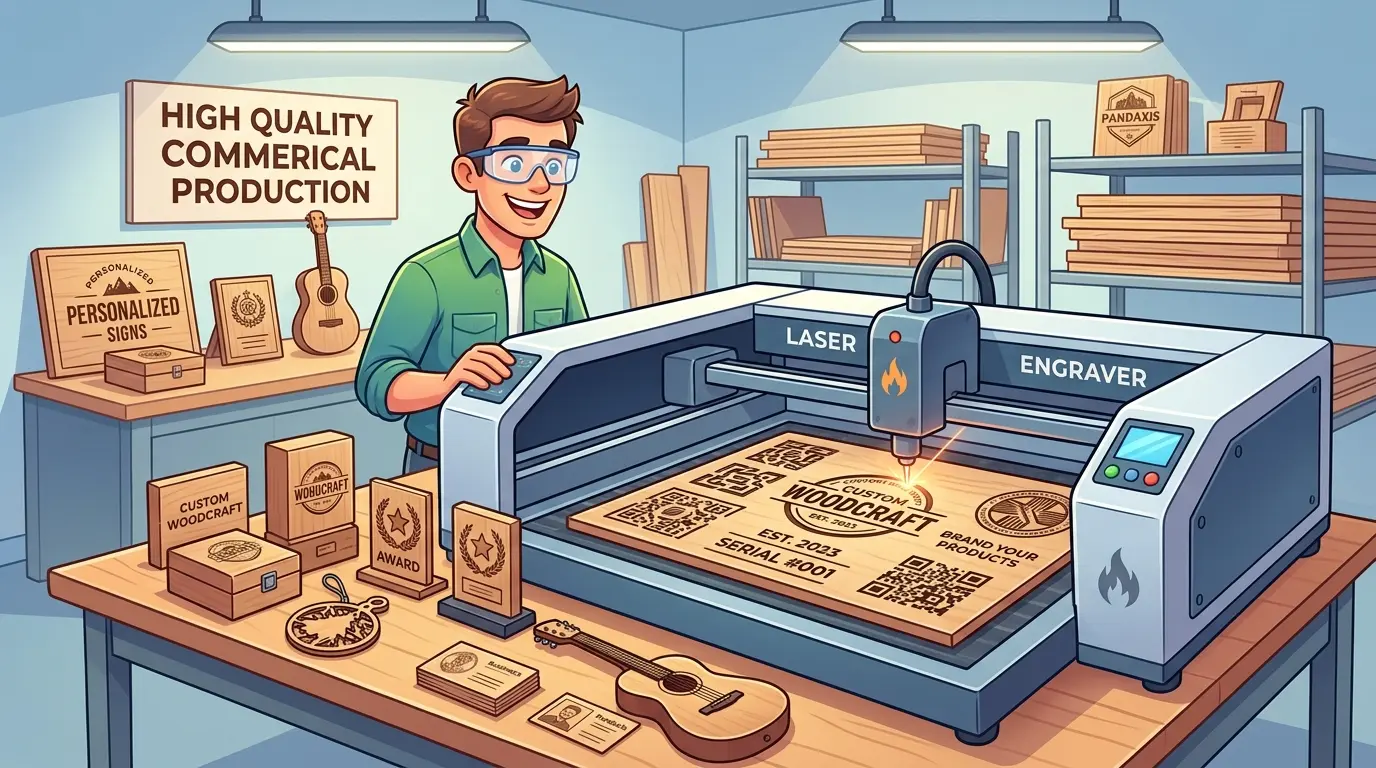
In commercial wood production, a laser engraver earns its place when the value of the part depends on surface detail, branding, fast artwork changes, or non-contact marking that stays repeatable across batches. It is a weaker fit when the real bottleneck is large-panel breakdown, deep material removal, or routed machining features.
For manufacturers evaluating laser cutters and engravers for wood and similar non-metallic work, the useful question is not simply whether the machine can engrave wood. The real question is where engraving improves sellable output, reduces manual finishing, or makes short-run variation easier to manage without turning every new design into a tooling project.
Why Use-Case Fit Matters More Than a Good Sample
Almost any supplier can show one attractive engraved wood sample. That does not prove the process is commercially well matched to your production mix.
In real use, a wood laser engraver has to hold up against practical factory pressures:
- Frequent Job Changes
- Variation in Plywood, MDF, Veneered Boards, or Solid Wood
- Visible-Face Quality Standards
- Repeated Placement Accuracy
- Operator-to-Operator Consistency
- Acceptable Throughput Across a Full Shift
That is why the best use cases are usually the ones where surface detail, repeatability, and changeover flexibility matter more than raw material-removal rate. If the job needs clean visual results on customer-facing parts, or if designs change faster than conventional tooling can keep up, laser engraving often becomes commercially relevant.
Best-Fit Use Cases at a Glance
| Use Case | Why Laser Engraving Fits | Main Workflow Benefit | What to Watch |
|---|---|---|---|
| Decorative furniture panels and cabinet fronts | Fine surface graphics, patterns, and branding can be added without contact tooling | Higher-value visible parts with repeatable appearance | Surface finish, smoke control, and consistency on veneered or laminated faces |
| Signage and retail display components | Text, logos, and decorative detail can be integrated into customer-facing wooden parts | Fewer manual finishing steps and easier short-run variation | Visual defects are more noticeable than on hidden components |
| Wooden packaging and presentation boxes | Branding and decorative personalization are often central to the product value | Fast design changes for OEM, private-label, or seasonal runs | Alignment and material variation across lids, inserts, and small parts |
| Small-batch personalization and OEM branding | Engraved names, logos, and SKU-specific details do not require new hard tooling | Lower changeover friction and better responsiveness to mixed orders | Recipe control and job file management become important |
| Light functional marking for assembly or sorting | Part IDs, orientation marks, and simple reference graphics can be applied directly to wood components | Less manual labeling and fewer mix-ups downstream | Marks must remain useful after sanding, coating, or assembly |
Decorative Furniture Panels, Cabinet Fronts, and Interior Components
One of the strongest commercial uses for wood laser engraving is decorative surface work on visible furniture parts. This can include cabinet fronts, wardrobe panels, wall features, interior decorative inserts, and design-led furniture components where the visual surface matters as much as the basic panel shape.
In these workflows, engraving helps when the manufacturer needs:
- Repeatable Patterns Across a Batch
- Clean Branding or Design Elements on Visible Faces
- Design Variety Without Rebuilding Mechanical Tooling
- A More Premium Surface Effect Than Plain Panel Processing Alone
The operational value is not only aesthetic. If the decorative detail can be applied in a consistent, programmable way, the factory can reduce hand-finishing variation and handle customer-specific design changes more efficiently.
This use case is especially relevant when the product mix includes mid-volume runs with frequent design variation. It is less compelling when the line mainly produces plain structural panels where the visible face is not driving the selling price.
Signage, Retail Display, and Branded Wood Components
Wood signage and retail display work often combines two production realities: the parts are customer-facing, and order variety is high. That makes laser engraving commercially useful because it supports clear text, logos, decorative linework, and brand-specific graphics without a separate marking tool for every order.
This is often a good fit for:
- Interior Brand Signage
- Retail Display Parts
- Hospitality and Wayfinding Elements
- Branded Point-of-Sale Fixtures
- Decorative Product Tags or Inserts
In this environment, the real benefit is workflow flexibility. A shop can move from one branded design to another with less setup disruption than processes that depend on fixed templates or more manual marking steps. If the same line also handles contour cutting on similar materials, a combined cut-and-engrave workflow can reduce handoffs between stations.
The tradeoff is that cosmetic standards are high. Surface staining, inconsistent contrast, or placement drift show up immediately on finished display pieces. That means extraction, material consistency, and operator discipline matter just as much as the engraving itself.
Wooden Packaging, Gift Boxes, and Premium Presentation Work
For many commercial producers, packaging is no longer just protective. It is part of the product presentation. Engraved lids, logo panels, branded inserts, and decorative wooden sleeves are commonly used where the packaging helps justify a premium position.
Laser engraving fits well here because packaging programs often involve:
- Short to Medium Batch Sizes
- Repeated Logo Placement
- Frequent Brand or Campaign Changes
- Small-Part Handling Rather Than Large-Panel Throughput
- Customer-Facing Finish Expectations
In practical terms, engraving can help a manufacturer standardize branding on wooden packaging without carrying large inventories of preprinted stock. That is useful for OEM packaging, private-label work, seasonal collections, or gift-oriented product lines that change artwork more often than the base box construction changes.
This is a better fit than it first appears because the commercial value comes from flexibility and presentation, not from maximum sheet-processing speed.
Small-Batch Personalization and OEM Branding
Another strong use case is production environments where the base wood component stays similar, but the visible identity changes by customer, order, or SKU.
Examples can include:
- Contract Manufacturing for Different Brands
- Personalized Product Lines
- Commemorative or Limited-Edition Runs
- Regional or Customer-Specific Branding
- Test Launches With Low Initial Volumes
Laser engraving is well suited to this kind of mixed-order environment because the process can switch graphics faster than many conventional alternatives. The key workflow benefit is reduced changeover friction. Instead of preparing a new physical marking tool for every design change, the operator manages artwork files, placement logic, and material-specific recipes.
That does not automatically make the line faster in pure cycle-time terms. The gain is usually in responsiveness, lower setup waste, and the ability to handle more order variation without slowing the entire shop.
Light Functional Marking for Assembly, Sorting, and Process Control
Not every commercial engraving job is decorative. In some wood-product lines, light marking helps internal production control.
This can include:
- Part Identification Codes
- Orientation Marks for Assembly
- Simple Positioning References
- Batch or Job Marking for Sorting
- Visual Guides for Downstream Operators
When this works well, it reduces manual labeling steps and lowers the chance of component mix-ups later in the process. The benefit is operational clarity rather than customer-facing appearance.
Still, this use case needs honest evaluation. If the part will be heavily sanded, coated, laminated, or machined again, the engraved mark may lose value unless it is placed at the right stage of production. For that reason, laser marking for process control is most useful when the mark remains visible long enough to help the next step.
When a Wood Laser Engraver Is Not the Best Primary Process
Laser engraving is not the right answer for every wood production problem. If the main bottleneck is large-sheet panel processing, routed machining, drilling integration, or furniture-part throughput on structural components, the factory may be solving the wrong problem with the right-looking machine.
For example, if the production line is dominated by nested sheet optimization, routing, and drilled furniture components, CNC nesting machines are usually closer to the real workflow requirement.
Laser engraving is also a weaker fit when the shop needs:
- Deep Material Removal Rather Than Surface Detail
- Fast Breakdown of Large Structural Panels
- Machined Grooves, Pockets, or Joinery Features
- High-Volume Parts Where Decorative Value Is Minimal
- A Process Mainly Driven by Hidden Components Rather Than Visible Faces
That does not make laser engraving less useful. It simply means it performs best when the business value comes from appearance, customization, and non-contact detail rather than from heavy woodworking operations.
How To Decide Whether It Fits Your Production Line
Before buying a wood laser engraver, production teams should ask a few practical questions:
- Is the product value driven by visible surface detail or by hidden structural machining?
- How often do artwork files, logos, or decorative patterns change?
- Are the engraved marks customer-facing, or only needed inside the factory?
- Will the mark still matter after sanding, coating, or assembly?
- Is the job mix mostly short-run and varied, or stable and repetitive?
- Do operators need engraving only, or a combined cut-and-engrave workflow on the same part family?
- Is the current bottleneck really marking and decorative detail, or is it panel processing somewhere earlier in the line?
These questions usually reveal whether a wood laser engraver is a primary production tool, a complementary finishing asset, or an unnecessary overlap with a different machine category.
Practical Summary
A wood laser engraver fits best in commercial production when engraving adds visible product value, supports brand variation, or simplifies short-run customization without adding tooling complexity. Decorative furniture faces, signage, branded display parts, wooden packaging, personalized product lines, and light functional marking are all commercially relevant use cases because the workflow benefit goes beyond the sample itself.
The important distinction is that laser engraving works best where detail, repeatability, and changeover flexibility matter more than deep machining or large-panel throughput. If that is where your factory wins orders or loses time today, a wood laser engraver can be a practical production asset. If the real pressure sits in routing, drilling, and sheet breakdown, another process may be the better first investment.