
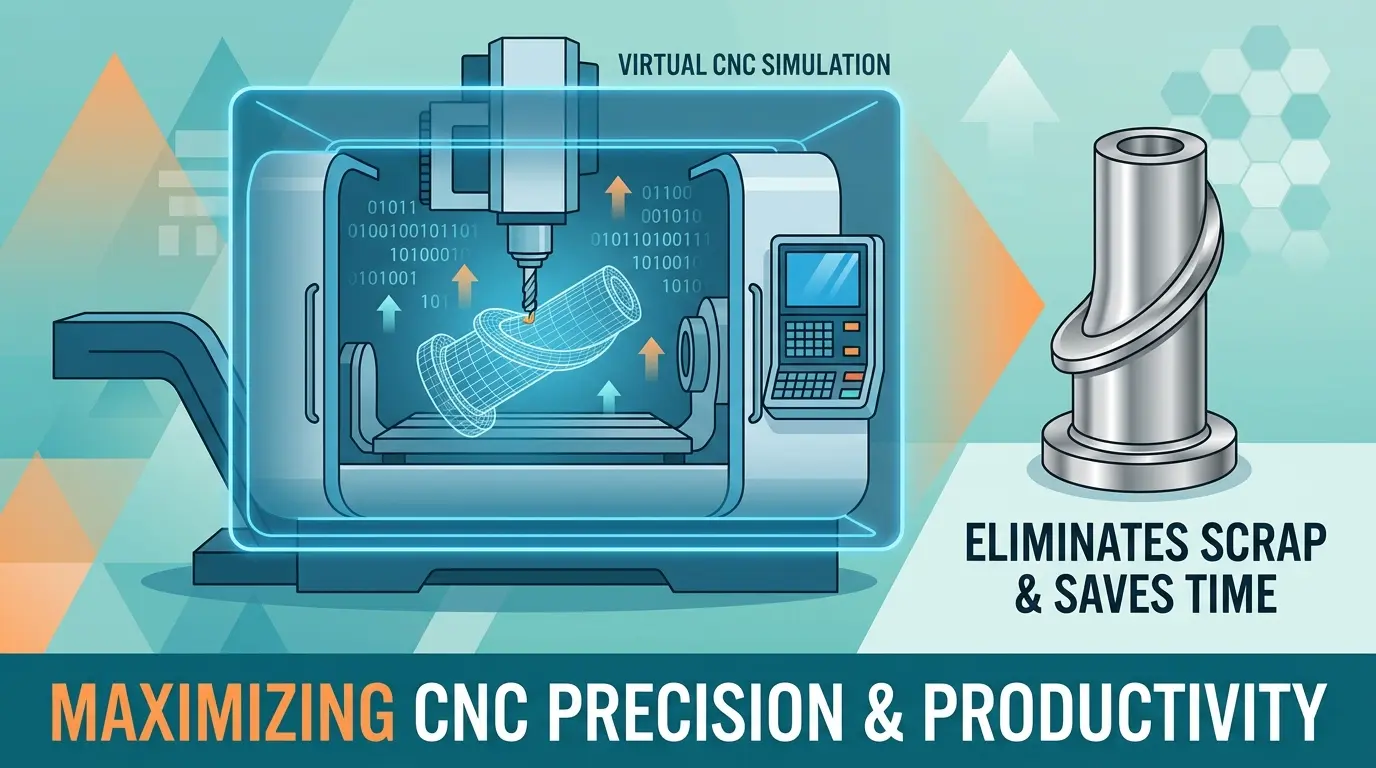
Simulation becomes valuable the moment a machine stops being used as a debugging station. If a risky retract, a holder collision, a travel-limit error, or a wasteful sequence can be found while the program is still on the programmer’s screen, the software is doing real work. If the program reaches the machine before anyone has challenged those basics, the spindle, the tooling, the fixture, and the raw material become part of an unnecessarily expensive review process.
That is why CNC simulation should be treated as a release-control tool, not as a modern-looking accessory. The question is not whether virtual testing appears sophisticated. The question is whether the shop is currently losing money on mistakes that virtual review can realistically catch before the machine moves.
A Useful Simulator Behaves Like A Release Gate
The strongest simulation workflows do not exist to entertain the programmer with motion graphics. They exist to stop risky code from reaching the floor until several practical questions are answered:
- Can the real machine physically execute this posted path?
- Will the tool, holder, spindle nose, or head orientation clear the setup?
- Does the sequence still make sense after material is progressively removed?
- Are there obvious non-cutting moves that waste time?
- Has the program created unsupported geometry, dangerous retracts, or clearance assumptions that only look safe in a generic model?
When teams treat simulation that way, it becomes a gate between programming and execution. When they treat it as a quick visual check after the program is already considered complete, it becomes much easier for the review to turn passive.
That difference is operational, not philosophical. A gate changes release behavior. A demo does not.
The Errors Simulation Usually Prevents Best
Virtual testing is strongest when the risk is geometric, kinematic, or sequence-based. It sees problems well when the failure is caused by path logic rather than by real-world physics the model never included. Common high-value catches include:
- Holder or spindle collisions.
- Machine-travel violations.
- Wrong retract behavior between features.
- Orientation errors on multi-sided or multi-axis work.
- Missing cut regions caused by programming oversight.
- Air-cut waste created by poor tool ordering or inefficient linking moves.
- Incorrect stock assumptions that change where the tool actually enters material.
These are expensive mistakes to discover on the floor because they consume prove-out time immediately and can escalate into broken tools, damaged fixtures, or lost stock. They are much cheaper to correct while the programmer is still rearranging the sequence at a desk.
This is why simulation gains respect fastest on first-run programs, dense nests, multi-tool jobs, tight-clearance setups, and higher-value material. The more expensive surprise becomes, the more useful virtual review usually is.
The Errors Simulation Cannot Prove Away
Virtual testing becomes dangerous when the shop starts expecting it to validate physical behavior it never modeled. A clean run on screen does not automatically prove that the fixture is rigid enough, that vacuum hold-down will survive changing cut forces, that the material is flat, that chips will evacuate cleanly, or that the tool will behave under heat and load exactly as predicted.
That matters because some of the most frustrating production failures occur after a program has already passed every digital review the team performed. Chatter, tool deflection, chip packing, workholding slip, warped stock, unexpected burrs, and material inconsistency can all defeat a beautiful simulation. None of those outcomes prove simulation is useless. They simply prove that simulation and physical validation are different control layers.
The mistake is not using simulation. The mistake is assuming that simulation replaces first-run discipline, fixture review, setup checks, or process tuning.
Accuracy Of The Model Decides Accuracy Of The Confidence
A simulator protects the shop only to the extent that it reflects the actual cutting environment. Generic models create generic reassurance. Specific models create useful risk reduction. That means the virtual machine, the tool assemblies, the holder lengths, the fixture heights, the stock condition, the work offset logic, and the posted motion all need to be close enough to reality to deserve trust.
If the simulation ignores real holder stickout, uses simplified fixture geometry, assumes perfect stock placement, or skips the actual post output the machine will run, the result should be interpreted carefully. It may still help expose obvious logic errors, but it should not be treated as a final safety verdict.
This is one of the reasons simulation disappoints some teams. The software is not necessarily the problem. The digital twin is too weak to justify the confidence they are placing in it.
Not Every Job Deserves The Same Review Burden
One reason simulation programs fail culturally is that some companies try to apply the same sign-off ritual to every job. That usually creates resentment because the low-risk work feels overcontrolled while the high-risk work still does not get reviewed deeply enough. A stable repeat program on inexpensive stock may not need the same simulation effort every time. A first-run nested sheet, a complex multi-tool part, a tight-clearance setup, or a high-value workpiece usually does.
Good factories therefore use simulation selectively, not lazily and not obsessively. They create higher review intensity where surprise is expensive and lighter review where the route is already mature and well understood. That selectivity keeps simulation respected because it is being applied where it clearly saves money.
The Hidden Financial Gain Is Often Prove-Out Time
Many buyers think simulation is mainly about crash prevention. Crash prevention is valuable, but the quieter economic win is usually shorter prove-out. A machine that spends half a shift confirming obvious clearances, fixing inefficient links, and correcting sequence mistakes is not cutting parts. It is functioning as a test bench that happens to be very expensive.
When simulation removes those obvious errors before release, the first-run on the floor becomes more focused. Operators can spend their time checking real process behavior rather than discovering elementary programming issues that should never have reached the control. That shortens the path to stable output and protects machine availability for productive work.
This payback only appears when the review happens early enough. If virtual testing is bolted onto the very end of programming as a ceremonial playback, most of the high-value decisions are already frozen. The software may still find something useful, but it is no longer influencing the route while changes are still cheap.
The Review Must Be Active To Matter
The most reliable simulation users do not just watch the path. They interrogate it. During review, they are asking where clearance becomes tightest, where support changes during stock removal, whether thin or fragile geometry is being left unsupported too early, whether tool changes are sequenced sensibly, and whether the posted output still matches the intended logic.
That active review mindset matters far more than polished graphics. A cheap-looking simulator used aggressively can create more value than an impressive visual package used passively. The discipline is in the questions being asked, not in the rendering quality.
It helps to assign ownership clearly. Someone should know whether the review is checking safety, efficiency, post accuracy, or release readiness. Otherwise, everyone assumes someone else handled the important part.
Woodworking And Panel Processing Benefit Beyond Crash Prevention
In panel and woodworking environments, simulation protects more than spindles and holders. A bad program can interrupt the full line. A poor nest, wrong drilling order, inefficient routing sequence, or careless part-release strategy can create delays for edgebanding, sorting, labeling, packaging, or assembly even if the machine never experiences a dramatic crash.
That is why virtual review matters in connected woodworking routes. The program has to be judged not only on whether the machine can cut it, but on whether the machine will feed the rest of the production flow correctly. A nest that cuts safely but releases small parts in the wrong sequence, increases sorting confusion, or creates unstable downstream timing can still be a production failure.
This is where it helps to think in the same broader way used when integrating drilling and other CNC stages into a connected line. Virtual testing has its highest value when it protects route behavior, not only one isolated motion path.
Implementation Fails More Often From Process Than From Software
Many teams underestimate what they are really buying when they adopt simulation. The purchase is not just a software license. It is a discipline: maintaining accurate machine and tooling models, controlling post versions, deciding which jobs require review, defining what “pass” means, and feeding real machine-floor learning back into the virtual setup.
Without that operating discipline, simulation slowly loses authority. The digital model drifts away from reality. Review becomes inconsistent. Operators stop trusting the result because too many “safe” programs still need avoidable correction on the floor. Once that credibility is lost, the software becomes easy to bypass.
The healthier approach is to define simulation as part of release control. Clarify which data must be current, who owns machine-model maintenance, which part families require deeper review, and how first-run findings update the digital environment. That turns simulation from a one-time software purchase into a maintained control layer.
A Practical Trigger List For When Simulation Deserves Priority
Factories deciding where to invest more rigor can use a simple trigger list. Simulation deserves stronger discipline when one or more of these conditions are common:
- First-run programs regularly consume too much prove-out time.
- Tooling or fixtures are expensive enough that avoidable collisions are unacceptable.
- The machine runs dense nests, complex tool changes, or high-clearance-risk setups.
- Posted output has caused surprises before.
- Downstream flow suffers when path order or part release is wrong.
- The plant is scaling toward less experienced operators who need cleaner code release.
- The cost of scrap or downtime is high relative to programming time.
If these conditions are rare, simulation may still help, but it may not deserve the same implementation depth as it would in a higher-risk environment.
Compare Simulation Offers By What They Deliver On The Floor
When simulation is bundled with a machine, software suite, or digital-manufacturing package, buyers should normalize what is actually included. One supplier may provide a configured machine model, verified post support, implementation help, and training that ties simulation to release workflow. Another may mainly provide software access and assume the customer will build the discipline internally. Those are not equivalent offers even if both are described as simulation capability.
The same rigor used to compare machinery quotes without missing hidden scope differences should be applied here too. Otherwise the buyer may think they purchased safe digital verification when they actually purchased only the possibility of it.
Use Your Last Failures As The Best Buying Data
If the factory is still unsure how much simulation matters, look backward. Review the last few crashes, scrap events, near misses, long prove-outs, and sequencing failures. Ask which ones were visible in software before the machine ran. If many of them were, simulation deserves more rigor. If most were driven by setup execution, unstable workholding, wear, or material behavior that the digital environment never modeled, the next improvement may need to happen elsewhere.
That is the practical conclusion. Virtual testing saves time and scrap when it blocks the kinds of mistakes virtual tools can truly see and when the shop treats it as a release gate instead of a playback ritual. It becomes weak when the models are generic, the review is passive, or the team expects software to replace physical process judgment.