Many buyers hear the phrase “laser glass cutter” and assume it means a standard non-metal laser can handle glass the same way it handles acrylic or wood. In real production, that assumption usually leads to the wrong shortlist. Glass marking, glass engraving, and true glass separation are related topics, but they are not the same equipment decision.
The more useful question is not whether a laser can interact with glass at all. The more useful question is whether laser-based glass cutting fits the part geometry, edge expectations, line stability, and reject-cost profile of the actual workflow.
Why “Laser Glass Cutter” Often Means Different Things in Practice
In industrial discussions, buyers often group three different operations under one label:
- Surface Marking Or Decorative Frosting
- Engraving For Appearance Or Identification
- Full Glass Separation Into Finished Part Geometry
That distinction matters because surface marking on glass is a very different process decision from cutting a part free from a sheet. A workflow that can add a frosted logo to glass is not automatically the right workflow for contour cutting fragile glass parts at production scale.
Many buyers start by reviewing non-metal laser cutters and engravers because those systems already fit acrylic, wood, and similar materials elsewhere in the factory. That is a reasonable starting point, but it should not be treated as proof that the same platform is automatically the right answer for true glass cutting.
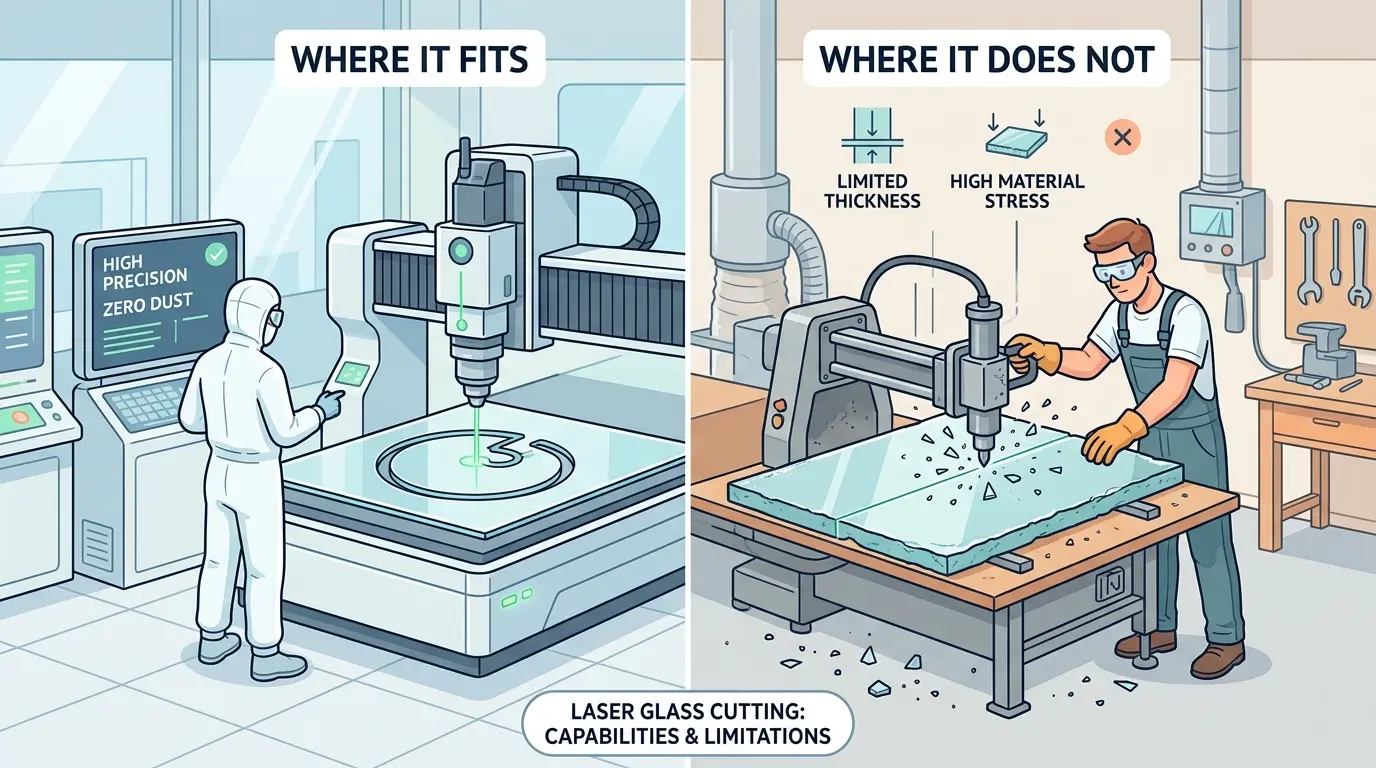
Where Laser-Based Glass Cutting Commonly Fits Best
Laser-based glass cutting is usually most attractive when the production problem is not just “cut this sheet somehow.” It tends to be considered when the line is trying to control breakage, reduce mechanical contact, or hold a more repeatable result on delicate parts.
| Workflow Situation | Why Laser-Based Cutting Is Often Considered | What Has To Be True For It To Make Sense |
|---|---|---|
| Thin Technical Or Decorative Glass Parts | Buyers may want a more controlled separation process on fragile parts | The product mix is stable enough for process qualification and recipe control |
| Small Or Complex Part Geometry | Laser-based methods may be considered when part shape is harder to handle with simple scoring workflows | The part value is high enough to justify tighter process control and qualification work |
| Automated, Repeatable Production Lines | Non-contact processing can fit lines that prioritize repeatability and lower manual handling | Fixturing, presentation, and incoming material consistency are already well controlled |
| Appearance-Sensitive Parts | Shops may be trying to limit visible chipping or reduce variability at the separation stage | Downstream quality standards are clear and rejects are expensive enough to matter |
In other words, laser-based glass cutting usually fits best when the glass part is technically demanding, cosmetically sensitive, or costly enough that process stability matters more than the cheapest possible cut method.
Where It Usually Does Not Fit
The term “laser glass cutter” can sound advanced enough that buyers assume it is automatically better. In practice, there are many workflows where it is simply the wrong tool or a weak value proposition.
Laser-based glass cutting is usually less attractive when:
- The shop mostly cuts simple rectangular blanks.
- The production mix changes frequently by thickness, finish, or glass type.
- The work is strongly cost-driven and reject cost is still manageable with conventional methods.
- The line already includes heavy downstream edging, grinding, or polishing that reduces the value of a more controlled separation step.
- The operation is a general job shop rather than a stable, repeatable production cell.
This is especially true in commodity glass preparation. If the line mainly needs straightforward blanking at acceptable yield, conventional scoring and breaking often remain the more practical benchmark. If the line is highly variable, the effort required to qualify laser recipes across multiple glass conditions can outweigh the benefit.
Why Buyers Often Overestimate the Fit
The overestimation usually comes from comparing glass to materials that behave more predictably on standard non-metal laser platforms. Acrylic, wood, and similar substrates often reward the flexibility of laser processing quickly. Glass is more demanding.
What changes is not only the material itself. The entire process discipline changes:
- Part Support Matters More
- Recipe Stability Matters More
- Thermal Response Matters More
- Reject Inspection Matters More
- Material Variation Matters More
That is why a demonstration that looks good on one sample does not automatically translate into a strong production fit. Buyers should assume that glass qualification is a workflow exercise, not a simple feature comparison.
What To Compare Before You Treat Laser As the Answer
The strongest decision process is usually comparative, not absolute. A laser-based glass cutting option should be compared against the realistic alternatives already used in glass fabrication.
| Process Option | Strongest Fit | Main Advantage | Main Limitation |
|---|---|---|---|
| Laser-Based Glass Cutting | Higher-value, more controlled, repeatable part workflows | Can align with non-contact handling and tighter process control goals | Requires careful qualification and is not automatically the lowest-cost answer |
| Mechanical Scoring And Breaking | Straightforward blank preparation and common production glass work | Familiar, practical, and often cost-effective for standard jobs | Less attractive when part geometry or edge-sensitive quality demands become more complex |
| Waterjet Cutting | Mixed geometry and materials where process flexibility matters more than line simplicity | Broad shape flexibility and wide industrial familiarity | Can add downstream finishing burden and may not be the cleanest answer for every delicate part |
| CNC Edge Processing After Initial Separation | Workflows where final edge quality and profiling matter greatly | Strong fit when edging, shaping, or finishing drives part value | It is usually part of a broader process chain rather than a direct substitute for every cutting step |
This is the practical point many buyers miss: the right question is rarely “laser or no laser.” The right question is which process chain gives the best balance of yield, edge condition, changeover burden, and downstream labor for the actual part family.
The Buying Questions That Usually Matter Most
Before comparing quotes or sample results, buyers usually get a better answer by resolving a few operational questions first:
- Is The Main Job Simple Blank Preparation Or Finished-Part Geometry?
- How Stable Is The Glass Type, Thickness, And Surface Finish Across Orders?
- Does The Workflow Prioritize Lower Manual Handling, Better Repeatability, Or Lower Capital Cost?
- How Expensive Are Rejects Once Coating, Tempering, Laminating, Or Secondary Processing Have Been Added?
- How Much Downstream Edge Work Happens No Matter How The Part Is Separated?
- Is The Line High-Volume And Repetitive, Or Low-Volume And Mixed?
- Does The Facility Need One Dedicated Glass Process, Or Is This Part Of A Broader Equipment Review?
That last question matters more than it first appears. If the project is part of a wider plant upgrade, it is often smarter to review the broader Pandaxis product catalog at the workflow level and then treat specialized glass cutting as a separate selection track instead of forcing one non-metal platform to solve every material problem.
A Practical Rule for Fit Versus Misfit
Laser-based glass cutting is usually worth serious evaluation when the part is delicate, the process is repeatable, the reject cost is meaningful, and the production team is prepared to qualify the workflow carefully.
It is usually a weaker fit when the work is commodity blanking, the glass mix changes constantly, downstream finishing already dominates total cost, or the line needs the simplest possible process rather than the most specialized one.
That is the core tradeoff. Laser can be a process-control decision, not just a cutting decision. If better process control is not where the factory is losing money today, the technology may sound more compelling than it performs on the balance sheet.
Practical Summary
A laser glass cutter fits best in controlled, higher-value production environments where part fragility, edge condition, repeatability, or non-contact handling justify a more specialized process. It does not fit automatically just because a factory already uses lasers on other non-metal materials, and it is often not the best answer for commodity glass blanking or highly variable job-shop work.
For most industrial buyers, the safest path is to separate glass marking from true glass cutting, compare laser-based separation against the real alternatives already used in fabrication, and judge the process by total workflow impact rather than by technology appeal alone.