Clean, accurate laser-cut parts do not come from beam power alone. Shops usually lose cut quality because gas choice, focus control, pierce settings, material condition, nesting discipline, and consumable health drift out of control. The damage often looks minor at the cutting table, but it shows up later as burr, poor fit-up, unstable bending, extra weld preparation, and avoidable rework.
That is why best practice in sheet metal laser cutting is really a process-control problem. A shop gets cleaner edges and more reliable dimensions when it treats the cutting cell as part of the full fabrication workflow rather than as an isolated speed machine.
Why Cut Quality Problems Usually Show Up After Cutting
Many factories do not first notice a cutting problem at the edge itself. They notice it when the part reaches the next operation and the process becomes harder to hold together.
- Holes Or Slots Need Manual Correction Before Assembly
- Bending Results Drift Because Blank Geometry Is Inconsistent
- Weld Fit-Up Takes Longer Than Planned
- Painted Or Finished Parts Need More Edge Preparation
- Operators Spend More Time Sorting Acceptable Parts From Marginal Ones
This matters because a cut can look acceptable in isolation and still damage throughput. A clean, accurate part is not just a part with a visually decent edge. It is a part that moves into bending, welding, coating, and assembly with less correction.
What Clean and Accurate Really Mean in Sheet Metal Cutting
The goal is not simply to reduce visible dross. Shops usually need a combination of edge quality, dimensional stability, and repeatability.
| Quality Target | What Good Performance Looks Like | Why It Matters Downstream |
|---|---|---|
| Edge Condition | Low burr, controlled oxidation, and stable kerf behavior | Reduces deburring, prep, and weld-edge cleanup |
| Hole And Slot Quality | More consistent geometry on internal features | Helps hardware fit, tab alignment, and assembly speed |
| Part Accuracy | Closer match to programmed contour and feature location | Supports predictable bending and fit-up |
| Thermal Stability | Less distortion on heat-sensitive geometries | Improves flatness and reduces correction work |
| Batch Repeatability | Similar results from first sheet to last sheet | Makes scheduling and repeat orders more reliable |
When these five conditions hold together, the cutting process creates usable parts rather than just cut shapes.
Best Practices That Protect Edge Quality and Dimensional Accuracy
The most consistent laser-cutting operations usually control the same set of variables every day.
| Best Practice | What To Control | Practical Outcome |
|---|---|---|
| Start With Stable Material | Flatness, surface condition, coating consistency, and sheet identification | Reduces variation before the cut begins |
| Match Assist Gas To The Real Requirement | Edge cleanliness, oxidation tolerance, and downstream finishing needs | Improves edge quality where it matters most |
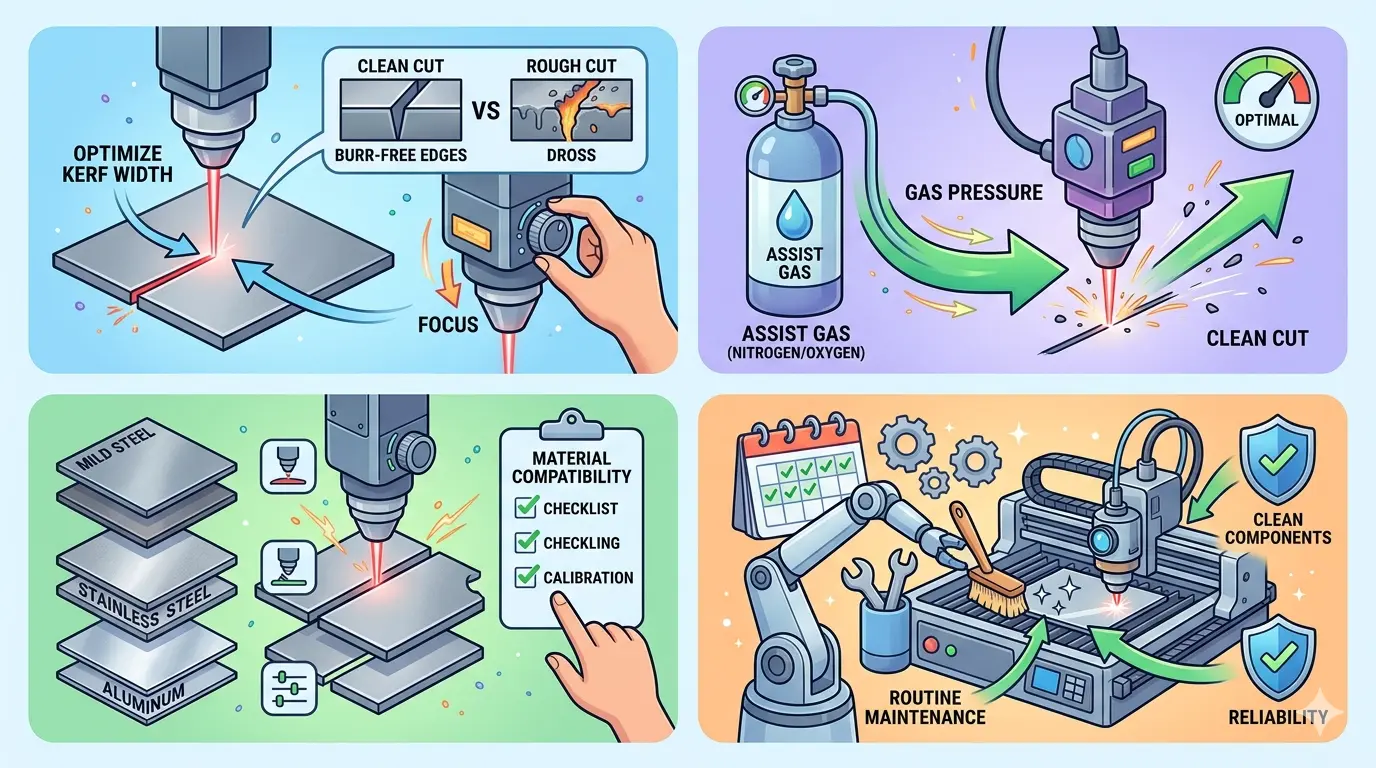
| Keep Focus And Nozzle Condition Stable | Nozzle damage, centering, contamination, and focus drift | Supports cleaner kerf behavior and more predictable geometry |
| Tune Pierce Strategy By Material And Thickness | Pierce timing, height strategy, and splash control | Reduces blowback, edge defects, and unstable starts |
| Use Feature-Aware Recipes | Small holes, narrow webs, corners, and contour-heavy parts need different control than straight lines | Protects detail quality and dimensional consistency |
| Manage Heat Across The Whole Nest | Cut order, part spacing, and heat concentration | Helps control distortion and maintain part stability |
| Protect Sheet Support And Part Stability | Skeleton strength, support condition, and unloading discipline | Prevents movement that damages accuracy late in the cut |
| Verify With First-Article Checks | Edge condition and critical dimensions before full production release | Catches drift before it becomes batch rework |
The cutting cell does not need every job to be handled the same way. It needs every job to be handled deliberately.
Match Assist Gas to the Real Edge Requirement
One of the fastest ways to lose cut quality is to choose assist gas on cost or habit alone. Gas selection changes edge condition, oxidation behavior, and the amount of downstream cleanup required.
| Assist Gas | Often Chosen For | Main Tradeoff |
|---|---|---|
| Nitrogen | Cleaner edges and lower oxidation when finish quality or welding readiness matters | Higher gas consumption and operating cost |
| Oxygen | Productive cutting on some mild-steel work, especially when speed matters more than bright-edge finish | More oxidation and a greater chance of added cleanup |
| Compressed Air | Lower operating cost on selected jobs where finish demands are less strict | Edge quality and consistency may not match nitrogen-based results |
The right question is not which gas is cheapest per hour. It is which gas creates the lowest total processing cost once deburring, welding preparation, painting, and inspection are included.
Do Not Treat Pierce Control as a Small Detail
Many accuracy complaints start at the pierce, not during the main cut path. A poor pierce can create edge splash, instability at entry, local deformation, or defects around holes and small internal features.
Good shops usually separate pierce thinking from cut-speed thinking. They do not assume a recipe that performs acceptably on outer contours will automatically protect internal geometry.
What typically helps:
- Matching pierce behavior to material type and thickness
- Paying close attention to small holes and contour-dense parts
- Watching for splash-related contamination that affects later cuts
- Checking whether the first defect is occurring at entry rather than along the entire path
If the pierce is unstable, the part often enters the process with a defect that later tuning cannot fully remove.
Protect Small Features, Corners, and Hole Quality
Straight-line cut speed can hide detail problems. Many parts fail quality expectations around holes, slots, tabs, corners, and narrow bridges because those features place different demands on the process than long external contours.
Best practice here is to judge quality by the most demanding geometry on the sheet, not by the easiest section to cut.
Shops generally get better results when they:
- Use settings that reflect the real feature mix of the part
- Monitor hole quality separately from outside contour appearance
- Watch corners for signs of rounding, overheating, or instability
- Avoid pushing productivity so hard that small-feature control collapses
This is especially important for parts that must bend accurately, locate to fixtures, or mate with hardware later in the process.
Manage Heat Across the Nest, Not Just One Part
Part quality depends on how heat moves through the entire sheet. Even when individual contours are programmed correctly, nests can create distortion or unstable cut behavior if heat accumulates in the wrong area.
Common causes include clustering too many sensitive features together, running long sequences without considering local heat buildup, or weakening the skeleton in a way that reduces stability before the last parts are finished.
A better approach is to treat the nest as a thermal strategy, not just a material-yield exercise. Material utilization matters, but it should not come at the cost of unstable edge quality or drifting part geometry.
Keep Nozzles, Optics, and Consumables Under Tight Control
Many shops try to solve cut defects with recipe changes when the real issue is consumable condition. Nozzle wear, contamination, centering problems, or upstream optical cleanliness issues can cause cut instability that looks like a programming problem.
That is why strong operations tend to use a simple rule: do not keep tuning around worn hardware.
Useful discipline includes:
- Inspecting nozzles before quality-critical runs
- Replacing damaged consumables before defects become obvious
- Checking centering whenever cut behavior changes unexpectedly
- Watching for gradual drift instead of waiting for obvious failure
Small consumable problems rarely stay small. They usually become batch-level variation if they are allowed to continue.
Hold the Sheet Stable From Loading to Unloading
Accurate cutting depends on more than the beam and CNC path. Material handling, sheet support, and part stability all affect what happens in the final result.
If the sheet is poorly supported, already stressed, or allowed to move as the nest opens up, the process becomes harder to hold. That is why production managers should care about loading quality, table condition, skeleton behavior, and unloading discipline alongside cutting parameters.
When the sheet stays stable, the machine has a better chance of repeating the programmed geometry from first sheet to last.
Common Mistakes That Turn Small Process Drift Into Rework
Most cut-quality losses do not come from one dramatic failure. They come from small shortcuts that accumulate.
- Running One Broad Recipe Across Too Many Material Conditions
- Prioritizing Straight-Line Speed Over Hole And Corner Quality
- Ignoring Gas Quality Or Delivery Stability
- Compensating For Worn Nozzles With More Aggressive Parameter Changes
- Packing Nests Too Tightly Without Respecting Heat Behavior
- Judging Quality By Outside Contours While Internal Features Drift
- Skipping First-Article Checks On Repeat Jobs After Material Changes
The pattern is consistent: when shops stop managing variation early, they pay for it later in finishing, assembly, and schedule reliability.
What Buyers and Production Managers Should Watch Every Day
For day-to-day control, the most useful question is not whether the machine can cut. It is whether the process is staying inside a stable operating window.
Warning signs worth tracking include rising deburring time, more frequent weld-edge cleanup, inconsistent hole quality, higher sorting effort at inspection, or noticeable difference between first-sheet and later-sheet performance. Those are often process-drift signals long before a machine is labeled as underperforming.
For buyers evaluating a new cutting cell, the same logic applies. The best machine is not the one with the most aggressive headline claim. It is the one that fits the factory’s real material mix, quality standard, throughput target, and downstream process sensitivity.
Practical Summary
Clean, accurate sheet metal laser cutting comes from process stability rather than beam power alone. Material condition, assist gas choice, focus control, nozzle health, pierce tuning, heat management, and sheet stability all shape whether a part leaves the table ready for the next operation or ready for rework.
The strongest shops treat cut quality as a workflow outcome. They judge success by edge condition, hole quality, fit-up, bend consistency, and repeatability across the full batch instead of by cut speed in isolation.
If your team is reviewing a broader factory equipment strategy rather than a single metal-cutting decision, the Pandaxis product catalog is a useful starting point for the machinery categories the brand currently emphasizes.