
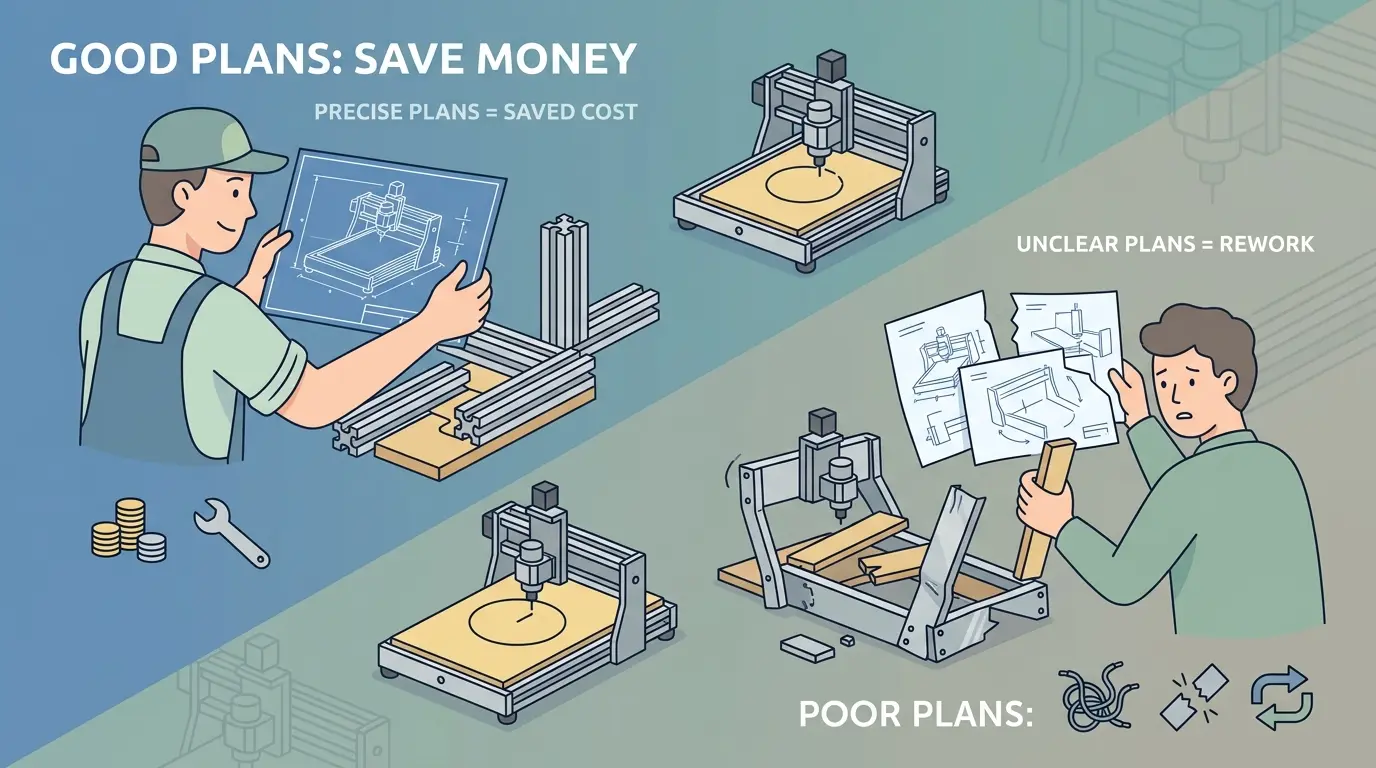
CNC machine plans often look attractive because they seem to lower the purchase bill, preserve flexibility, and let the company tailor the final machine to its own needs. Those advantages can be real. But the benefits only hold when the company is deliberately taking on the engineering, integration, support, and documentation work that a finished machine supplier would normally absorb. Plans do not remove that burden. They move it.
That is why the smartest first question is not whether the plans are detailed. It is whether the company is intentionally choosing to run a machine-building project. If the answer is yes, plans may be useful. If the business really wants dependable cutting capacity quickly, the same plans can become a very efficient way to buy rework.
The issue is not whether building from plans is good or bad. The issue is whether the responsibility transfer is being recognized early enough.
Stage One: Decide What Success Actually Means
Plan-based machines can succeed under very different definitions of success, and that is where confusion often begins. A machine can be successful as a learning platform, an internal experimental system, a narrow fixture-making tool, or a controlled-use specialty build while still being a poor answer for revenue-driven production.
This matters because companies often approve one type of project while mentally expecting the outcome of another. They say the goal is learning, but later demand production reliability. They say the application is narrow, then let the scope expand. They say the project is internal, then start treating the machine as if it were a fully supported asset.
That is why every plan-based build should begin with a simple gate: is this project supposed to teach, support a bounded internal use, or carry commercial production? The higher the output expectation, the higher the bar for plans to remain economically sound.
Stage Two: Recognize That The Builder Has Become The Practical OEM
The moment a company decides to build from plans, it becomes far more than a buyer of parts. It becomes the practical OEM of the finished system. That means the company inherits responsibilities that would normally sit with a finished-machine supplier: sourcing judgment, integration quality, troubleshooting logic, documentation quality, revision control, and future service clarity.
Some teams want that role. They may have the engineering depth, the maintenance culture, and the strategic reason to internalize machine knowledge. For them, the shift can be useful. Other teams only want the output. For them, this same shift quietly creates risk because the organization is now carrying responsibilities it never budgeted honestly.
This is the real fork in the road. A plan-driven build is not just a cheaper purchase method. It is a governance choice about who owns the machine’s unresolved engineering.
Stage Three: Audit How Much Decision-Making The Plans Actually Save
A strong plan set earns its value by reducing repeated engineering. It does not merely show where the frame goes. It carries enough proven decisions that the builder avoids reinventing structure, motion assumptions, cable routes, mounting logic, service access, guarding behavior, and build order from scratch.
That is why buyers should judge plans by the quality of the decisions they remove from the project, not by the number of drawing pages. Visual completeness is not the same as solved engineering. Plans can look polished and still leave the builder alone with critical choices.
The practical question is this: once the company begins sourcing and assembling, how many expensive decisions still remain open? If the answer is “many,” the plans are less a package of proven engineering and more a starting draft for an internal design project.
That distinction is where much of the economic truth lives.
Stage Four: Review The Interfaces, Because That Is Where Rework Starts
Most rework in build-from-plans projects does not begin on the obvious large components. It begins where disciplines meet. Structure meets motion. Motion meets cable management. Controls meet safety behavior. Extraction meets guarding. Service access meets enclosure design. Those interfaces are where incomplete plans reveal themselves.
This is why a serious review should pressure-test each boundary, not just each subsystem. Buyers and builders should ask:
- How do moving elements avoid conflict with cables, hoses, and guards?
- How does service access work without dismantling unrelated systems?
- Where does emergency-stop logic become real machine behavior?
- How are dust, chips, or coolant handled around the actual motion path?
- What assumptions about mounting, alignment, and access are still being left to the builder?
These questions matter because the machine only works as a system. A frame drawing that looks solid does not prevent expensive redesign if the interfaces remain unresolved.
Stage Five: Treat “Upgrade Later” As A Potential Redesign Path
Many plan-based projects are mentally justified by the phrase “we can improve it later.” Sometimes that is true. But later improvements often expose assumptions that the original design never fully carried. A heavier spindle can change structural needs. Faster motion can reveal weaknesses in damping or mounting. Added extraction or guarding can interfere with access. Control changes can demand more rewiring and more debugging than the team assumed.
The issue is not that upgrades are bad. It is that upgrade paths are often imagined as modular when they are actually structural. Later changes do not arrive in an empty system. They arrive in a stack of earlier choices. If those earlier choices were not sized or documented for the next burden, the project begins revisiting work that was supposed to be finished.
That is why many plan-driven “future upgrades” are not clean enhancements. They are delayed redesign programs.
Stage Six: Budget Internal Engineering Hours Like Real Purchased Capacity
Plan-based machines often look economical when the comparison is reduced to hardware cost versus finished-machine invoice. That is incomplete. Interpretation, sourcing substitutions, assembly correction, tuning, calibration, redesign, troubleshooting, and documentation all consume internal engineering capacity. Even if those hours do not create a separate invoice, they still have cost.
For some teams, that cost is strategic and acceptable. They want the learning, control, or internal capability. For other teams, those same hours compete directly with customer work, process improvement, or maintenance backlog. In that case, the project may be consuming some of the business’s most valuable capacity while still appearing cheap in procurement terms.
This is why internal hours should be priced with the same seriousness as purchased components. If they are not, the plan-based machine can become an expensive capacity decision hiding inside a low hardware budget.
Stage Seven: Documentation Is Part Of Machine Performance
A machine built from plans does not arrive with organizational memory attached. The builder has to create that memory. Electrical records, revision history, parameter backups, troubleshooting notes, spare-part logic, and maintenance procedures become part of whether the machine stays usable over time.
This is where many plan-based builds succeed technically but fail operationally. The machine runs, but only one person really understands it. That makes the system fragile. Staff changes, shift changes, or ordinary maintenance events suddenly become larger problems because the machine’s logic lives in memory instead of records.
That is why documentation is not an optional cleanup task after the build. It is part of the machine itself. A build without transferable documentation is not a finished production asset. It is a dependency.
Stage Eight: Livability Often Gets Underbuilt
Many plan-driven projects give strong attention to structure, motors, and controls while underbuilding the ordinary things that make daily use tolerable: guarding, cable protection, extraction support, housekeeping flow, access for maintenance, and practical cleanup. That is especially important in routing and woodworking contexts, where dust control and service access can decide whether the machine is tolerated or resented.
The easiest way to see this gap is to compare a plan-built concept with industrial wood CNC equipment built for real production use. The difference is rarely only cutting motion. It is the whole set of supporting decisions that make the machine usable across real shifts instead of impressive only in a trial run.
If the plan-built machine creates too much dust burden, awkward guarding, difficult service access, or daily cleanup frustration, the business may still have a functioning machine but not a competitive production tool.
Stage Nine: Plans Work Best When The Application Is Narrow And Stable
There are strong cases for building from plans. They usually share a few traits. The intended use is narrow. The load case is well understood. The tolerance and duty expectations are controlled. Downtime is acceptable. The company sees strategic value in owning the development knowledge.
In those conditions, plans can be rational because the build is not being forced to absorb endless change. The narrower the use case, the less opportunity there is for hidden assumptions to multiply into redesign. The machine does one bounded job, and the builder can engineer around that job deliberately.
That is why plans are often strongest in internal tooling, fixture work, learning programs, or tightly scoped special-purpose uses. They are much harder to justify when the target keeps moving or when the machine is expected to become a broadly capable production asset quickly.
Stage Ten: Finished Machines Usually Win When Output Urgency Is Real
If the true business goal is stable output, faster startup, clearer support boundaries, and lower organizational fragility, a finished machine is usually easier to defend. This is especially true when internal engineering bandwidth is already busy, deadlines matter, or staff turnover makes undocumented systems risky.
In that situation, the better comparison is usually not between plans and dream economics. It is between internal engineering burden and a cleaner external ownership path. That is where factory-direct buying discipline becomes more relevant than builder enthusiasm. And if the company is still stepping back to compare machine-family paths at a higher level, the Pandaxis machinery lineup is the better place to narrow by workflow fit before getting romantic about building internally.
This does not mean plans are wrong. It means output urgency should be allowed to overrule the appeal of engineering control when the business really needs dependable capacity.
The Final Gate Question
Management can simplify the entire decision with one blunt test: are we deliberately choosing to own machine design, integration, support, and documentation inside the company, or are we trying to buy output while pretending that work does not count?
That question forces the economics into the open. If the company truly wants the capability and is ready to carry the responsibility, plans can save money and create valuable internal knowledge. If the company only wants cutting capacity and a faster path to reliable output, the same plans often create redesign, undocumented dependence, and delayed payback.
In the end, CNC machine plans save money only when the relocated engineering burden is both intentional and affordable. When that ownership is real, plans can be a rational choice. When it is denied, rework usually arrives to collect the difference.