
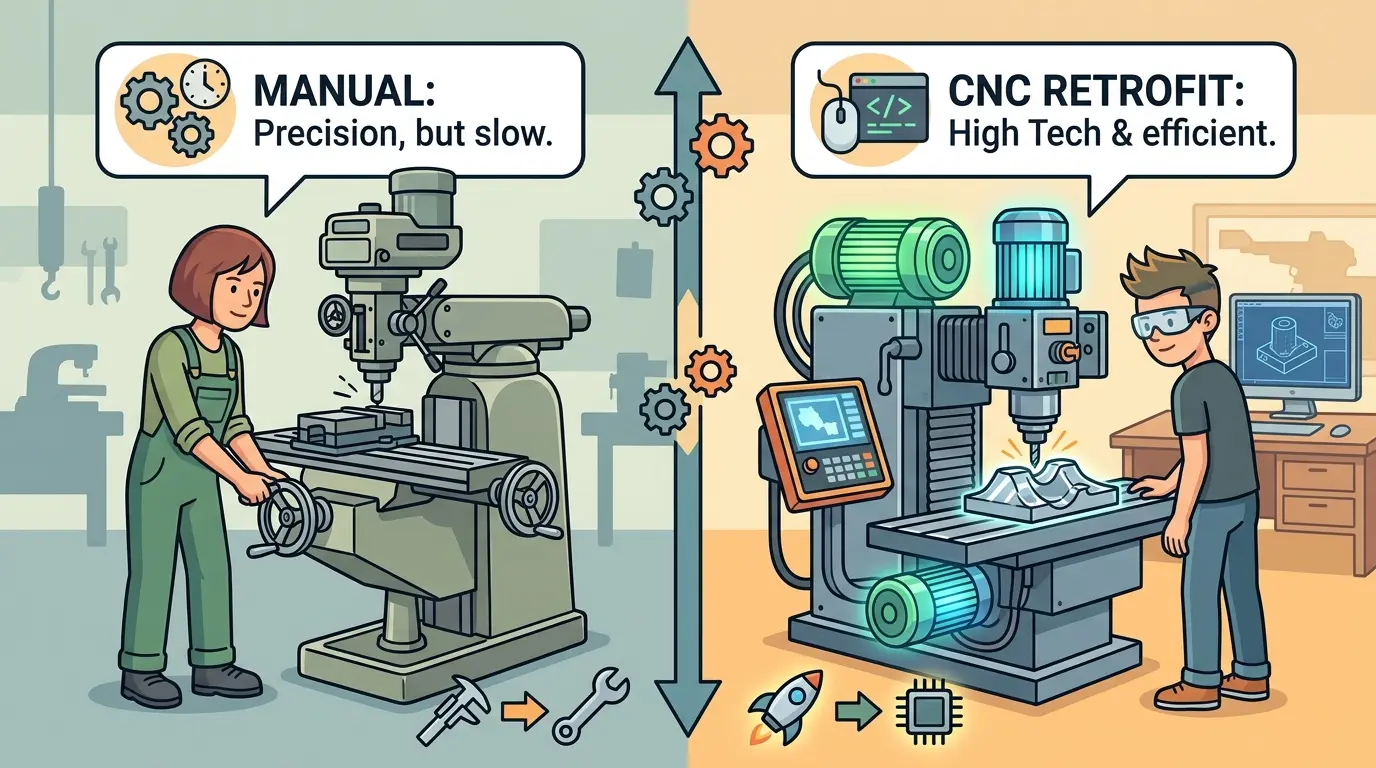
This question looks simple only if you stop at donor price. Once you look one layer deeper, it becomes a project-architecture decision. Are you building mainly to learn CNC conversion work at a tolerable entry cost, or are you building because you want the finished machine to behave like a credible working asset with fewer built-in excuses?
That is the real split between converting a Central Machinery-class mill and converting stronger manual iron. Both paths can be rational. Neither path is universally better. The difference is where compromise enters the project, how much of it stays with the machine forever, and how honest the builder is willing to be about the donor before spending on control hardware.
Most retrofit disappointment comes from answering the wrong question. Builders ask, “Can this mill be converted?” when they should be asking, “What kind of life will this machine have after conversion, and what weaknesses will still be there when the first exciting weekend is over?”
Decide Whether You Are Building A Machine Or Running A Retrofit Education Project
Before choosing a donor, define the mission in plain language.
Is the project mainly a learning platform for ball screws, motor mounting, controller wiring, homing, software, and tuning? If so, a lower-cost donor can be defensible because education is part of the output. The machine is not only a tool. The machine is also the lesson.
Is the project supposed to become a reliable machine for repeated prototype work, regular hobby machining, or low-stakes part production? Then the donor has to be judged much harder because the finished machine will be asked to carry a real workload.
Is the project being justified as a way to save money against buying a finished machine? Then the donor decision becomes even more serious, because hidden mechanical compromise will keep charging interest long after the conversion is technically complete.
These are different missions. A donor acceptable for education can be the wrong donor for repeat use. A donor worth serious rebuild effort can be wasteful if the real goal is only to understand the retrofit stack. Once the mission is written clearly, many donor arguments collapse on their own.
Audit The Donor Before You Dream About The Retrofit
This is the stage builders want to skip because it is less fun than choosing motors or controller software. It is also the stage that protects the whole project.
Before discussing electronics, look at the donor like an auditor. Check the ways, backlash, spindle feel, gib condition, alignment stability, wear pattern, lubrication condition, table movement, and whether the machine already tells a story of compromise before one CNC part is mounted.
That matters because the conversion does not erase the donor’s truth. It automates it.
If the donor is light, flexible, worn, poorly adjusted, or mechanically inconsistent, the CNC conversion will still live on top of those facts. A cleaner control path may make motion easier to command, but it will not transform weak geometry into strong geometry. The finished machine may move under code, but it will still be negotiating the same base-machine limitations.
This is why the first real retrofit question is not what hardware you can bolt on. It is what weaknesses you are willing to live with after the build is done.
What A Central Machinery-Class Donor Usually Buys You
A Central Machinery-class donor usually buys access, not confidence.
That is not an insult. It is simply the normal attraction of the path. Builders often choose this route because the donor is easier to reach financially, easier to justify as a learning experiment, and easier to accept as a staged project rather than a major capital decision. In the right context, that is a valid reason.
This path often fits builders who want:
- Hands-on retrofit experience.
- A lower barrier to entry.
- A machine that can support modest personal projects.
- A platform where mistakes are educational rather than commercially expensive.
- A gradual spending path instead of a large up-front move.
The mistake is believing that lower donor cost means lower total compromise. Usually it does not. It means compromise is entering earlier and more deeply into the machine foundation.
That matters because a lighter, cheaper donor often asks the builder to spend the rest of the project compensating for what the base machine never offered in the first place. The retrofit may still be enjoyable and worthwhile, but the builder needs to name the trade correctly. The reward is entry and learning, not automatically a strong final machine.
What Stronger Manual Iron Usually Buys You
Converting a stronger manual mill usually costs more at the donor stage because the donor itself is carrying more of the future machine’s truth.
The builder is paying for a better starting point: more confidence in the underlying iron, a better chance that geometry and rigidity are worth preserving, and a higher probability that the converted machine can become a stable tool instead of a permanent explanation.
This does not mean every heavier or more expensive manual mill is a good donor. Wear, abuse, sloppy repairs, and bad maintenance can ruin that assumption. But when the underlying machine is genuinely better, the retrofit effort has a stronger foundation.
That changes the whole emotional tone of the project. Instead of asking, “How much can I get away with on this donor?” the builder starts asking, “How well can I finish a machine that already deserves the effort?”
That is usually the better path when the machine is expected to handle real recurring work, not just teach retrofit mechanics.
The Hidden Cost Of Cheap Donors Appears After The Exciting Parts Start
Lower donor price is seductive because it makes the project feel possible. The problem is that donor price is only the first invoice.
What follows usually includes:
- Ball screws or another motion-upgrade strategy.
- Motor selection and mounting hardware.
- Couplers, bearing blocks, and bracket fabrication.
- Controller hardware and enclosure work.
- Power-supply planning.
- Limit and homing hardware.
- Wiring, grounding, and cable management.
- Lubrication access and maintenance planning.
- Machine cleanup, correction, and commissioning time.
If the donor is already mechanically compromised, each of these later steps gets built on less certainty. That does not always make the project fail. It does make the project harder to finish into something dependable.
This is why builders often misread the cheap path. The donor saves money at the beginning, then quietly demands more patience, more expectation management, and more tolerance for a machine that may never stop feeling slightly provisional.
Which Path Handles Imperfect Integration Better
No retrofit is executed perfectly. Mounting plates end up needing correction. Wiring choices evolve. Tuning takes longer than planned. Alignment work reveals secondary issues. Everyone believes the project will stay linear. Few do.
That is why one of the smartest comparison questions is not which donor is theoretically better, but which donor handles imperfect integration with more grace.
A stronger donor usually forgives integration imperfection better because the base machine is already carrying more stability. A weaker donor often amplifies mistakes. Small alignment errors, soft mounting ideas, or marginal tuning choices get layered onto already limited mechanical truth.
This difference matters most after first motion. Many conversion projects feel successful when the axes finally move. The real test begins when the machine has to cut predictably, hold adjustments, and stop surprising the builder with one more weakness hiding underneath the retrofit.
The donor that handles ordinary integration mistakes better is often the donor that remains usable longer.
A Decision Matrix For Real Retrofit Goals
If the project purpose is clear, the donor choice usually becomes less emotional.
| Real Project Goal | Path That Usually Fits Better | Why |
|---|---|---|
| Learn CNC conversion mechanics without committing to expensive donor iron | Central Machinery-class donor | Entry cost is lower, and educational value is still high if expectations stay honest |
| Build a machine for modest experimentation where occasional compromise is acceptable | Central Machinery-class donor, if the builder accepts the limits clearly | The donor can be enough when the machine is not expected to protect time-sensitive work |
| Create a more credible working tool for repeated machining tasks | Stronger manual donor | Better iron gives the retrofit a better chance of becoming stable instead of provisional |
| Reduce long-term explanation, compensation, and mechanical doubt | Stronger manual donor | More of the final machine quality comes from the donor instead of from workarounds |
| Stretch every dollar at the start regardless of later friction | Central Machinery-class donor, but only with open eyes | The builder is choosing delayed pain in exchange for immediate affordability |
| Spend more up front to reduce structural compromise later | Stronger manual donor | The project burden shifts toward finishing a better machine rather than defending a weaker one |
This table is useful because it forces the builder to state the real priority. Most retrofit arguments become clearer once the project is no longer pretending to satisfy every goal at once.
The Wrong Question Is Still “Can It Be Converted?”
Yes, many donors can be converted. That fact is not enough to justify choosing them.
The better questions are these.
What material will the machine cut most often?
How expensive is inconsistency in this workflow?
How often does the operator need to repeat the same setup?
Will the machine be a patient personal project, or will it be blamed when real deadlines slip?
What level of mechanical apology are you willing to tolerate after the retrofit is technically complete?
Those questions move the decision from internet possibility to machine ownership reality. A donor is not good because conversion is possible. A donor is good when the finished machine can support the intended life of the project with acceptable friction.
When The Retrofit Stops Being A Retrofit And Starts Looking Like A Delayed Purchase
Every serious retrofit should have a stop rule.
If donor wear is worse than expected, if rebuild work keeps expanding, if the controller budget is climbing, if fabricated mounting solutions keep turning into redesign cycles, or if the intended workload is becoming more commercially serious, the builder should stop and ask whether the project has crossed into a different buying decision.
That is the moment to step back and compare machinery quotes without missing critical details instead of defending the retrofit purely because money and pride are already invested. It is also the moment to revisit what makes industrial CNC equipment worth the investment if the project is slowly being asked to behave like a more serious production asset.
If the question expands beyond a donor conversion into broader equipment planning, the Pandaxis product catalog can serve as a general reference point for larger machinery categories, even if the retrofit topic itself sits outside Pandaxis’ direct product focus.
The stop rule matters because scope drift is not a side issue in retrofit work. It is the default failure mode. Without a clear boundary, builders can keep spending to defend an old decision long after the machine requirement has changed.
The Better Path Is The One That Leaves Fewer Lies In The Build
That is the most practical answer.
Choose a Central Machinery-class conversion when the project is honestly about learning, experimenting, and accepting that the donor itself is part of the compromise. It can be worthwhile, educational, and satisfying if the builder never asks it to pretend to be more than that.
Choose stronger manual-donor iron when the goal is a machine with a more believable chance of long-term usability, better mechanical confidence, and less need for permanent explanation after the retrofit is finished.
The wrong choice is not necessarily the cheaper donor or the more expensive donor. The wrong choice is the donor that forces the project to live on a false story. If the build says it is educational, then let it be educational. If the build says it needs to become a dependable tool, then start from iron that gives that goal a real chance. Once the project stops lying about its mission, the better retrofit path usually becomes obvious.