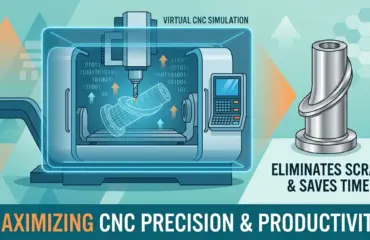
When a part moves from flat faces and simple pockets into blended curves, carved reliefs, changing radii, or continuously flowing surfaces, the machining question changes immediately.
The shop is no longer judging the job only by removal rate. It is judging how to keep the cutter stable on a changing form, how to protect visible finish across a long toolpath, how to hold the work without blocking the surface, and how to inspect geometry that cannot be reduced to a few easy dimensions.
That is the real production meaning of 3D CNC machining.
The Surface Starts Controlling The Workflow
On ordinary prismatic work, the conversation often starts with dimensions, tool access, and material removal speed.
On complex-surface work, the priorities shift toward:
- Finish Continuity.
- Blend Quality.
- Cutter Reach.
- Holder Clearance.
- Inspection Method.
A part can therefore look simple in CAD and still be difficult in production. A shallow contoured panel may demand more thought around tool marks, sanding allowance, and visible quality than a block full of holes.
Define Acceptance Before Choosing Hardware
The first serious question on a 3D job is not axis count. It is acceptance.
A hidden internal profile can tolerate a very different route from an exposed face that will be coated, polished, sealed, or inspected under strong light.
Before any equipment path is shortlisted, the team should define:
- Whether the surface is functional, cosmetic, or both.
- Whether sanding, polishing, or hand blending is allowed.
- Whether scallops, witness lines, or blend transitions matter downstream.
- How the part will actually be approved: fit, appearance, templating, CAD comparison, or another method.
Until those points are explicit, machine selection stays vague.
Access Usually Decides Whether The Job Stays Economical
Many factories debate 3-axis, 4-axis, or 5-axis too early. In practice, access is often the variable that decides whether the route stays economical.
Deep valleys, narrow transitions, reverse curves, and long sweeping surfaces all challenge the cutter’s ability to stay short, calm, and properly aligned.
A part can be technically machinable on a simpler platform and still be a poor production choice there. The route may need extra setups, longer tools, awkward fixtures, or repeated re-datuming just to reach the geometry.
The goal is not to buy the most impressive motion package. The goal is to give the cutter repeatable access with the least unstable reach and the fewest unnecessary handling steps.
Roughing, Semi-Finishing, And Finishing Become One Surface Strategy
On simpler parts, roughing and finishing are often treated as familiar stages. On complex surfaces, each stage influences the next much more directly.
- Roughing must leave a stable condition for later tools.
- Semi-finishing often decides whether the finishing tool sees a calm load or a changing one.
- Finishing exposes path direction, step-over, and blend logic in ways prismatic parts often do not.
Shops that handle 3D work well do not treat finishing as a cosmetic afterthought. They treat roughing, semi-finishing, and finishing as one connected surface plan.
Tool Reach And Step-Over Become Commercial Decisions
Complex-surface work changes how tooling should be judged.
The practical question is not only cutter diameter. It is also reach, holder interference, deflection risk, and what kind of scallop the surface can tolerate.
A route can look fast in spindle time and still be slow in total job cost if the finishing labor later pays for poor reach or aggressive step-over decisions.
That is one of the main reasons buyers misread 3D machining cost. They see machine time and miss how much cost has been pushed into manual cleanup.
Fixturing Must Protect Access And Shape Integrity At The Same Time
In 3D workholding, the setup has to do two jobs at once: stabilize the part and stay out of the path.
That means the team must ask:
- Which surfaces need to remain reachable in one setup.
- How many orientations are actually required.
- Which datums can survive through multiple operations.
- Whether support choices risk distorting a visible form.
On simple parts, weak fixturing may show up as a missed dimension. On complex surfaces, it may show up as a blend inconsistency that becomes obvious only under final lighting or final fit-up.
CAM And Simulation Are Part Of Process Engineering
Complex-surface work usually demands more from CAM than first-time buyers expect.
Toolpaths need stronger simulation. Holder and fixture collisions matter more. Revision control matters more because a small geometry change can force a broader rethink of the finishing plan.
Shops that handle 3D work well do not treat CAM as clerical conversion. On these jobs, the toolpath is part of the manufacturing plan.
Inspection Must Match The Real Function Of The Surface
A complex surface can look correct and still create downstream cost. It may pass a few spot dimensions and still trigger polishing labor, fit issues, sealing trouble, or visible quality defects after coating or installation.
Depending on the job, inspection may need:
- CAD Comparison.
- Critical Section Checks.
- Templating.
- Fit-Up Against A Mating Part.
- Scan-Based Evaluation.
- Finish Review Under Real Lighting.
If acceptance criteria stay vague, machining, quality, and the customer will end up judging different things.
3 Axis, Indexed Positioning, Or Full 5 Axis?
The machine choice becomes clearer when framed around what problem the added motion actually changes.
| Real Problem In The Route | What Often Solves It Best |
|---|---|
| Access stays reasonable and multiple setups do not destroy consistency | 3 axis may still be enough |
| The part needs several stable orientations but not continuous reorientation during the cut | Indexed positioning may solve most of the problem |
| Cutter angle must change through the cut to preserve reach, finish, or collision-free motion | Full simultaneous 5 axis becomes more compelling |
The mistake is assuming “3D” automatically means the most advanced axis package.
Material Changes The Best Strategy, But Geometry Still Leads
The same geometry behaves differently in wood, panel products, stone, aluminum, composites, and other materials.
That matters in Pandaxis-relevant workflows. In furniture and panel production, a shaped component may belong inside broader CNC nesting workflows where routing, cutting, and drilling are coordinated around material flow. In countertop and architectural fabrication, similar-looking geometry may belong inside stone CNC workflows where carving, surfacing, and polishing follow a different production logic.
Geometry does not choose the machine alone. Geometry interacts with material, finish expectation, and factory flow.
Separate Launch Risk From Repeat-Production Cost
Complex-surface work often carries high launch effort because programming, simulation, fixture tuning, inspection planning, and finishing assumptions all need to be proven.
Once stabilized, repeat production may be much calmer.
For that reason, it helps to compare machinery quotes line by line instead of treating all “3D machining” offers as interchangeable. The important question is not only the hourly rate. It is what assumptions had to be true for that rate to make sense.