In machinery buying, the visible machine price is only one part of the decision. The bigger cost often shows up later, when a line runs below target, installation takes longer than expected, spare parts are unclear, or the machine that looked competitive on paper turns out to be a poor fit for the actual workflow.
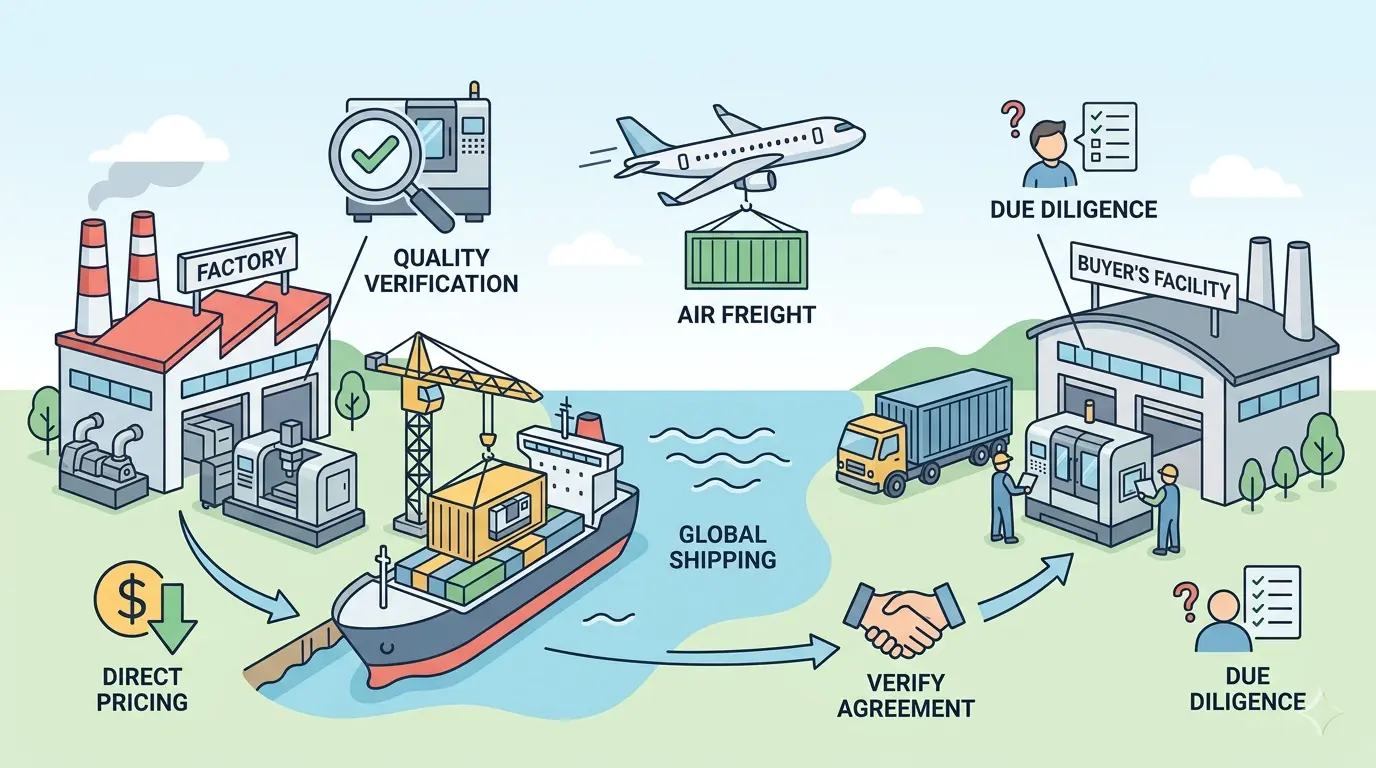
That is why factory-direct buying deserves a more disciplined review than a simple price comparison. Buying direct from a manufacturer can improve communication, shorten commercial handoffs, and create a clearer path to process-specific configuration. It can also shift more verification work onto the buyer. If that work is skipped, the savings can disappear quickly.
Why Buyers Go Factory Direct In The First Place
Most factory-direct discussions start with price, but serious buyers usually care about more than margin. They are often trying to solve one or more practical problems:
- Too Many Layers Between Technical Questions And Technical Answers
- Slow Quote Revisions When Process Requirements Change
- Weak Alignment Between Machine Scope And Production Reality
- Limited Visibility Into What Is Included, Excluded, Or Assumed
- Frustration With Buying Through A Channel That Knows The Price Better Than The Process
In that sense, factory-direct buying is often less about finding a cheap machine and more about reducing distortion between the production requirement and the final machine scope.
Where The Real Advantages Come From
Buying direct can create real value when the machine has to fit a specific process rather than a generic use case.
| Potential Advantage | Why It Can Matter In Practice | What Still Needs Verification |
|---|---|---|
| Fewer Commercial Handoffs | Technical questions may reach the people closest to machine design or configuration faster | Confirm that the responses are specific, documented, and consistent |
| Better Fit For Process-Specific Configuration | Direct communication often helps when material flow, automation boundaries, or line balance matter | Verify that the final quotation and scope reflect those discussions |
| Clearer Commercial Visibility | Buyers may get a more direct view of options, exclusions, and upgrade choices | Make sure optional items, tooling, and commissioning scope are separated clearly |
| Potential Cost Efficiency | Removing channel layers can improve the buying structure in some cases | Compare total delivered scope, not headline machine price alone |
| Faster Clarification Cycles | Changes can move more quickly when fewer parties are relaying questions | Check whether speed in discussion also translates into precision in documentation |
These benefits are strongest when the buyer already understands the process well and can ask disciplined questions. If the buyer is still unclear about the machine category itself, it usually helps to step back and review the broader Pandaxis machinery catalog before narrowing the conversation to one quotation.
Where Factory-Direct Buying Gets Risky
The biggest factory-direct risk is not that the machine is automatically worse. It is that the buyer assumes direct access removes the need for formal verification.
In reality, factory-direct projects can become riskier when:
- The Buyer Confuses Fast Communication With Complete Scope Definition
- The Machine Category Is Chosen Before The Workflow Problem Is Fully Understood
- Installation, Utilities, And Site Conditions Are Treated As Secondary Details
- Warranty Language Is Clearer Than Acceptance Criteria
- Spare Parts Planning Is Delayed Until After Installation
- Training And Commissioning Responsibility Are Left Ambiguous
- Cross-Border Logistics, Standards, Or Service Response Are Assumed Rather Than Confirmed
Direct access to the manufacturer can help resolve these issues, but it does not remove them. In many cases, it simply means the buyer has to manage them more actively.
Verify Machine Fit Before You Negotiate Too Hard On Price
One of the most expensive buying mistakes is negotiating aggressively on a machine that should not have been shortlisted in the first place. Before price pressure becomes the center of the discussion, verify whether the machine actually fits the production model.
Start with the production facts:
- What Materials Run Through The Process Most Often
- What Output The Line Must Reach Per Shift Or Per Day
- What Quality Standard Downstream Processes Depend On
- Where The Current Bottleneck Actually Sits
- How Much Variation The Operation Can Tolerate Without Rework
- How Much The Workflow Depends On Operator Judgment Versus Repeatable Process Control
If those answers are vague, the buying risk is already high, regardless of whether the source is a manufacturer, distributor, or trading company.
What To Verify About The Machine Itself
Buyers should pressure-test the machine at the level of workflow fit, not just brochure language.
| Verification Area | Why It Matters | What To Clarify |
|---|---|---|
| Process Fit | A machine can be technically capable but still wrong for the line | Which exact operation it is expected to improve and which problems it will not solve |
| Material Fit | Material type and surface condition change machine behavior significantly | The materials, part conditions, and product mix the machine is expected to handle |
| Throughput Fit | Quoted output is not the same as stable line output | Expected production rhythm, changeover frequency, and realistic operating mode |
| Quality Fit | Downstream departments pay for weak front-end consistency | The tolerances, finish expectations, or repeatability requirements the machine must support |
| Integration Fit | A strong machine can still create a weak line if handoffs are poor | How parts, sheets, or workpieces enter and leave the machine within the real workflow |
| Site Fit | Utilities and layout problems can delay installation or reduce performance | Power, air, space, handling path, and any site-preparation responsibilities |
| Support Fit | After-sales weakness often shows up when the line is already under pressure | Support path, spare parts planning, and what kind of commissioning help is actually available |
This is also where buyers should ask for evidence that is relevant to their use case. That does not always need to mean a perfect match, but it should mean something more useful than general claims. Comparable applications, process examples, layout drawings, and clearly written technical responses are usually more valuable than broad promises.
Verify The Supplier, Not Just The Quotation
A factory-direct purchase is partly a machine decision and partly an execution decision. Buyers should evaluate how the supplier handles precision, not just how the machine is described.
Useful signs to check include:
- How Clearly Technical Questions Are Answered
- Whether Revisions In Scope Are Reflected Cleanly In Updated Documents
- Whether Included And Excluded Items Are Easy To Identify
- Whether Site Requirements Are Defined Early Or Left Until Late
- Whether Communication Stays Consistent Across Sales, Technical, And Delivery Discussions
- Whether Spare Parts, Consumables, And Service Expectations Are Discussed Before The Order Is Finalized
This matters because the buying relationship does not end when the deposit is paid. The same discipline shown during technical clarification usually predicts how smooth the later stages will be.
What Must Be Clarified In Writing Before Payment
Factory-direct buying becomes much safer when the commercial documents force ambiguity out of the project. If an item matters to startup, output, quality, or handover, it should appear in writing.
At minimum, buyers should confirm:
- Exact Machine Scope
- Optional Items And Upgrade Items
- Included Tooling, Fixtures, Or Standard Accessories
- Utility And Site Requirements
- Installation Responsibilities
- Commissioning Responsibilities
- Operator Training Scope
- Acceptance Test Criteria
- Delivery Terms And Packing Scope
- Spare Parts Recommendations
- Consumables Or Wear-Item Expectations
- Warranty Coverage And Warranty Boundaries
- Documentation Deliverables
- Payment Milestones Linked To Deliverables Or Project Stages
The critical point is not to create paperwork for its own sake. It is to make sure the machine that is priced is the same machine that is expected, delivered, installed, and accepted.
Acceptance Criteria Deserve More Attention Than Warranty Language
Many buyers read the warranty carefully and treat acceptance criteria as a formality. That is backwards.
Warranty language matters, but acceptance criteria decide whether the delivered machine has met the agreed standard at handover. If those criteria are vague, the buyer can end up arguing about performance from a weak starting position.
Good acceptance criteria usually define things such as:
- What Operation The Machine Must Perform
- Under What Material Or Product Conditions It Will Be Evaluated
- What Counts As Successful Startup Or Commissioning
- Which Functions Are Included In The Delivery Scope
- What Documentation, Training, Or Handover Items Must Be Completed
Without that structure, disputes often turn into interpretation problems instead of engineering problems.
When Factory Direct Usually Makes The Most Sense
Factory-direct buying is often a strong fit when the buyer has enough internal discipline to manage a technical purchase properly.
| Situation | Factory-Direct Fit | Why |
|---|---|---|
| The Production Need Is Clear And Well Defined | Strong | The buyer can evaluate scope precisely instead of shopping by appearance |
| The Buyer Has Engineering Or Process Capacity In House | Strong | Questions can stay technical and verification can stay disciplined |
| The Machine Needs Workflow-Specific Configuration | Strong | Direct communication can reduce distortion between need and solution |
| The Buyer Needs Full Local Handholding To Execute The Project | Weaker | Local implementation support may matter more than direct commercial access |
| The Buyer Is Entering A New Process Category For The First Time | Weaker | The category decision itself may still need outside guidance |
| The Line Cannot Tolerate Slow Clarification After Delivery | Conditional | Support and spare-parts planning must be especially clear before purchase |
The point is not that factory direct is always better or always riskier. It is better in some operating conditions and riskier in others.
A Practical Pre-Order Verification Checklist
Before committing, a buyer should be able to answer yes to most of the questions below:
- Do We Understand The Real Production Problem The Machine Is Supposed To Solve?
- Have We Confirmed That The Machine Category Fits That Problem?
- Is The Scope Written Clearly Enough That Another Person Could Review It Without Guessing?
- Have We Clarified What Is Included, Excluded, Optional, And Assumed?
- Are Utilities, Layout, Handling, And Site Conditions Already Defined?
- Do We Know Who Installs, Commissions, Trains, And Signs Off?
- Are Acceptance Criteria Specific Enough To Use At Handover?
- Do We Understand The Spare Parts And Support Plan Before Startup?
- Are We Comparing Total Delivered Scope Rather Than Price Alone?
- If Something Goes Wrong After Delivery, Do We Know The Actual Response Path?
If too many of those answers are still unclear, the buying decision is not ready, even if the quotation looks attractive.
Practical Summary
Factory-direct machinery buying can create real advantages when the buyer wants fewer commercial layers, clearer technical communication, and a machine scope that matches the production requirement more closely. Those benefits are most valuable when the buyer already understands the process and can verify the project with discipline.
The risks are equally real. A direct purchase can expose weak scope control, vague acceptance criteria, poor site planning, and unclear support expectations faster than a more buffered channel model. That does not make factory direct a bad strategy. It makes verification the center of the strategy.
The safest way to buy direct is simple: define the production problem first, verify the machine against the workflow, confirm the project scope in writing, and treat handover criteria as seriously as price. When those steps are done well, factory-direct buying can be efficient, technically clear, and commercially rational. When they are skipped, the savings rarely stay saved.