
Searching for “CNC machining near me” feels practical because distance looks like risk reduction. Sometimes it is. A nearby supplier can make first-article review easier, shorten travel for engineering clarification, reduce freight complexity on awkward parts, and help containment move faster when a problem appears. But location does not automatically improve capability, quality control, revision discipline, or schedule performance. A weak shop ten miles away can create more cost than a strong supplier in another state.
That is why the right move before sending a drawing is not to ask, “Is this shop local?” The better move is to ask, “What exactly is local access supposed to improve on this job?” If proximity does not make launch faster, review clearer, freight safer, or response tighter, then “near me” may be more of a comfort filter than a sourcing strategy.
This topic is easiest to handle as a series of buyer questions. Before you release files, each question below should have a specific answer. If it does not, geography is getting more credit than it has earned.
What Problem Is Local Supply Supposed To Solve?
The first useful question has nothing to do with machine count, price, or even the drawing itself. It is about the friction you expect proximity to remove. Many buyers begin with local search because it feels safer, but safety needs an operational definition.
Good reasons to prioritize a nearby supplier usually include faster first-article review, easier in-person engineering discussion, lower freight risk on heavy or damage-sensitive parts, faster containment when something drifts, or a realistic need for occasional visits during launch or repeat production. Those are concrete reasons. “It feels easier” is not. If the job is stable, the parts are easy to ship, the tolerances are not unusually sensitive, and the supplier interaction will rarely require physical presence, the local advantage may be weaker than the search term suggests.
This matters because proximity should be weighted against a real business problem. If the problem is vague, the shortlist is likely to favor nearby suppliers before they have earned that position on process fit.
Does The Shop Regularly Run Work Like This?
Before you send a full drawing package, confirm that the supplier routinely handles the kind of work you actually need. Local access does not compensate for a poor fit in material, tolerance style, finish expectation, or order pattern.
That means asking what the shop runs every week, not what it could probably quote once. Does it regularly process your material family? Does it normally deal with the part size you are sending? Does it understand the cosmetic standard, the batch pattern, and the documentation you expect? A nearby shop may be willing to quote almost anything. That does not mean your work is normal inside its system.
The fastest way to waste time is to send a detailed RFQ to every local company that answers the phone. A short fit conversation is often enough to screen out curiosity from real alignment. If the fit is unclear, do not assume the shop will reveal that cleanly after it has your full package.
What Should You Send Before The Full RFQ?
Buyers often send too much too early or too little to be useful. A better local sourcing approach is usually a two-step release.
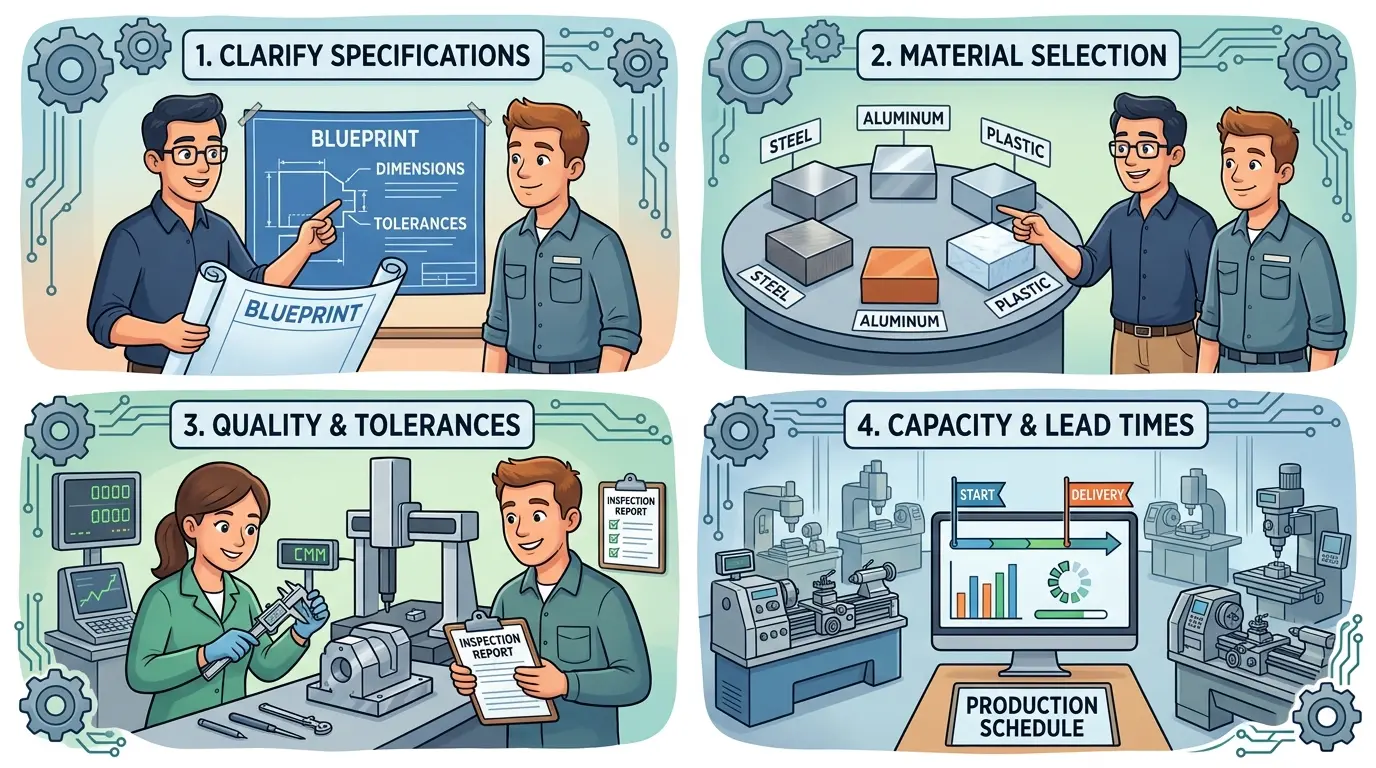
First, send a short summary that lets the shop confirm basic fit. This can include the material family, rough size range, quantity pattern, tolerance sensitivity, finish expectations, and whether outside processing or special inspection matters. The goal at this stage is not a price. The goal is to find out whether the supplier is genuinely aligned before you release the full package.
Second, once the fit screen is positive, send the formal RFQ with the current revision, model if required, material specification, notes, finish callouts, quantity, urgency, and any traceability or reporting expectations. This two-step approach is useful with local shops because convenience often encourages informal behavior. Accessibility should make qualification faster. It should not replace qualification.
If The Shop Is Nearby, Can You Be More Informal?
No. In fact, nearby suppliers often need more discipline, not less, because both sides are tempted to fill gaps later through phone calls, quick visits, and verbal clarification. That feels efficient at first. It often becomes expensive when the quote, the release package, and the shop-floor interpretation stop matching one another.
A local shop does not need less information because it is ten minutes away. It needs the same commercial clarity as any other supplier. If the buyer assumes missing details can be explained later, then pricing becomes soft, assumptions stay hidden, and revision control gets weaker. That is exactly the kind of looseness that later becomes delivery drift, scope argument, or mixed-revision exposure.
So before sending the drawing, make sure the package is complete. A strong local relationship should accelerate a well-formed RFQ. It should never depend on proximity to rescue a weak one.
What Should You Ask About First-Article Review?
For many buyers, first-article learning is the best real reason to go local. If you can review a first article in person, a day of email traffic can become a one-hour meeting with the part on the table. A minor datum concern, surface issue, or assembly-fit question can be resolved quickly when engineers, buyers, and the supplier are all looking at the same evidence.
That is why you should ask how the shop handles first article before you release files. Does it have a formal approval step? What data will be returned? Can critical features be reviewed in person if needed? If a problem appears, does the shop know how to isolate the technical issue from the paperwork issue and the schedule issue?
Locality is valuable here only when it shortens a structured review process. It is not valuable if it encourages undocumented decisions. The nearby supplier that says, “Come by and we’ll sort it out,” may sound helpful, but if nothing is captured formally, that convenience can turn into later confusion.
Who Owns Revision Control When Communication Is Easy?
This is one of the most important local-sourcing questions because proximity creates a false sense of control. The buyer visits the shop. A feature is discussed beside the machine. Someone agrees to “just update” something. A phone call follows. A day later, nobody is completely sure which revision is active, which parts were run under the old assumption, and what exactly was approved.
That kind of mixed-revision risk is common in physically convenient relationships because both sides assume they are aligned. Ask the supplier how revisions are locked, how superseded documents are removed, how material already in process is identified if a change lands late, and how verbal conversations are converted into controlled releases. If those answers are weak, location becomes dangerous rather than helpful.
The rule is simple: easy communication does not reduce the need for formal revision control. It increases it.
What Happens When The Job Goes Off Normal?
Local suppliers rarely prove their value when everything is running smoothly. They prove it when something goes off normal. That is the moment when distance either matters or does not.
Ask direct response questions:
- If the first article fails or raises concern, how fast can technical review happen?
- If assembly fit is questioned, who leads the investigation and how is the result documented?
- If replacement parts are suddenly urgent, what is the actual expedite path?
- If an outside process slips, how is the revised schedule communicated?
- If a dimension trend looks unstable, what containment action happens before more parts are released?
These questions matter because a nearby shop that cannot respond clearly under abnormal conditions is not giving you much real local value. Geography helps only when it changes the speed and quality of the response.
What Should A Useful Local Site Visit Look Like?
One of the biggest advantages of local sourcing is that site visits are realistic. That advantage is wasted if the visit becomes a tour of machine models and a friendly conversation with no operational insight. The useful visit follows one order through the system.
Watch how work is identified. Ask how revisions are released to the floor. See where incoming material waits, how first-article approval is handled, how nonconforming parts are separated, and what happens between inspection and shipment. If outside processing exists, ask how that handoff is tracked. The point is not to judge whether the shop is polished. It is to judge whether the route looks controlled in ordinary work.
This kind of visit is especially important with local shops because convenience can create confidence before evidence exists. If the walk-through raises more questions than reassurance, proximity has still done you a favor. It helped you learn that truth sooner.
How Should You Weigh Local Versus Better Process Fit?
Many buyers make the mistake of treating location as an unopposed benefit. A better way is to weigh it against a defined alternative. A nearby supplier may save time on visits and response. A remote supplier may still be the better award if its process fit, quality control, material experience, or schedule discipline is clearly stronger.
So compare location against specific outcomes, not against nothing. Does local access improve first-article learning? Does it reduce freight damage risk? Does it make containment meaningfully faster? Does it support repeat releases with fewer delays? If yes, geography has earned weight. If no, it should not override technical and operational evidence.
This is especially important under time pressure. Urgent jobs make local shops feel safer because the buyer can picture driving there if something goes wrong. Sometimes that instinct is correct. Sometimes it becomes a shortcut that protects the wrong supplier from harder scrutiny.
Locality should help a strong supplier win. It should never excuse a weak one.
Which Questions Expose Whether The Shop Is Nearby Operationally, Not Just Geographically?
A strong local supplier becomes easier to work with over time. That is the real payoff. The question is not whether the building is nearby. The question is whether the working relationship becomes nearby in operational terms.
That means repeat releases get smoother. Clarifications get shorter. Containment moves earlier. Urgent replacements are easier to coordinate. Physical review is used for improvement instead of firefighting. If the relationship stays noisy after the first few jobs, the local advantage is not compounding.
Here are the questions that help expose that difference:
- On the second and third order, what should become easier?
- What information will you already have from the first release, and what will still need to be reconfirmed?
- If we need a visit, what is the best reason for one: launch support, process review, or crisis containment?
- How do you prevent repeat jobs from feeling like new jobs each time?
Those answers say more about the real value of “near me” than the map result does.
When “Near Me” Keeps Appearing In Search, What Bigger Problem Might It Reveal?
Sometimes repeated local searching is a symptom of a deeper sourcing issue. The company keeps trying to reduce emergency freight, shorten replacement response, or recover from poor supplier communication. In that case, the problem may not actually be distance. It may be weak supplier discipline, weak qualification, or a structural mismatch between what the business needs and what its current vendor model can support.
If that pattern keeps returning, it may help to step back and review what to verify before committing to factory-direct machinery rather than solving the same problem one rushed RFQ at a time. And if the discussion broadens beyond vendor choice into a longer-term capacity review, the broader Pandaxis machinery lineup is a useful category map for thinking about in-house options with more structure.
That does not mean the answer is always internal capacity. It means “local” should not become a substitute for diagnosing the real sourcing pain.
Send The Drawing Only After The Answers Are Specific
Before releasing a drawing to any local shop, make sure you can answer a few things clearly: what local access is supposed to improve, whether the shop truly runs comparable work, how first-article review is handled, how revision control stays formal, and what abnormal-condition response actually looks like. If those answers are specific and the process fit is strong, local sourcing can create real commercial value. If those answers stay vague, “near me” is only a search habit.
The best local suppliers are not valuable because they are easy to drive to. They are valuable because proximity strengthens a process that was already worth trusting.