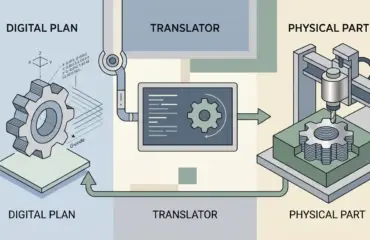
The real difference between a standard lathe and a turning center is not that one sounds newer or more impressive. The real difference is that one usually supports a simpler turning route, while the other is chosen when the shop wants to keep more of the part inside one controlled machine environment. That matters because many capital mistakes happen when buyers compare machine capability without comparing how parts actually move through the factory.
If the part family is mostly straight turning, a standard lathe can remain the sensible answer for a long time. If the route keeps losing time, labor, or alignment every time the part leaves the first setup, a turning center starts to matter because it can reduce fragmentation. Integrated operations pay when they remove repeated friction from the route, not simply because the specification sheet offers more functions.
| Route Question | When A Standard Lathe Still Fits | When A Turning Center Starts To Pay |
|---|---|---|
| Is the part mostly rotational? | Yes, with limited secondary work | No, several linked operations affect the finished part |
| Are transfers cheap and controlled? | Usually yes | No, queue time and re-clamping consume labor |
| Do feature relationships survive handoffs easily? | Usually | Not reliably, every transfer adds alignment risk |
| Is the same route pain repeating often enough to justify integration? | Not necessarily | Usually yes |
| Is the shop ready to program and support broader capability? | Less critical | Essential |
Count The Current Setups Before You Compare Machines
One of the clearest buying tools is setup count. How many times does the average part need to be touched, moved, re-clamped, or re-established before it is complete enough to ship or move safely to the next stage? If the answer is more than the route should reasonably require, then the shop may not have a cutting problem at all. It may have a handoff problem.
This is where many comparisons become distorted. Buyers look at spindle power, axis travel, live tooling options, and control features before they map the actual route. Meanwhile the real cost may be sitting outside the machine: parts waiting in queues, operators carrying them between cells, datums being recovered, intermediate inspection being performed because the next step cannot proceed confidently without rechecking the part. Those are machine costs too, even though they appear in labor and scheduling rather than in the brochure.
A Standard Lathe Still Wins When The Route Is Honestly Simple
For shafts, bushings, sleeves, spacers, threaded collars, and other mostly rotational parts, a standard lathe can remain the right production backbone. If the work is straightforward, if the critical features are largely coaxial, if secondary operations are limited, and if the downstream route is already well controlled, adding more integration may only add cost and complexity.
In that situation, the shop often gains more from disciplined setup, clean tooling control, and orderly part flow than from broader machine capability. A turning center is not automatically a productivity upgrade if the part family does not actually suffer from transfers. The better decision is the one that fits the route the shop runs every day, not the machine that looks more advanced in isolation.
A Turning Center Starts Paying When Handoffs Become The Bottleneck
Turning centers become attractive when the real pain is no longer the cut itself but the route around it. A part may leave the first turning setup for cross drilling, flats, milled features, second-end work, or related secondary operations. Each move can add queue time, labor, alignment recovery, inspection pause, and another chance to damage feature relationships. If that friction repeats every day, integrated capability starts to create real commercial value.
The point is not that more operations in one machine are always better. The point is that fewer transfers can reduce labor, queue time, and variation when the part family is already paying for those transfers repeatedly. The machine earns its place when it removes recurring route loss, not when it merely offers a bigger list of possible functions.
Feature Relationships Often Tip The Decision More Than Cycle Time
Some parts do not just require several operations. They require those operations to remain in tight relationship with one another. Turned diameters, drilled holes, milled flats, face features, or off-center details may all need to stay aligned relative to a datum that becomes harder to protect each time the part is moved. In these cases, the true risk is not only added labor. It is loss of relationship between features that each looked fine separately.
When scrap, rework, or repeated inspection keeps appearing because alignment has to be recovered after every transfer, integrated processing starts to matter for quality as much as for throughput. A turning center may not cut one single diameter faster than a standard lathe, but it can still create better economics by keeping critical relationships inside one controlled environment longer.
Queue Time And Labor Are Part Of The Machine Decision
Machine comparisons often ignore the time between machines. Yet in many shops, that hidden time is exactly where the margin disappears. A part waits by the lathe. Then it waits by the mill. Then it waits for inspection because the next operation depends on confidence in the prior setup. Each wait may look small. Across hundreds or thousands of parts, it becomes a serious cost.
That is why route planning should include physical movement and queue logic, not just spindle time. A turning center starts to make sense when it removes those repeated noncutting losses. If the shop’s real waste comes from transport, scheduling friction, and re-establishing the part rather than from the turning cut itself, then the more integrated machine may be the cheaper route even when its hourly rate looks higher.
Integrated Capability Only Pays If The Workload Repeats The Same Pain
Not every shop gains the same value from integration. A small job shop making varied one-off work may not benefit from the same machine architecture that suits a plant repeating similar complex parts every day. A factory with spare downstream capacity may tolerate transfers that would be expensive in a tighter plant. A low-volume environment may accept several handoffs if the total burden stays manageable.
That is why buyers need to separate occasional complexity from repeating complexity. If the hard part family is rare, the turning center may become an expensive solution to a problem the shop does not face often enough. If the same multi-operation route pain keeps returning, the investment case becomes much stronger. Repetition is what turns integration from a technical luxury into a process improvement.
Standard Lathes Still Matter Even In Sophisticated Shops
It is easy to talk about turning centers as if they eventually replace standard lathes everywhere. In practice, many capable factories still need straightforward turning capacity for parts that do not require integrated handling. A standard lathe can remain faster to schedule, simpler to support, and more economical for dedicated rotational work where the route is already clean.
This matters because buyers sometimes overgeneralize from the most complicated parts in the portfolio. The better question is not whether turning centers are better in general. The better question is which percentage of the workload genuinely benefits from keeping more work inside one machine and which percentage is still best handled through a simpler turning route.
Complexity Has To Earn Its Place Operationally
Turning centers bring broader capability, but they also bring broader obligations. Programming strategy becomes more demanding. Tooling management becomes more complex. Setup discipline matters more. The organization has to be ready to use the integrated machine as an integrated process, not merely as an expensive lathe with underused options.
If the shop lacks the programming support, tooling discipline, or routing logic to exploit that capability, the turning center can become a capital-heavy machine that rarely operates to its true advantage. That is why readiness matters. The investment should be tied not only to part complexity but also to whether the organization can convert added capability into cleaner daily production.
The Part Family Should Decide, Not The Hardest One-Off Sample
Buyers often get pulled toward broader capability because of one difficult part that looks persuasive during the capital review. That can be useful if the difficult part represents the actual future of the business. It can also be misleading if the rest of the workload is still mostly simple turning. A machine should not be selected around a dramatic edge case unless that edge case describes where the plant is headed consistently.
The safer way to compare is to group the real workload. Which parts are straight turning? Which parts repeatedly require secondary operations? Which ones lose the most time to transfer and re-clamping? Which ones create the most inspection pause because feature relationships are hard to protect? The answers usually make the lathe-versus-turning-center decision much clearer than any isolated sample part can.
Part Examples Often Make The Difference Obvious
A family of basic bushings, threaded sleeves, and simple shafts often fits well on standard lathes because the functional geometry is mostly coaxial and downstream work is minimal. A family of parts that combines turning with repeated cross features, flats, second-end work, and relationship-sensitive dimensions often pushes the shop toward a turning center because the cost of several handoffs becomes harder to defend.
This is also where turned-part design matters. If the part has been designed in a way that keeps more critical geometry inside the turning route, a standard lathe may remain viable longer. If the design naturally creates a hybrid route with several linked operations, the case for integrated handling becomes stronger. Buyers who want to improve this decision earlier in the process should connect it to how turned-part design can either protect or complicate the route, because machine choice and part design often amplify each other.
Read Vendor Claims Against The Current Route, Not Against Theory
A turning center vendor will usually highlight capability. A standard lathe vendor will usually highlight simplicity, reliability, or value. Both are normal positions. The buyer’s job is to translate those claims back into route economics. Which transfers disappear? Which inspection points disappear? Which feature relationships become easier to hold? Which part families will still go elsewhere anyway? Which programming and tooling burdens will increase?
That is why quotes should be read operationally, not only technically. If the turning center offer does not explain which repeated losses it removes, the comparison is incomplete. If the standard lathe offer ignores how much the plant is already paying between machines, that comparison is incomplete too. It helps to apply the same discipline used when buyers compare equipment quotes without losing sight of the real production burden.
The Better Machine Is The One That Removes Repeated Friction
A standard lathe usually remains the smarter choice when the work is mostly turning, the route is already controlled, and the shop does not lose much between operations. A turning center becomes the stronger choice when setup transfers, queue time, and feature-alignment risk keep consuming labor and margin. Integrated operations matter when they remove recurring route friction, not simply because the machine can do more in theory.
For readers using Pandaxis content to sharpen industrial buying logic, that is the practical takeaway. Count the setups, follow the handoffs, and price the waiting time as seriously as the cutting time. Once the real route is visible, the right machine is usually easier to see.