
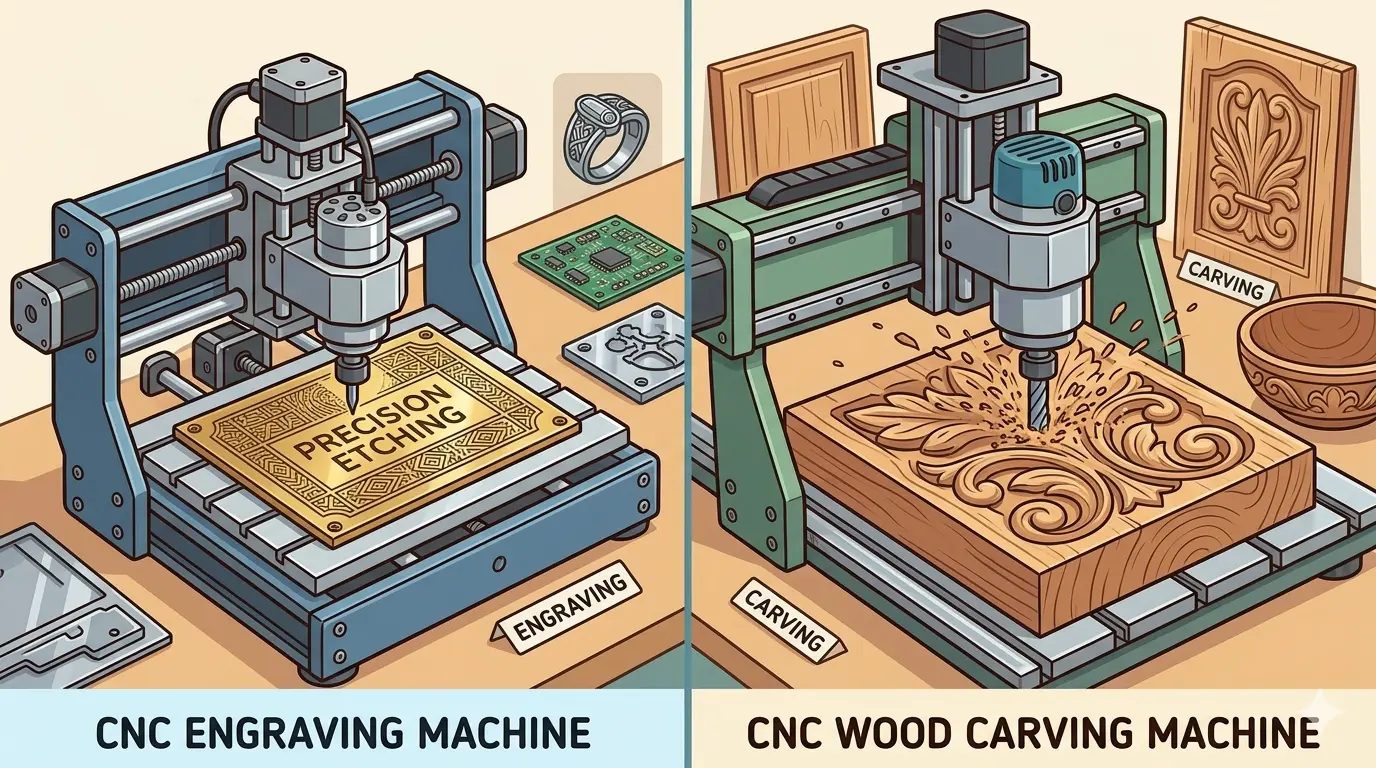
Buyers often compare wood carving machines and CNC engraving machines because both seem to promise decorative, customized, or higher-value woodworking output. In practice, they are usually purchased for different reasons. A carving machine is selected when the work depends on depth, relief, contour, panel texture, sculpted surfaces, or shaped decorative routing. An engraving machine is selected when the work depends on line clarity, shallow detail, text, logos, surface ornament, and fine marks that do not require substantial material removal.
That distinction sounds simple, but it gets blurred quickly in the market. Some shops use the word “engraving” loosely for any decorative cut. Others use it specifically for shallow detail work. Buyers then add another layer of confusion by comparing routed engraving with laser-based decorative marking in suitable non-metallic applications. The result is that many purchasing discussions are not really about two versions of the same machine. They are about two different finished effects and two different business models.
The strongest buying question is therefore not which machine sounds more advanced. It is what the shop is actually selling most often. If the finished product needs visible depth and shape, carving should lead the decision. If the finished product needs crisp detail at or near the surface, engraving should lead. If the business needs both, the choice depends on which kind of output dominates revenue and which one can be added without turning the machine into an expensive compromise.
| Shop Need | Better-Fit Machine Logic | Why It Fits |
|---|---|---|
| Relief carving, sculpted door panels, dimensional signage | Wood carving machine | The value comes from depth, contour, and visible three-dimensional form |
| Fine text, logos, line work, shallow decorative marking | Engraving machine | The value comes from detail clarity, not from heavy material removal |
| Decorative routing plus broader woodworking production | Carving-capable routing platform | The machine can support shaped output and other routed work |
| Fine non-metallic decorative work where depth is limited | Engraving workflow, sometimes including laser options | Surface detail matters more than routed volume removal |
The Real Divider Is Depth, Not The Sales Label
The quickest route to a bad purchase is choosing by category name alone. “Carving” sounds expressive. “Engraving” sounds precise. Neither word is useful until the buyer defines the finished effect the customer is paying for. Does the work need relief depth that changes how light falls on the panel? Does the product rely on sculpted transitions or layered contours? Or is the real goal clean lettering, fine decorative outlines, and shallow surface detail that reads clearly without much stock removal?
That one distinction changes nearly everything else. Tooling changes. Cycle time changes. Dust load changes. Surface preparation changes. Finishing labor changes. A shop producing carved cabinet doors or dimensional wood signs should not buy with the same logic as a shop mainly creating branded plaques, product labels, logo panels, or fine ornamental detailing.
Once the shop defines the visual result honestly, the comparison becomes easier. Carving is about shape and depth. Engraving is about detail and surface definition. Many mixed-use machines can touch both, but one of those priorities usually dominates the job mix.
Carving Machines Are Bought For Shape-Making, Not Just Decoration
Wood carving machines earn their value when the work depends on visible three-dimensional effect. Relief panels, textured decorative surfaces, shaped furniture details, ornate cabinet components, dimensional signs, and routed contours all belong to this family. The machine is not simply adding lines. It is removing enough material to create a form.
That makes carving a more substantial routing problem than many new buyers first assume. The platform needs to support stable motion over longer toolpaths and deeper or layered cuts. Hold-down, chip evacuation, cutter selection, and path quality matter because the finished effect is visually unforgiving. If the route is unstable, the defects show up in surface transitions, uneven depth, ragged edges, or extra finishing work.
Carving also connects more naturally with broader woodworking workflows than some buyers expect. A carving-capable router is often still a router first. Depending on the shop model, it may also support shaping, profiling, pocketing, panel work, and selected production tasks beyond decoration. That makes carving equipment particularly interesting to workshops that do not want a decorative-only asset sitting idle outside premium jobs.
Engraving Machines Are Bought For Precision Surface Language
Engraving machines become the stronger fit when the job is mainly about clean surface-level information or fine decorative detail. Text, logos, line art, shallow ornament, identification marks, branding panels, and delicate visual work usually fit engraving logic better than carving logic. The machine’s job is to preserve small features cleanly and repeat them consistently.
This does not mean engraving is always easy. Fine detail can be ruined by vibration, poor tooling, dust contamination, weak surface preparation, or overly aggressive settings. But the production goal is still different from carving. The machine is being asked to create clarity, not sculpted mass removal.
That difference matters economically. Shops that buy heavy carving-oriented solutions for mostly fine engraving often end up paying for depth capacity they rarely use while still not optimizing the route for small-feature precision. A machine can be capable of both in theory and still be poorly matched to the work that dominates real orders.
The Product You Ship Should Matter More Than The Words You Use In Marketing
Many workshops describe themselves in language that does not reflect their real order book. A shop may advertise carving because it sounds premium, even though most of its income comes from shallow branded panels or surface details. Another shop may say it does engraving, but most weekly output is actually relief routing on decorative panels, dimensional sign faces, or textured furniture parts. That mismatch between language and work is a common source of poor equipment decisions.
The better method is to look at recent production history. What jobs recur most often? How deep are the cuts? How often do customers pay for visible relief rather than for crisp surface marks? Which jobs consume the most machine hours? Which jobs generate the most finishing labor? These questions usually reveal whether the business is really a carving business, an engraving business, or a mixed shop that needs a more versatile routing decision.
Order history is more reliable than aspiration. Buy around the work that keeps the shop alive, not only around the work that looks most exciting in photos.
Material Choice Changes The Carving-And-Engraving Decision Fast
The substrate matters almost as much as the visual effect. MDF, plywood, veneered panels, laminated board, solid hardwood, softwood, and composite decorative materials do not behave the same way under fine detail or deeper routing. Some materials support clean shallow engraving but become messy or labor-intensive under deeper carving. Others accept heavier routed detail well but do not preserve very fine decorative marks as cleanly as buyers expect.
This is why a machine should not be chosen without reviewing the material mix. Shops processing decorative MDF doors and routed furniture panels often need a different balance from shops marking hardwood plaques or branding elements on flatter, simpler surfaces. Material behavior changes the real cost of both carving and engraving because it affects finish quality, tool life, dust load, and post-process cleanup.
If the business is heavily panel-based, the decision may also overlap with broader routing and sheet-processing questions. Some workshops that begin by comparing decorative machines eventually realize the real purchase is a more versatile production router or even a CNC nesting machine because the decorative work sits inside a larger cabinetry or panel-furniture flow.
Throughput Depends On Whether You Are Selling Depth Or Detail
Carving and engraving consume machine time differently. Carving often requires layered passes, longer routed travel, more stock removal, more chips, and more finishing attention after the cut. Engraving can also be time-intensive when detail is very fine, but it usually depends less on bulk removal and more on preserving feature clarity. That means throughput should be judged in relation to the product being sold, not in vague terms such as “faster spindle” or “more advanced machine.”
If the shop’s profit comes from relief carving, dimensional signs, or sculpted decorative panels, then longer cycle times may be economically acceptable because the finished product carries higher apparent value. If the shop’s profit comes from crisp logos, repeated nameplates, or shallow decorative branding, then the machine should be judged by how efficiently it can preserve detail without overbuilding the route around depth it does not need.
This is why buyers should compare job families, not only machine classes. The right machine is the one whose cycle profile matches the work customers repeatedly buy.
Tooling, Dust, And Surface Finish Become Different Management Problems
Carving creates more aggressive material movement, which makes dust extraction, chip clearance, workholding, and tool strategy especially important. If dust builds up, detail breaks down. If hold-down is weak, depth consistency drifts. If the cutter geometry is not matched to the profile, finishing labor rises quickly. Carving quality is therefore partly a machine question and partly a process-discipline question.
Engraving has a different risk pattern. Fine lines can blur if the tool is dull, the surface is unstable, or vibration enters the route. Problems that barely matter on heavier routing may show clearly on delicate detail work. That means the shop should not assume engraving is simply “lighter carving.” It is its own process with its own stability demands.
The most useful buying insight is often hidden in finishing labor. If your team spends too much time cleaning up rough depth transitions, profiling errors, or inconsistent relief, carving capability and process support likely matter more. If the team struggles to keep small text and fine lines clean and repeatable, engraving stability matters more.
Laser Enters The Conversation Only For Certain Engraving Jobs
Some buyers also compare routed engraving with laser cutters and engravers. That comparison can be useful, but only when the job is truly about fine surface-level non-metallic detail and not about sculpted depth. Laser processing is not a substitute for wood carving. It is a different answer for a different result.
This is where many equipment conversations drift off course. If the product needs visible relief, contouring, or meaningful material removal, laser should not be standing in for carving. If the job is mainly branding, fine text, ornament, or crisp decorative marking on suitable non-metallic substrates, then the engraving conversation may reasonably include laser.
The practical rule is simple: if the finished effect depends on depth, stay in the carving discussion. If the finished effect depends on fine surface detail, engraving may include more than one process option.
Many Shops Actually Need A Versatile Router More Than A Pure Decorative Machine
There is a middle ground that buyers should not ignore. Some shops do not need a dedicated carving machine or a dedicated engraving machine as separate investments. They need a versatile routing platform that can perform decorative work while still supporting broader woodworking output. This is common in growing cabinet, furniture, sign, and interior-fit-out businesses where decorative work is profitable but not the whole business.
In those cases, the right purchase may be a machine that handles carving well enough while still supporting profiling, cutouts, pockets, grooves, and other production tasks. The point is not to maximize the most decorative possible result on rare jobs. It is to create a tool that earns its place every week across different order types.
This is one reason some buyers eventually zoom out and compare the decorative question to the broader Pandaxis machinery lineup instead of forcing a narrow decision too early. Decorative output can be part of a wider production strategy, not just a specialty corner of it.
Three Buying Questions Usually Reveal The Right Direction
Before choosing between carving and engraving, buyers should answer three direct questions. First, does the product need real depth or mostly surface detail? Second, does the business earn more from decorative artistry or from production woodworking with some decorative content added? Third, which materials dominate the weekly job mix?
If the answer points toward relief, contour, and visible shape, carving should lead. If the answer points toward fine lines, logos, and shallow detail, engraving should lead. If the answer is mixed, the shop should evaluate whether a versatile routing platform is the better core investment.
Those three questions sound basic, but they usually outperform long lists of features because they tie the purchase back to revenue and workflow.
When It Makes Sense To Separate Carving And Engraving Into Different Stations
Some shops start by hoping one machine will handle every decorative request. That can work at small scale, but it becomes harder as order volume rises and the work separates into two distinct product families. If one group of jobs depends on deeper routed relief and another depends on high-volume fine-detail marking, the process demands begin to pull the machine in two directions. Tooling changes become more frequent. Scheduling becomes more awkward. One style of work waits while the other occupies the platform.
That is often the point where buyers should stop asking whether one machine can technically do both and start asking whether one machine should do both. If decorative relief is becoming a stable premium product line and engraved detail is becoming a repeated commercial offering of its own, separating the stations may improve scheduling, reduce compromise in tooling choices, and make pricing more honest because each route is evaluated on its own production logic.
The key is not to split too early. It is to recognize when mixed decorative demand has become large enough that one compromise platform is now slowing both sides of the business.
Buy For The Effect Customers Pay For Most Often
A wood carving machine is usually the stronger choice when the finished product depends on depth, contour, and substantial decorative routing. A CNC engraving machine is usually the stronger choice when the finished product depends on fine text, logos, and shallow detail that reads clearly without heavy stock removal. The machine decision should follow the effect customers are paying for, not whichever category sounds more sophisticated on paper.
That means buyers should start with real job history, real substrates, and real finishing pain. If the business lives on dimensional decorative work, buy around carving. If it lives on fine surface language, buy around engraving. If it genuinely needs both, buy the platform that serves the dominant revenue stream without turning every secondary task into an awkward compromise.