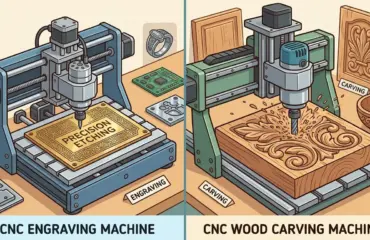
DIY CNC projects attract people for good reasons. Building a machine yourself can reduce apparent upfront cost, deepen your understanding of motion systems, give you control over layout choices, and create a platform tailored to a specific kind of work. For learners, experimenters, and hands-on builders, the process itself has real value. But there is a major difference between building a CNC machine as a project and building one because it is supposedly the best path to dependable production. Confusing those two goals is where many DIY CNC decisions go wrong.
Some subsystems are very reasonable to build yourself. Others are not worth improvising once repeatability, uptime, safety, and delivery discipline start to matter. A business that needs reliable output should not use the same decision logic as a builder who mainly wants to learn controls, motion integration, and machine design. The smarter question is therefore not “should I build or buy?” in one broad sense. It is “which parts of the system are smart to build for my goal, and which parts are smarter to buy ready-made?”
That framing keeps the decision practical. DIY is strongest where learning, customization, and lower-risk experimentation matter. Ready-made equipment is strongest where machine truth, support, reliability, and repeat production matter more than the build experience. Many successful workshops use both instincts wisely: they buy the machine foundation and build the accessories, fixtures, worktables, and surrounding support systems around it.
The First Decision Is Not Technical. It Is Strategic.
Before discussing motors, rails, frames, or controllers, buyers should answer a more important question: are you building a project, or are you buying capacity? If the main goal is to learn CNC design, understand motion systems, test controller integration, or enjoy the engineering challenge, a DIY route can be excellent. The build itself is part of the return. You do not need the machine to generate dependable revenue immediately for the project to make sense.
If the main goal is dependable output, however, the logic changes completely. Now the machine is not mainly a learning tool. It is production capacity. That means geometry, reliability, safety, maintainability, and support matter far more than the satisfaction of having designed the frame yourself. Many disappointing DIY outcomes come from buying under a production justification while really following a project motivation.
The healthier choice is to state the goal clearly. Project value and production value are not the same thing, and they should not be judged with the same expectations.
DIY Is Strongest Where Failure Does Not Destroy The Value Of The Project
One simple way to understand the build-versus-buy question is to ask where imperfection is acceptable. If the machine is for learning, experimentation, occasional prototype work, or tightly defined hobby-scale output, the cost of iteration is part of the value. If one design choice needs to be reworked, or one controller choice turns out to be awkward, the user still gains knowledge and experience.
That makes DIY highly defensible in narrow or exploratory use cases. A machine built to cut foam, engrave signs, test fixture concepts, or support low-risk prototyping can justify itself even if it evolves slowly. The build does not have to impersonate industrial equipment. It only needs to fulfill the clearly defined project goal.
The more commercial the requirement becomes, the less forgiving that logic gets. Once downtime, accuracy drift, or recurring rework start threatening schedules and customer trust, the same flexibility that made DIY exciting can become a liability.
What Is Usually Reasonable To Build Yourself
DIY makes the most sense on elements that do not carry the full burden of machine truth. Stands, tables, enclosures, guards, dust shoes, spoilboard systems, cable organization, tool storage, accessory racks, lighting, material supports, and workflow-specific support equipment are often very reasonable areas to build yourself. These elements can save money, improve ergonomics, and tailor the machine to the shop without forcing you to reinvent the most accuracy-sensitive parts of the system.
This is often the smartest DIY zone for small shops. Buy a stable core machine, then build the surrounding environment so it actually fits your workflow. That preserves reliability where it matters most and still captures the benefits of customization and hands-on problem solving.
The same logic applies to some low-risk experimental platforms. If the machine is not expected to carry commercial deadlines, building more of the structure yourself can still be worthwhile simply because the learning return is high.
What Becomes Much Harder To Justify As DIY
The core machine becomes far harder to defend as a DIY decision once repeatability and uptime matter. Motion accuracy, structural stiffness, spindle integration, electrical safety, controller stability, cable management under repeated use, limit logic, and maintainability are all harder than they first appear when the machine has to behave well every day rather than merely function occasionally.
A home-built platform may absolutely work. That is not the same as saying it is the best source of dependable production capacity. If the business plans to move into repeated routing, machining, or any form of schedule-driven output, the cost of uncertain reliability is not only repair time. It is lost schedule trust, variable results, operator hesitation, and the constant temptation to re-debug the machine instead of using it.
In those situations, buying the core machine ready-made is usually the stronger choice.
Build Accessories. Buy The Truth.
That sentence captures the most useful rule for many buyers. Accessories, workflow aids, handling systems, and ergonomics are often great DIY territory. The parts of the machine that carry positional truth, cutting stability, safety-critical behavior, and daily reliability are usually much better bought unless you already have substantial machine-building experience.
This is not an anti-DIY argument. It is a risk-allocation argument. The more a subsystem controls accuracy, uptime, or safety, the less attractive it becomes as an improvisation target. The more a subsystem controls convenience, workflow fit, or local customization, the more attractive DIY usually becomes.
Many workshops improve quickly when they stop asking “can I build it?” and start asking “should this be the part of the system where I spend my engineering time?”
DIY Is Often Best For Learning, Narrow Machines, And Controlled Use Cases
A DIY CNC machine can make excellent sense when the intended use is narrow and controlled. Educational builds, light-duty engraving, foam cutting, experimental routing, maker-scale fabrication, and project-specific prototypes can all justify home-built systems depending on the builder’s skill and tolerance for iteration.
That narrowness is actually a strength. The more clearly defined the task, the easier it is to make smart DIY choices. Trouble starts when the builder assumes that the same machine can later absorb heavier work, larger workpieces, customer-facing production, or shop-wide responsibility without much additional engineering. That path is usually more expensive and slower than it first appears.
DIY is therefore most defensible when the use case is limited, the learning is valuable, and the consequences of imperfection are acceptable.
Production Woodworking Is Usually A Buy Decision At The Core
If the goal is real woodworking output, especially panel furniture, cabinetry, repeated routing, or connected production flow, building the full CNC platform yourself is usually the weaker choice. These workflows depend on more than spindle motion. They depend on hold-down quality, alignment, dust control, repeatable tool management, serviceability, and the ability to keep the line moving on schedule.
That is why shops moving toward actual production usually do better by buying the machine foundation and reserving DIY effort for the ecosystem around it. If the workflow clearly needs industrial-style panel processing, then a ready-made route such as CNC nesting machines belongs in the conversation much earlier than many DIY builders initially want to admit.
This is not a criticism of DIY skill. It is recognition that production woodworking rewards dependable machine systems more than personalized experimentation at the platform core.
Hidden Costs Are Why DIY Is So Often Mispriced
DIY enthusiasts often compare component cost to finished-machine price and stop there. That is too narrow. The real cost includes design time, sourcing mistakes, shipping delays, compatibility surprises, debugging, replacement parts, rework, safety upgrades, and the opportunity cost of not producing useful work while the machine is still being refined.
If the machine is meant for business, lost production time belongs in the math as well. A “cheaper” build that absorbs months of instability can be far more expensive than a ready-made machine that starts producing quickly.
This does not mean DIY is never economical. It means the economics only make sense when learning, experimentation, and customization are intentionally part of the return. If the builder enjoys the process and values the knowledge gained, those hours are not automatically waste. If the business urgently needs stable cutting capacity, those same hours can be extremely expensive.
Reliability And Safety Should End The Debate In Some Cases
There are situations where the build-versus-buy debate should stop very quickly. If the machine will be used commercially with deadlines, by multiple operators, near customers or staff, or in ways that create meaningful electrical, motion, or dust risk, then safety and reliability deserve much more weight. A machine that works “most of the time” or “with careful handling” is not an acceptable substitute for a stable production asset in those environments.
This is why many experienced shops draw a clear line. They are happy to build carts, stands, fixtures, enclosures, storage, and workflow aids. They are much less eager to make the entire machine the experimental object once other people or real delivery commitments depend on it. That is a mature distinction, not a lack of ambition.
A Hybrid Strategy Is Usually Smarter Than A Pure Ideological One
The strongest answer for many workshops is not purely DIY or purely purchased. It is hybrid. Buy the machine base or major motion system that carries the truth and risk. Build the surrounding environment that makes the machine actually fit the shop. That may include the stand, dust-management routing, hold-down accessories, storage, lighting, workflow tables, fixtures, and other process-specific aids.
This approach captures a large share of DIY value without forcing the shop to reinvent the most failure-sensitive parts of the system. It also scales better. The purchased core can support more serious work later, while the surrounding DIY pieces remain easy to refine as the workflow grows.
For many buyers, especially those who like building but also need results, this hybrid route is the most balanced answer available.
Buying Ready-Made Can Still Be The More Customizable Decision In Practice
This sounds counterintuitive, but it is often true. A ready-made machine that works consistently gives you a far better base for customizing the rest of the workflow than a fully DIY machine that is still unstable at the foundation. When the core is dependable, you can build fixtures, stands, material supports, enclosures, loading aids, and other supporting systems around a stable reference.
When the core is still evolving, every surrounding customization is built on uncertainty. That tends to slow everything down. So buyers should not assume that a fully DIY route automatically gives more practical control. Sometimes the most adaptable setup is a reliable purchased core paired with highly customized surroundings.
Questions That Usually Clarify The Right Route Quickly
Before deciding, ask a few blunt questions. Is the machine primarily a learning project or a business tool? How much downtime can you tolerate? Do you enjoy debugging mechanical and electrical systems enough for that work to count as value? Are you building because you want the experience, or because you believe it is the cheapest path to production? What happens if the machine is six months later to stability than you expect?
If those answers point toward learning, controlled experimentation, and narrow use, more DIY usually makes sense. If they point toward revenue, deadlines, multiple users, and repeat output, buying ready-made becomes much easier to defend.
Build What Expresses Your Workflow. Buy What Carries Your Production Risk.
Build it yourself when the value lies in learning, customization, controlled experimentation, and lower-risk support systems around the machine. Buy it ready-made when the value lies in dependable accuracy, uptime, safety, and repeat production. The mistake is treating those two goals as if they lead to the same decision.
For many serious users, the smartest route is hybrid: buy the core CNC machine and build the accessories, stands, enclosures, fixtures, and workflow-specific add-ons around it. That preserves the most important parts of reliability while still giving you room to tailor the setup to your needs. In CNC, as in most manufacturing decisions, the best choice is the one that matches the real burden the system must carry.