
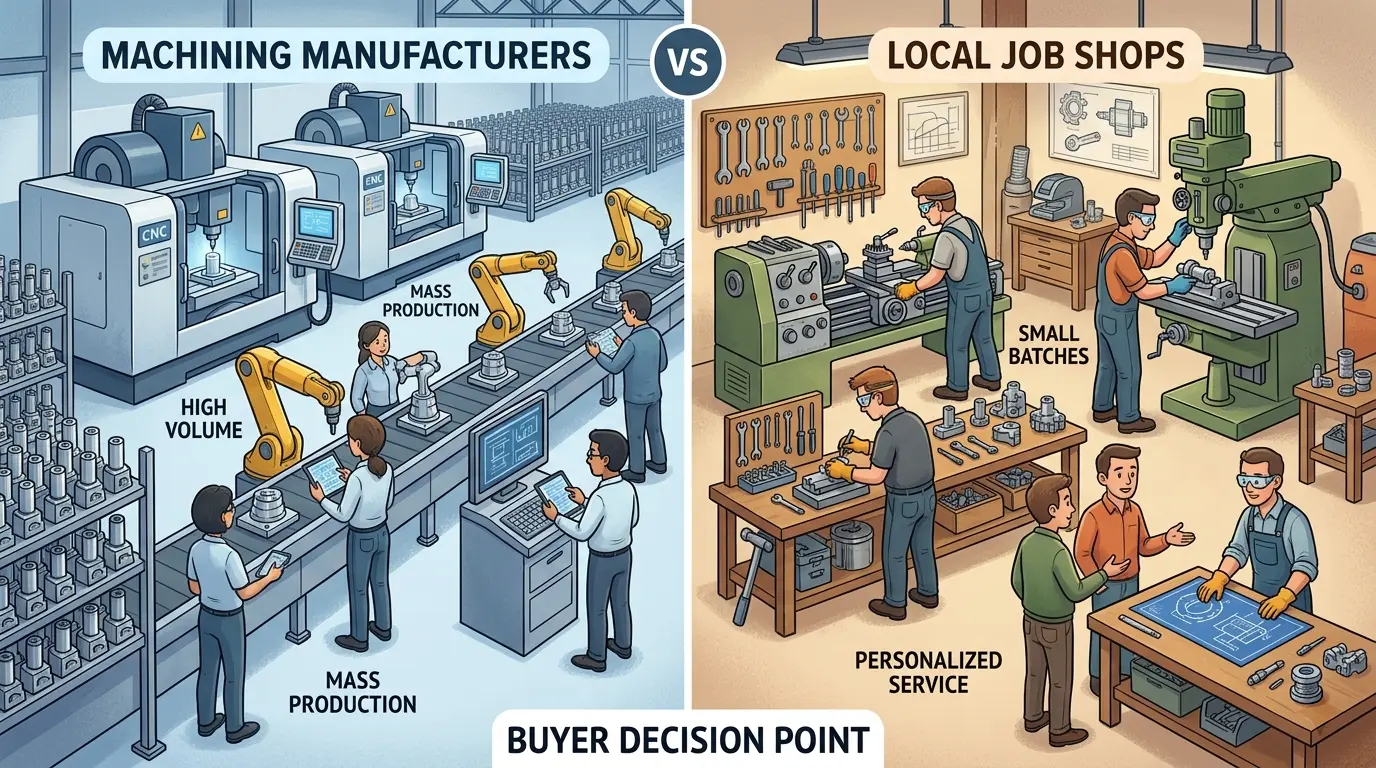
The words manufacturer and job shop often create more confusion than clarity. Buyers hear manufacturer and assume stronger systems, deeper capacity, and better quality. They hear local job shop and assume smaller scale, more flexibility, or quicker response. Sometimes those assumptions are correct. Often they are not. These are not rankings. They are operating models.
A manufacturer may run machining mainly to support its own product families, with strong process ownership and weaker appetite for unrelated custom work. A local job shop may handle mixed contract machining exceptionally well because flexibility is its core business. The right choice depends on the part family, the business risk, the communication style, and whether the buyer needs adaptability, repeat discipline, engineering feedback, or integrated supply accountability. Once that is understood, the label matters much less than the fit.
Start With The Job, Not With The Supplier Label
The most useful filter is not “Which type is better?” It is “What kind of problem am I actually trying to solve?” Buyers sometimes begin by comparing supplier image rather than workload reality. That leads to lazy assumptions. A larger or more formal supplier may still be wrong for a fast-changing low-volume program. A smaller local shop may still be wrong for a tightly governed repeat family with long-term documentation demands.
The decision becomes clearer when the buyer defines the program first. Is the work prototype-heavy or repeat-heavy? Does it change often? Does it require engineering feedback during launch? Does it need strong traceability, stable scheduling, or close physical access? Is the main risk slow adaptation or repeat inconsistency?
Once those questions are answered, the operating model begins to matter in a practical way rather than as a prestige debate.
What A Manufacturer-Style Source Usually Brings
When machining is part of a manufacturer’s broader product or systems operation, the process often benefits from stronger repeat discipline on known work. Fixtures, tooling strategies, documentation rules, and quality checks may be built around recurring families of parts. That can create a stable environment for repeat volume and consistent process ownership.
This model is often strongest when the buyer’s needs resemble the supplier’s natural operating rhythm. If the parts look like the kind of work the manufacturer already understands deeply, the fit can be excellent. Documentation may be stronger. Escalation paths may be clearer. Process control may already be tuned to predictable demand.
The risk appears when buyers assume that this structure automatically makes the supplier ideal for unrelated part families, one-off development work, or rapidly changing prints. A manufacturer may be highly capable and still be slow or uncomfortable outside its core flow.
What A Local Job Shop Usually Brings
Local job shops often win on flexibility, responsiveness, and tolerance for varied work. Mixed lots, prototype runs, small batches, urgent revisions, and direct conversations about changes are often more natural in this environment because adapting to diverse work is part of the business model.
That flexibility can be extremely valuable when the part definition is still evolving, when lot sizes are modest, or when the buyer needs more direct communication with the people actually making the parts. Local proximity can also reduce friction around visits, issue review, and schedule discussion.
The tradeoff is that not every job shop has the same depth in traceability, broader supply-chain coordination, documentation control, or heavily audited systems. Some do. Some do not. That is why the operating model should guide the questions rather than replace them.
Match The Supplier Model To The Dominant Risk In The Program
This is where the decision becomes real. If the bigger risk is slow adaptation, then a flexible job shop may be the safer source even if it looks less formal on paper. If the bigger risk is long-term repeat discipline across recurring demand, a manufacturer-style source may be the safer answer because the systems around the work are built for steady repetition.
This does not mean one model is universally more mature. It means each model is vulnerable in different ways. Job shops can struggle when the buyer tries to push them into heavy-volume stability without enough planning structure. Manufacturers can struggle when the buyer expects fast-turn conversational engineering on work that sits outside the supplier’s normal product rhythm.
Fit is more important than prestige.
Communication Style Changes The Real Experience More Than Most Buyers Expect
Local job shops are often valued because communication can be fast and direct. That advantage is real when parts evolve quickly or when subtle decisions need rapid clarification. Manufacturer-style sources may offer more formal communication structures, which can be useful on stable programs but slower on fast-moving changes.
Neither style is automatically superior. The key is matching the supplier’s communication rhythm to the life of the part. If the work needs rapid iteration, a rigid formal channel may feel frustrating. If the work needs controlled documentation across multiple departments or sites, an informal fast-response style may feel risky.
The better supplier is often the one whose communication model fits how the part will actually live over the next year.
Engineering Support Is Often The Real Divider
Some programs need more than machining capacity. They need manufacturability review, fixture thinking, tolerance-risk feedback, or early warning that the print is likely to cause trouble. Buyers should therefore ask how engineering questions actually move inside the supplier. Is there someone who can review the print thoughtfully? Does the shop escalate issues early? Does the supplier only want stable released work, or can it help improve a changing part?
The answer often reveals whether the source is a passive executor or a useful production partner. In many buying decisions, that matters more than whether the company calls itself a manufacturer or a job shop.
Capacity Fit Is Different From Capability Fit
A supplier may look ideal on capability and still be wrong on queue behavior. Some manufacturers prioritize their own product load or long-run commercial commitments. Some job shops can pivot brilliantly on small work but struggle when buyers suddenly need scaled repeat volume. Capacity fit is therefore different from machine capability.
Buyers should ask what the supplier is naturally optimized to schedule. Do they want repeat families, fast-turn prototypes, mixed lots, or longer committed windows? How do they behave when the queue tightens? How do they protect existing programs when urgent work appears?
Lead-time disappointment is often a business-model mismatch rather than a machining failure.
Accountability Around Rework, Traceability, And Recovery Matters More Than Names
Whatever the supplier type, the buyer still needs clear answers on accountability. Who decides rework disposition? How is traceability handled? What happens when a lot is late, when material changes, or when a defect appears after assembly? How are repeat escapes prevented?
These questions matter far more than whether the supplier calls itself a manufacturer or a job shop. This is where contracts, quality plans, and RFQ discipline matter. Many expensive sourcing errors happen because buyers assumed the larger or more formal label implied stronger accountability than was actually defined.
Systems protect the program. Titles do not.
A Practical Comparison Matrix Makes The Tradeoffs Visible
| Need | Often Favors Manufacturer-Style Source | Often Favors Local Job Shop |
|---|---|---|
| Stable repeat production | Yes | Sometimes |
| Fast prototype iteration | Sometimes | Often |
| Broad traceability discipline | Often | Varies by shop |
| Mixed low-volume work | Less naturally | Often |
| Close local interaction | Sometimes | Often |
| High documentation structure | Often | Varies |
| Rapid print clarification | Sometimes | Often |
This table is not a rulebook. It is a reminder that the operating model shapes likely strengths and likely failure modes.
Local Does Not Automatically Mean Faster, And Larger Does Not Automatically Mean Safer
Many buyers assume local job shops will always be faster because they are physically closer. Sometimes they are. But local distance does not erase overloaded schedules, staffing gaps, or weak planning systems. Likewise, a manufacturer with more formal structure may still outperform a nearby shop if its planning discipline and repeat processes are stronger.
The useful lesson is to separate geography from execution. Local access is valuable, but it should be treated as one factor among several rather than as proof of responsiveness.
The opposite assumption is equally risky. Larger or more formal suppliers are not automatically safer if your part family does not fit their rhythm. A buyer can hide behind supplier image while still choosing a source that is wrong for the actual program.
Dual Sourcing Only Works When The Buyer Governs It Intentionally
When buyers split work between a manufacturer-style source and a local job shop, they often assume competition alone will protect them. In reality, dual sourcing adds its own management burden. Drawings, datums, finishing expectations, inspection logic, lot documentation, and revision control all need tighter alignment or the buyer may receive two acceptable but not interchangeable streams of parts.
Dual sourcing can be smart, but only when the buyer is prepared to govern it deliberately. Without that discipline, the second source adds noise instead of resilience.
Order Pattern Often Decides The Winner More Than Machine Capability
Buyers sometimes compare supplier types as if every order behaves the same way. In reality, the pattern of ordering often decides the best fit faster than the machine list does. A job that arrives in irregular bursts, changes frequently, and needs short conversational feedback loops may suit a strong job shop even if the technical work itself is not extreme. A program built around predictable releases, recurring documentation, and repeat scheduling may favor a manufacturer-style source because the commercial rhythm is more aligned.
This is one reason so many sourcing disappointments are misdiagnosed. The supplier may be technically capable but commercially mismatched. A source built for orderly repeat flow may feel unresponsive when the buyer keeps changing drawings late. A flexible shop may feel inconsistent when the buyer quietly expects the discipline of a locked production program without helping to create one.
That is why buyers should review their own ordering behavior honestly before choosing a source. If your purchase pattern is chaotic, the best supplier may be the one that absorbs change best. If your purchase pattern is stable, the best supplier may be the one that rewards that stability with stronger repeat systems.
Local Access Is Most Valuable When The Program Needs Fast Problem Solving, Not Just Fast Delivery
One of the real strengths of a nearby shop is not merely shipping speed. It is the ability to resolve ambiguity quickly when the work still contains uncertainty. Local access matters when engineers need to stand by the machine, when fixture or handling decisions benefit from face-to-face discussion, or when the first few lots of a part family still need tight feedback between buyer and supplier.
That advantage is easy to overstate, but it is also easy to misuse. A nearby supplier should not become a dumping ground for underdefined work simply because the buyer can drive there quickly. The value of local access is highest when both sides use it to shorten learning cycles, expose risks early, and stabilize the program. Once the work is mature and repeatable, physical proximity may matter less than scheduling reliability and systems discipline.
This is why “local” should be evaluated as a problem-solving advantage, not just as a logistics label.
Visit The Workflow, Not Just The Machine List
If the job is commercially important, buyers should try to understand how the supplier actually runs work rather than only reading a capability sheet. How are jobs scheduled? How are changes communicated? How are quality issues escalated? How are urgent jobs handled without wrecking the rest of the queue?
A smaller shop with disciplined flow may be a better fit than a larger source with impressive equipment but weaker responsiveness for your part family. The best sourcing decisions come from seeing how the operating model behaves in practice, not from assuming machine count tells the whole story.
The Decision Sometimes Turns Into Make Versus Buy
At some point, buyers comparing manufacturers and job shops discover that the real question is whether some work should be brought in-house. That shift usually happens when lead times, schedule control, engineering feedback, or recurring volume make outsourcing friction more visible than machining itself.
This is where Pandaxis becomes useful as a planning bridge. If the discussion is moving from supplier selection toward broader production strategy, it helps to compare machine shops and contract manufacturers through a more explicit sourcing lens. The broader question of what buyers should expect from CNC machining services is also relevant before the supplier model debate gets too abstract. And when insourcing becomes serious, comparing CNC machinery quotes without mixing scope and the broader Pandaxis shop become more useful than another debate about supplier titles.
A Better Final Question Is Which Model Will Make The Next Twelve Months Calmer
Before awarding work, ask which supplier model will make the next twelve months calmer: the one better at repeat structure or the one better at change response. That framing usually surfaces the right answer faster than debating size, image, or label.
Choose between machining manufacturers and local job shops by matching the supplier’s operating model to your part family, communication needs, accountability requirements, engineering demands, and queue risk. A manufacturer is not automatically better. A local job shop is not automatically more agile in the ways that matter to your program.
The right supplier is the one whose strengths align with your real production problem. Everything else is naming noise.