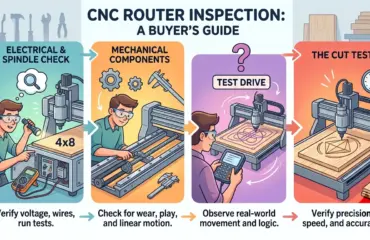
Retrofit projects appeal to builders because they seem to combine the best of both worlds: an existing machine base with the freedom to modernize controls, drives, and software on your own terms. On paper, that sounds efficient. In practice, retrofit success depends less on the excitement of the control upgrade and more on the boring details builders tend to underestimate. Mechanical wear, documentation gaps, safety integration, electrical cleanup, lubrication condition, spindle health, and alignment work often decide the outcome long before the new control ever runs its first program.
That is why the smartest retrofit question is not “Can this old mill be converted?” It is “What hidden work sits between a converted machine and a trustworthy production asset?” A knee mill, bench mill, or mini mill can absolutely become a useful CNC platform, but only if the builder understands the difference between motion and production. Making axes move is the early milestone. Making the machine stable, safe, repeatable, and supportable is the real job.
This article looks at the practical issues builders usually miss when evaluating open retrofit platforms.
Why Retrofit Projects Look So Attractive at the Start
The appeal is easy to understand. Builders see cast iron, usable travels, an existing spindle, and a lower entry price than a new CNC machine. They also like the sense of control. Open retrofit platforms promise freedom to choose motors, controls, software, and upgrade priorities without being locked into a closed supplier ecosystem.
For technically capable users, that freedom has real value. A retrofit can preserve a mechanically solid machine, extend equipment life, and create a platform tailored to a specific workflow. In toolrooms, hobby shops, schools, and some prototype environments, that can be a smart approach.
But the same freedom that makes retrofits attractive also shifts responsibility onto the builder. When the system is not integrated by one supplier, the builder becomes the integrator. That includes every weak assumption, every missing document, and every unexpected tolerance stack that only becomes visible after parts are cut.
Knee Mills, Bench Mills, and Mini Mills Are Not the Same Starting Point
One reason retrofit conversations go wrong is that buyers talk about “retrofitting a mill” as if every machine type carries the same burden. It does not.
Knee mills often appeal because they bring real mass and familiar machine-tool geometry. But age, wear, screw condition, spindle history, and manual-machine compromises matter. A robust-looking base can still hide backlash, wear patterns, or lubrication neglect that no control upgrade will solve.
Bench mills tend to sit in a middle zone. They can be attractive for prototypes, labs, and small shop environments because they are more manageable physically. But their retrofit value depends heavily on the quality of the underlying structure, not the enthusiasm of the builder.
Mini mills are popular because entry cost is lower and the scale feels approachable. The tradeoff is that the margin for mechanical weakness is smaller. Small machine limitations do not disappear just because electronics improve.
So the first rule is simple: do not evaluate the retrofit only as a control project. Evaluate the base machine as a machine first.
Mechanical Reality Comes Before Electronics
Builders often spend enormous energy selecting motors, breakout boards, or control software and not enough time asking whether the iron is worth upgrading. That is backwards.
Before any retrofit plan advances, inspect screw condition, backlash behavior, axis smoothness, way wear, lubrication history, spindle sound, and head condition. Check whether the machine can hold alignment and whether it behaves consistently after warm-up. If the base machine is mechanically unstable, better controls will only make instability easier to command.
This is also where project cost quietly grows. A builder may price the electronics and think the budget is reasonable, only to discover that the real spend sits in rebuilding screws, replacing bearings, chasing geometry, repairing lubrication faults, or correcting decades of neglect.
That is not an argument against retrofits. It is an argument against pretending the machine base is free just because you already own it or found it cheaply.
Electrical Integration Is Usually Messier Than Expected
Open retrofit discussions often focus on the satisfying parts of the project: motion control, software setup, interface design, and the moment the machine first runs under CNC command. Less attention goes to the electrical cabinet, grounding, noise control, emergency stops, limit logic, spindle interface, and wiring discipline that make the system dependable.
This is where many retrofit builds lose time. A system can seem close to completion while still lacking clean, serviceable electrical design. Troubleshooting becomes harder, safety becomes ambiguous, and every future change becomes riskier because no one wants to revisit a cabinet that was assembled under schedule pressure.
Open retrofits need documentation just as much as proprietary systems do. If you cannot trace the wiring cleanly, back up parameters, and explain the logic to the next person who touches the machine, the retrofit remains fragile.
Safety Is Not a Side Project
Builders sometimes treat safety as something to tidy up after motion works. That is a serious mistake. Emergency stops, limit behavior, spindle stop response, guarding assumptions, homing logic, and restart behavior should be designed as part of the system, not added as decoration.
This matters even in private shops. A retrofit that behaves unpredictably under fault conditions is not finished. It does not matter how impressive the control interface looks if the machine has unclear stop behavior or inconsistent recovery after interruption.
The more open the platform, the more disciplined the builder has to be. Open architecture provides freedom, but it does not provide automatic safety completeness.
Software Freedom Comes With Process Responsibility
One reason builders prefer open platforms is software flexibility. That flexibility is valuable, especially for technically strong users who want deeper control over motion tuning, postprocessors, or interface choices.
But software freedom is not the same thing as workflow simplicity. Once you select an open stack, you own the interaction between CAD, CAM, control behavior, tool length logic, work offsets, probing strategy, and recovery methods. If anything in that chain is weak, the machine becomes difficult to trust.
This is why retrofit projects that look inexpensive in hardware terms can become expensive in engineering time. The builder is not only buying components. The builder is committing to system understanding.
Commissioning Usually Takes Longer Than The Builder’s Motivation Curve
One hidden problem in open retrofit work is that the project timeline and the builder’s enthusiasm rarely decline at the same rate. Early phases feel productive because parts arrive, brackets get made, motors mount, and wiring progresses visibly. The slower phase comes later, when homing logic, limit behavior, backlash compensation choices, spindle interface details, repeatability tests, and recovery behavior all need to be proven under actual cutting conditions.
This is where many conversions stall. The machine looks close enough to finished that the builder mentally counts it as complete, but the remaining work is the part that determines whether the machine becomes trustworthy. That is why a retrofit should never be judged by first motion or first chips. It should be judged by whether the machine can repeat setups calmly, recover from interruption, and support normal work without constant interpretation.
Serviceability Is Part Of The Retrofit, Not A Bonus Afterward
Builders often focus on getting the machine to run and only later discover that ordinary maintenance has become awkward. Cable routing blocks access. Lubrication points are hard to reach. Switches are vulnerable to chips. A cabinet opens badly or is poorly labeled. These problems rarely stop the first test cut, but they make the machine harder to live with month after month.
That matters because long-term retrofit success depends on whether the system becomes easier to own, not merely possible to command. A strong retrofit is one that the builder can inspect, clean, document, and repair without dreading the next intervention. If routine service feels improvised, the machine will never become as useful as the builder imagined when the project started.
When Open Retrofits Make Sense
Open retrofits usually make sense for technically capable owners who want a machine for prototyping, learning, custom process development, or shop use where absolute production reliability is not the first requirement. They also make sense when the builder already owns a mechanically worthy machine and understands what the project will demand.
Retrofits are often strongest when the project itself is part of the goal. Some builders genuinely want to learn the machine deeply, tune it, and accept that the system will evolve. In that context, the project creates value beyond the finished machine.
They are much weaker when the business urgently needs dependable output, quick commissioning, or clean service responsibility. In that case, the freedom of an open retrofit often becomes the very reason the project drifts.
A Retrofit Decision Table
| Situation | Retrofit often makes sense | Retrofit is risky |
|---|---|---|
| Technically strong owner building for learning and prototypes | Yes | Less risky if schedule pressure is low |
| Existing machine with good mechanical condition | Often yes | Still requires disciplined evaluation |
| Shop needing immediate dependable output | Rarely ideal | High risk if retrofit delays production |
| Buyer with limited electrical and tuning experience | Sometimes, with trusted help | Often a frustrating path |
| Business expecting factory-style uptime quickly | Usually not the best route | Risk often outweighs savings |
The question is not whether a retrofit can work. It is whether the retrofit is the most economical way to reach the operational state you need.
When It Is Smarter to Skip the Retrofit
If the machine base is questionable, the documentation is poor, and the business cannot absorb a long integration phase, skipping the retrofit may be the wiser choice. The same is true if your production plan depends on a fast, clean installation with clear support responsibility.
At that point, the buying logic shifts away from openness and toward integrated delivery. Buyers facing that decision often need to step back and compare the retrofit dream against what an actual production-ready equipment purchase is meant to deliver. Looking at the broader Pandaxis product catalog can be useful for that comparison because it shows the difference between an engineering project and a machine category designed around production outcomes.
Practical Summary
Open retrofit platforms are not a bad idea. They are simply harder, broader projects than many builders first assume. The real risks are not only motor choice or control software. They are mechanical condition, electrical discipline, safety completeness, documentation quality, and the builder’s willingness to own the integration burden for the life of the machine.
If you want learning, flexibility, and hands-on control, a retrofit can be rewarding. If you need predictable output on a clear timeline, it may be the wrong kind of freedom. The smartest builders decide that before the conversion starts, not after the machine is already half-disassembled.