
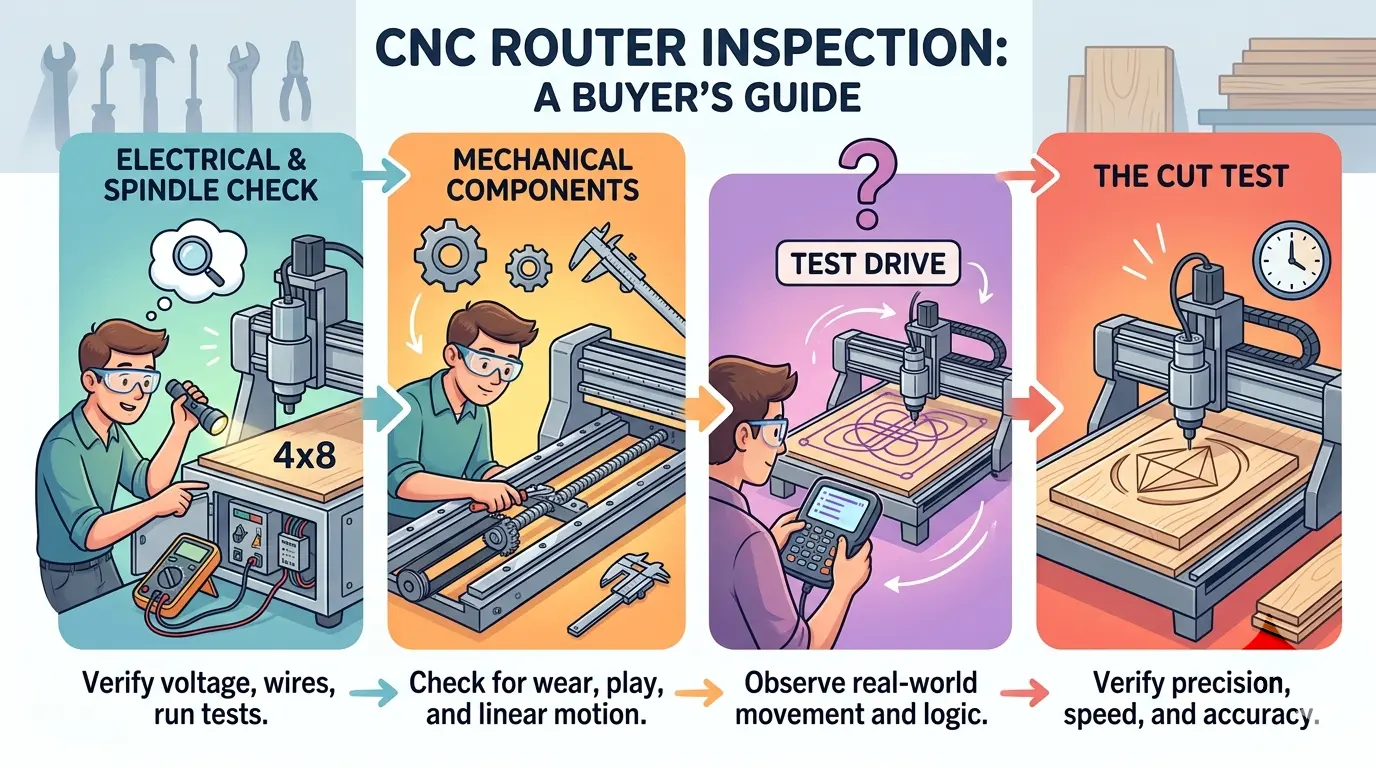
A used 4×8 CNC router can be the fastest way to add real sheet-processing capacity to a growing shop, and one of the fastest ways to inherit somebody else’s unfinished problems. The format is attractive for obvious reasons: 4×8 matches common panel sizes, fits cabinet and signage workflows, and appears on the market whenever a shop upgrades, reorganizes, or exits a product line. That combination creates urgency. Urgency is exactly what causes weak inspections.
The wrong used-router purchase often looks fine at first. The machine powers on. The seller cuts a clean sample. The frame looks freshly cleaned. The price feels low enough to make the risk manageable. Then the buyer brings it in-house and discovers that vacuum performance is weak, gantry motion is not staying square across the sheet, the controller environment is poorly documented, and recommissioning consumes the savings that justified the deal.
That is why a used 4×8 router should be inspected as a production asset, not as a hobby platform with a large table. The real question is not whether the machine runs. The real question is whether it can still hold sheets securely, move cleanly across the entire bed, cut at believable production speed, and be restarted in your own environment without becoming an open-ended project.
Start With A More Important Question: Should You Still Be Buying A General 4×8 Router?
Inspection starts before the site visit. First confirm that a general 4×8 router still fits the role your shop needs to fill. Many companies default to that format because it is familiar, not because it is still the right next step.
If your workflow is now moving toward nested cabinet production with drilling, part labeling, and downstream assembly discipline, you may be closer to a dedicated nesting decision than to a general router decision. If the shop mostly runs mixed signage, occasional panel work, custom displays, and one-off fabrication, a conventional 4×8 router may still be exactly right.
This matters because the used machine must be judged against the work it will inherit. A router that made sense in the seller’s environment may be wrong for yours even if it is mechanically healthy. If the business is already moving toward integrated panel flow, it helps to compare the used listing against the broader production logic in 4×8 routing for cabinet and furniture work before assuming that used automatically means best value.
The point is not to talk yourself out of buying. It is to avoid inspecting a machine category you should not be chasing anymore.
Ask For Operating History Before You Start Negotiating Price
Serious used-equipment buying begins with records. Ask how old the machine is, what kind of work it mainly ran, whether it worked one shift or several, what controller it uses, whether manuals and parameter backups exist, and what major repairs have already been done. Ask about spindle history, vacuum pump maintenance, lubrication practice, and whether the machine spent most of its life on wood, MDF, plastics, composites, or occasional non-ferrous material.
Also ask for a recent powered-up video and a cutting video before you travel if the machine is not local. These do not prove that the machine is healthy, but they often reveal how serious the seller is and whether the machine has been active or sitting idle. Long idle periods are not automatically disqualifying, but they change the inspection logic. Seals dry out, lubrication discipline gets interrupted, and recommissioning risk climbs.
History matters because it tells you what kind of wear pattern to expect. A machine used steadily for cabinet parts may show ordinary production wear. A machine that has been moved repeatedly, modified casually, or used inconsistently may be hiding alignment and control issues that no polished listing photo will show.
Structure First, Because Structure Is The Hardest Problem To Price Back Out
Many buyers walk straight to the spindle because it feels like the heart of the machine. On a used 4×8 router, the better place to start is the structure. Full-sheet routing depends on table stability, frame integrity, and gantry motion staying square over long travel. If those fundamentals are compromised, a good spindle and a usable controller will not rescue production quality.
Inspect the base, frame, gantry side supports, and table area carefully. Look for patched welds, twisted members, impact marks, crash evidence near end stops, unusual spacer additions, or anything suggesting the machine was repaired after a collision or moved badly. Ask whether the spoilboard has been resurfaced many times and whether the vacuum zones below it still seal properly after those resurfacings.
This is where many used-router problems hide. A spindle can be replaced. A controller can sometimes be updated. A compromised frame or gantry system is far more likely to turn the purchase into a project.
Vacuum Performance Tells You Whether The Machine Still Belongs In Production
Vacuum hold-down is not a side issue. It is one of the machine’s core production systems. Buyers who under-inspect it often end up with a router that technically cuts but cannot secure nested parts well enough for reliable output. That means more tabs, more babysitting, more feed-rate caution, more cleanup, and more scrap.
Ask how the table is zoned, whether pumps are included, what pump type is installed, and how the previous owner managed spoilboard resurfacing and gasketing. During the demo, do not watch only a large easy panel. Watch what happens near edges, on smaller shapes, and on conditions that would normally challenge hold-down.
A weak vacuum system can look acceptable during a simple sample cut and then fail badly inside a real cabinet or sign job mix. If your workflow depends on sheet efficiency, treat vacuum as seriously as the spindle. It affects part movement risk, cut quality, and how aggressively the machine can run. The reference logic in router vacuum table performance and hold-down quality is a useful benchmark during inspection.
Run The Motion System Across The Whole Bed, Not Just The Comfortable Zone
Used machines usually look best in the part of travel the seller expects you to watch. That is why the motion inspection should cover as much full stroke as possible. Run the machine to the far ends of travel. Listen for changes in noise, hesitation, binding, or motion quality that feels different in one region than another.
Pay attention to rack-and-pinion or ball-screw condition depending on design, the state of the guides, lubrication points, cable chains, home-sensor areas, and whether both sides of the gantry appear to move like a synchronized system. A 4×8 router amplifies small alignment problems because long cuts reveal what short demo moves hide.
A slight squareness issue near the far edge of travel may not show on a decorative sample but can absolutely matter on cabinet parts spread across a full sheet. Heat, sound, and axis feel help here. One side running warmer or sounding harsher can be a clue that the machine is not behaving evenly across its full envelope.
Judge The Spindle Under Real Load, Not By Idle Sound Alone
A spindle can sound fine at idle and still be a near-term expense under cutting load. Ask about hours, bearing history, cooling arrangement, recent alarms, and whether the spindle has shown vibration or heat issues in production. Then, if possible, watch it cut material that resembles your own work.
During the cut, pay attention to entry stability, corner behavior, finish consistency, and whether the sound changes sharply as load changes. Check toolholding habits too. Worn collets, dirty tool tapers, and careless clamping often say as much about likely future trouble as the spindle brand itself. If the machine includes automatic tool changing, watch several cycles, not one. A single clean tool swap proves almost nothing.
The goal is not to reject a spindle with ordinary wear. The goal is to understand whether you are buying a still-usable production spindle or quietly inheriting a rebuild.
Electrical And Control Clarity Often Decide Whether The Machine Is A Deal Or A Headache
A structurally decent used router can still become a weak purchase if the control environment is opaque, outdated, or undocumented. Open the cabinet if the seller allows it. Look for improvised rewiring, heat damage, excessive dust, patched relays, weak labeling, unsupported PCs, or safety modifications that look more homemade than engineered.
Ask for:
- Controller manuals.
- Parameter backups.
- Post-processor information.
- Passwords or access details needed for maintenance.
- Wiring diagrams and cabinet labeling.
Control problems rarely stay cheap. If the machine depends on obsolete computers, awkward file-transfer methods, undocumented macros, or the seller’s memory of how it was configured, startup risk rises quickly. The router may still be worth buying, but it should be priced as a recommissioning project rather than as an immediate production asset.
Also check how well the control environment fits your own CAD/CAM workflow. A used router that requires workarounds every time you post and transfer a file carries a recurring labor penalty, not just a technical inconvenience.
Auxiliary Systems Deserve The Same Respect As The Main Axes
Dust extraction, pneumatics, pressure systems, and tool-release hardware often get treated as secondary details in used listings. In actual routing work they are production systems. Poor extraction affects cut cleanliness, sensor reliability, bearing life, cabinet contamination, and operator comfort. Weak pneumatics can create exactly the kind of intermittent trouble that ruins confidence: the machine works until it suddenly does not, or it misses one tool release out of twenty and scraps a part.
Inspect hood condition, hose routing, damaged areas, air-preparation units, regulators, filter bowls, and the general condition of support lines. These systems shape daily stability more than buyers expect. Many “nuisance issues” that make used routers frustrating live here, not in the spindle or major axes.
Demand A Demo That Looks Like Your Production Reality
The demo should resemble your actual work. If you are buying for MDF cabinet parts, watch it cut sheet goods, not a tiny acrylic pattern. If vacuum matters, ask to see smaller nested shapes near sheet edges. If tool changes matter, watch repeated tool changes. If the machine includes drilling or aggregate behavior relevant to your workflow, ask to see it.
A realistic demo reveals more than machine performance. It reveals seller confidence. Sellers who only want to run a short easy pattern may be protecting a weak area. Sellers who are comfortable showing full-sheet travel, repeated tool changes, and material behavior closer to real work usually give you a much better basis for judgment.
During the demo, watch more than cut quality. Watch operator comfort, controller messaging, vacuum sound, chip evacuation, and whether the machine behaves like a calm daily asset or like something the current owner has learned to work around carefully.
Reinstallation Risk Is Part Of The Purchase Price
Many used-router deals go wrong after the money changes hands. The machine was not impossible to buy. It was expensive to move, level, reconnect, re-square, and recommission. Buyers often underestimate rigging, electrical preparation, dust extraction hookup, vacuum pump movement, spoilboard resurfacing, and the debugging time needed to make the machine trustworthy again.
Ask how the machine will be disconnected, what markings or setup notes exist, whether the seller can provide reference settings, and whether any support is available after installation if problems appear. A strong used purchase is one that survives transport and startup without becoming a month of uncertainty.
If the deal only works on paper because these steps are being ignored, then it is not really a low-cost machine. It is an incomplete cost estimate.
Bucket Your Findings Before You Let Price Talk You Into A Story
One practical way to stay disciplined is to classify the machine into one of three buckets before final negotiation:
| Inspection Result | What It Really Means | Buyer Response |
|---|---|---|
| Structure is clean, vacuum is credible, motion is smooth, controls are documented, and the demo resembles real work | The machine looks like a usable production asset with ordinary setup work | Buy if total cost still makes sense |
| Core frame is sound, but spindle wear, vacuum weakness, control cleanup, or restart work needs real money | The machine may still be viable, but savings only exist at the right price | Renegotiate firmly |
| Structural doubt, weak vacuum, unclear controls, poor demo discipline, major undocumented modification, or risky reinstallation path | You are likely buying uncertainty instead of capacity | Walk away |
This is the discipline many buyers skip. The machine does not have to be perfect to be worth buying. It does have to fall into the correct bucket.
Buy Used Capacity Only When You Can See The Restart Path Clearly
Used 4×8 routers are strongest purchases when the buyer already understands router setup, can inspect structural and support systems seriously, and has a realistic plan for installation and restart. They are weaker purchases when the shop needs instant perfect uptime and has little tolerance for debugging or staged refurbishment.
That is not a flaw in used machinery. It is simply how value transfers from seller to buyer. Some growing shops should absolutely buy used because the machine adds practical sheet capacity without forcing them into the cost of a full new package. Other shops, especially those already moving toward more integrated cabinet flow, should ask whether the business really needs to step directly into a nesting-machine workflow instead of buying another general-purpose router.
The safest used-router decision happens when the machine is judged as part of the whole shop. If it can enter your workflow, secure sheets properly, move cleanly across the full bed, and be recommissioned without turning into a rolling repair plan, it may be one of the best equipment values on your floor. If it only looks good in the listing and collapses under real inspection, the cheapest decision is to keep walking.