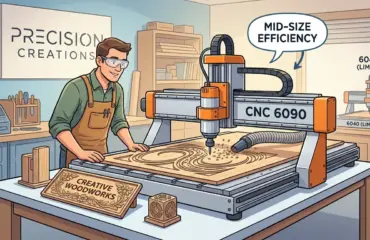
A 4×4 CNC router is not just the smaller option in the catalog. In the right shop, it is the bed size that keeps the whole routing cell calm. In the wrong shop, it becomes a daily reminder that stock is being broken down too early and handled too many times.
The key question is simple: does a 4×4 format match how work already moves through the shop?
Where A 4×4 Usually Makes Sense
This format is usually strongest when the shop wins on flexibility rather than panel throughput.
That often means:
- Custom Requests More Than Long Repetitive Batches.
- Smaller Blanks Or Already Broken-Down Stock.
- Short Runs, Samples, Templates, And Prototype Work.
- One Flexible Routing Cell Instead Of A Full-Sheet Production Island.
In that environment, the main advantage is not compactness by itself. It is manageability. One operator can stage stock, load the bed, run the program, unload parts, and keep the cell under control without turning the machine into a handling project.
The Best Test Is Material Entry, Not Machine Ambition
Many buyers ask whether a 4×4 machine will be enough for the future. That usually leads to anxiety, not clarity.
The better test is to look at the last few months of real orders and ask:
- What size material usually enters the routing cell?
- How often is stock already cut down before it reaches the router?
- How often do recurring parts fit the bed cleanly?
- How often does the operator need awkward repositioning or support?
- Is the profitable work mostly compact and varied, or mostly sheet-driven?
This review usually answers the bed-size question faster than any abstract discussion about growth.
A 4×4 Works Best When The Cell Stays Small And Clear
Buyers often compare bed sizes as if they were just rectangles of travel. In practice, the router lives inside a working cell.
Material has to arrive, be staged, be held down, be cut, be unloaded, and move to the next step. A 4×4 router performs well when that whole loop stays simple:
- The Operator Stays Close To The Work.
- Setup Changes Happen Without Long Walks.
- Offcuts Stay Visible.
- Maintenance Access Stays Easy.
- The Cell Does Not Need A Larger Support System Just To Feel Normal.
Some 4×4 routers work extremely well in real shops because the machine is not fighting the layout around it.
Broken-Down Stock Is Not Automatically A Weakness
Some buyers assume that using smaller blanks or cut-to-size stock is automatically less advanced than feeding full sheets into a larger router. That is only true when the business actually wants sheet-based production.
If the shop already makes money from shorter runs, mixed orders, signs, displays, templates, sample parts, or custom woodworking, then working from smaller stock may be the correct operating model. In that case, a 4×4 router is matching the work honestly.
The warning sign is different: if the shop keeps breaking down full panels only because the routing cell cannot carry the natural material format economically, then the 4×4 may be forcing labor upstream.
A Quick Fit Table
| Shop Condition | 4×4 Usually Fits Well | Why |
|---|---|---|
| One operator manages most of the cell | Yes | Direct access and short movement matter more than maximum bed area |
| Most profitable work starts as smaller blanks or partial sheets | Yes | The machine matches the natural stock format |
| The schedule is full of mixed custom jobs | Yes | Fast changeover matters more than full-sheet nesting |
| The shop keeps pre-cutting full sheets just to feed the router | No | Labor is being paid before the cut starts |
| Repeated panel flow is becoming the normal business model | No | The shop may need a broader sheet-processing route |
This table is often more useful than comparing spindle numbers because it ties the decision to daily work.
Hold-Down Still Decides Whether The Machine Feels Easy
Smaller format does not automatically mean easier routing. A 4×4 router can still become frustrating if the hold-down method is weak.
Varied work often includes:
- Small Parts.
- Mixed Blank Sizes.
- Narrow Strips.
- Repeated Job Changes.
If the vacuum layout, spoilboard strategy, tabs, or secondary restraint do not match that variety, the cell loses the simplicity that justified the bed size in the first place.
Signs The Shop Is Outgrowing A 4×4
The 4×4 format usually starts feeling too small when these signals become routine:
- Profitable work keeps starting from full sheets and losing time to pre-cutting.
- Production pressure is shifting away from custom mixed work and toward repeated panel flow.
- The router is now only one step inside a broader system that needs cleaner routing, drilling, edging, labeling, and part movement.
When those signs become normal, the conversation is no longer about compact routing. It is about workflow structure. That is often when it makes more sense to compare CNC nesting machines or review what changes when furniture production becomes more connected.
The Best Buying Rule
Buy a 4×4 router when it removes daily friction from the work you already do well: smaller stock, mixed-order routing, fast setup changes, and direct operator control.
Do not buy one just because the entry price feels safer if the shop is already paying labor every week to force full-sheet work through a compact cell.