In furniture manufacturing, this comparison usually appears when a factory wants faster panel processing but is not yet clear about what kind of machining problem it is really trying to solve. The symptoms often look similar at first: too much manual handling, unstable part flow, poor material utilization, slow cut-to-assembly turnaround, or too much rework after early-stage processing.
But a CNC nesting machine and a CNC router are not always different in the way buyers first assume. In many cases, the real difference is not the motion system alone. It is the production role the machine is expected to play.
Why This Comparison Creates So Much Confusion
The clearest way to frame the issue is this: in machine-design terms, many nesting machines are based on CNC router principles. They use similar gantry-style motion, spindle-driven machining, and flat-bed processing logic.
In production terms, however, not every CNC router is a nesting machine.
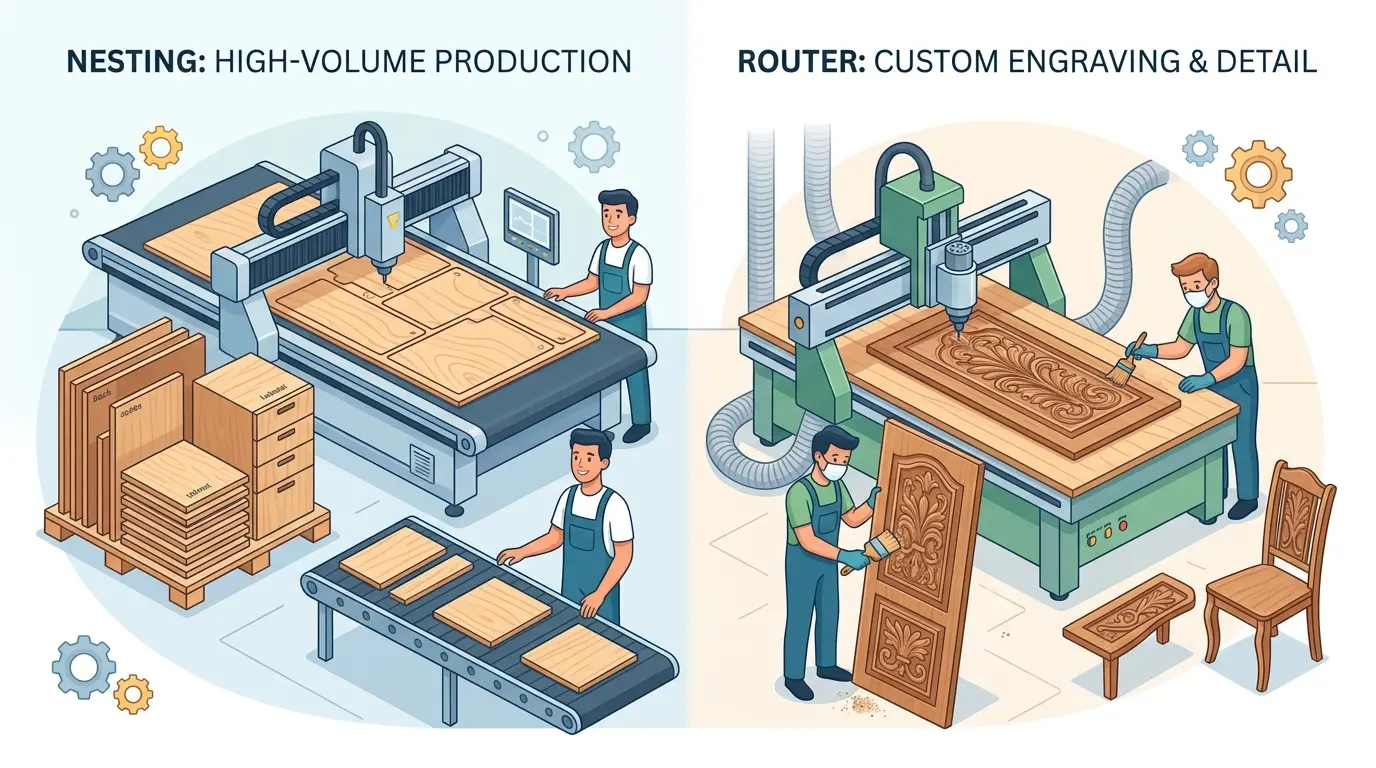
A CNC router is a broad machining category. It can be used for contouring, grooving, trimming, cutouts, drilling, and shape-based part processing across different types of furniture components.
A CNC nesting machine is usually a more production-specific application of that same core technology. It is configured around sheet-based furniture manufacturing, where the machine must do more than route shapes. It must help turn full sheets into organized parts with better yield, smoother downstream flow, and more repeatable preparation for later operations.
That is why shops often get misled by hardware similarity. The more important distinction is whether the factory needs flexible CNC machining in general, or a front-end cell optimized for nested panel production.
What A CNC Router Usually Does Best In Furniture Work
A standard CNC router is usually the stronger fit when flexibility is the main requirement.
That is often true when production involves:
- Shaped Components Rather Than Mostly Rectangular Panels
- Frequent Program Changes Across Different Part Types
- Door Parts, Decorative Elements, Or Machined Features
- Grooving, Slotting, Cutouts, And Profile-Driven Work
- Mixed Production Where Parts Do Not Always Begin As Nested Sheet Layouts
In those conditions, the router’s value comes from machining versatility. It can adapt to different geometries and different processing tasks without forcing the factory into a sheet-nesting workflow.
This matters in shops where the work changes from order to order, or where the value comes from component machining rather than from high-efficiency sheet breakdown. A router can still process panels, but that does not automatically mean it is the best answer for panel-furniture flow.
If the factory uses a general router as its main front-end panel machine, it may still achieve acceptable cutting and machining results. But the overall process may require more manual sheet handling, more sorting discipline, and more operator intervention than a true nesting-oriented workflow.
What A CNC Nesting Machine Changes In A Furniture Factory
A CNC nesting machine is usually selected when the factory’s front end begins with full sheets and the goal is to release production-ready parts into downstream operations with less waste and fewer handoffs.
Instead of treating routing as an isolated machining task, a nesting machine treats cutting, routing, and related panel processing as part of one larger furniture-production sequence.
That typically changes the workflow in several ways:
- Better Material Utilization Through Nested Layouts
- Easier Integration Of Cutting, Routing, And Some Drilling Or Grooving Steps
- More Stable Part Flow Into Edge Banding, Drilling, Or Assembly
- Less Dependence On Manual Re-Sorting After Front-End Processing
- Stronger Fit For Cabinet, Wardrobe, Office Furniture, And Other Sheet-Based Production
In more automated furniture lines, nesting-oriented processing may also be paired with loading or unloading support because the machine is being evaluated as part of a production system, not only as a spindle platform.
That is the practical difference many buyers miss. A nesting machine is usually not chosen because it is merely “more CNC.” It is chosen because the factory wants a better way to organize the first stage of sheet-based production.
Side-By-Side Difference Table
| Decision Factor | CNC Router | CNC Nesting Machine |
|---|---|---|
| Basic Role | General CNC machining platform for routing, contouring, trimming, cutouts, and varied part processing | Production-oriented CNC platform optimized for nested sheet processing in furniture manufacturing |
| Starting Material Logic | Often suits mixed parts, pre-sized blanks, shaped components, or varied machining tasks | Usually starts from full sheets that must be converted into multiple parts efficiently |
| Strongest Use Case | Flexible component machining and geometry-driven work | Panel-furniture production where yield, batching, and downstream flow matter |
| Main Workflow Outcome | Machining flexibility | Better material utilization and more organized front-end production |
| Downstream Impact | Can work well, but often depends more on manual process discipline around the machine | Usually better aligned with repeatable cut-route-drill flow into later furniture operations |
| Best Fit For | High-mix shops, contour work, diverse part geometry, and more router-led tasks | Cabinet, wardrobe, office, and panel-furniture workflows built around sheet processing |
| Main Tradeoff | May not be the most efficient structure for nested sheet production if used as a general-purpose solution | May be more process-specific than needed if the shop mainly needs flexible routing on varied individual parts |
What Actually Changes On The Factory Floor
The difference becomes clearer when you look at what happens after the spindle stops.
In a router-led workflow, the machining result may be good, but the factory may still spend extra effort on sheet setup, part identification, batching, or moving components to the next station in a clean sequence. For some shops, that is acceptable because the work mix is varied enough that flexibility matters more than rigid flow.
In a nesting-led workflow, the early-stage objective is broader. The factory is usually trying to improve:
- Material Yield From Each Sheet
- Part Repeatability Across Jobs Or Batches
- Fewer Early-Stage Bottlenecks Before Finishing And Assembly
- Cleaner Handoffs Into Subsequent Operations
- Reduced Rework Caused By Disconnected Front-End Steps
That is why the nesting decision is often tied to furniture-production strategy. The machine is not only cutting parts. It is helping define how the production day is organized.
Which One Fits Different Furniture Production Models?
The answer depends less on which machine sounds more advanced and more on which production model is driving the business.
| Production Model | Better Fit | Why |
|---|---|---|
| High-Mix Shop With Frequent Shape Changes And Varied Component Geometry | CNC Router | The workflow benefits more from machining flexibility than from strict nesting structure |
| Panel-Furniture Production Built Around MDF, Plywood, Particleboard, Or Melamine-Faced Sheets | CNC Nesting Machine | The factory gains more from sheet optimization, integrated processing, and stable part flow |
| Shop Using One CNC Mainly For Cutouts, Grooves, Decorative Parts, Or Irregular Workpieces | CNC Router | The core value comes from broad routing capability rather than nested panel release |
| Factory Trying To Reduce Waste, Manual Handoffs, And Front-End Disorder In Cabinet Production | CNC Nesting Machine | The machine fits a more system-driven approach to early-stage production |
| Operation Producing Mostly Repeated Rectangular Panels With Very Little Shape Variation | It May Require A Different Comparison | In some cases, the more relevant decision may be between nesting and dedicated panel-sizing equipment rather than between nesting and a general router |
The Most Common Buying Mistake
The biggest mistake is treating this as a hardware-only comparison.
If the real problem is poor sheet yield, unstable batch flow, too many early handoffs, or weak coordination between cutting and later panel processing, then buying a general router because it can also cut panels may not solve the root issue.
If the real problem is varied geometry, contour work, or the need to machine many different part types without centering the workflow on nested sheet production, then buying a nesting-oriented system may add process structure the shop does not fully need.
The better question is simple: where is the real constraint?
If the constraint is machining flexibility, a router is often the more natural fit.
If the constraint is sheet-based production flow, a nesting machine is often the stronger answer.
Practical Summary
A CNC nesting machine and a CNC router are closely related, but they do not always play the same role in furniture production. A router is a broader machining platform. A nesting machine is usually a furniture-oriented production application built around full-sheet processing, better material utilization, and smoother release of parts into the next stages of manufacturing.
Choose a CNC router when the shop depends on flexible machining across varied components and geometries. Choose a CNC nesting machine when the factory depends on turning sheets into organized furniture parts with better yield, fewer handoffs, and more repeatable front-end flow.
The most useful decision is not based on which term sounds more industrial. It is based on whether the business needs a flexible CNC workstation or a sheet-production cell that changes how furniture parts move through the plant.