
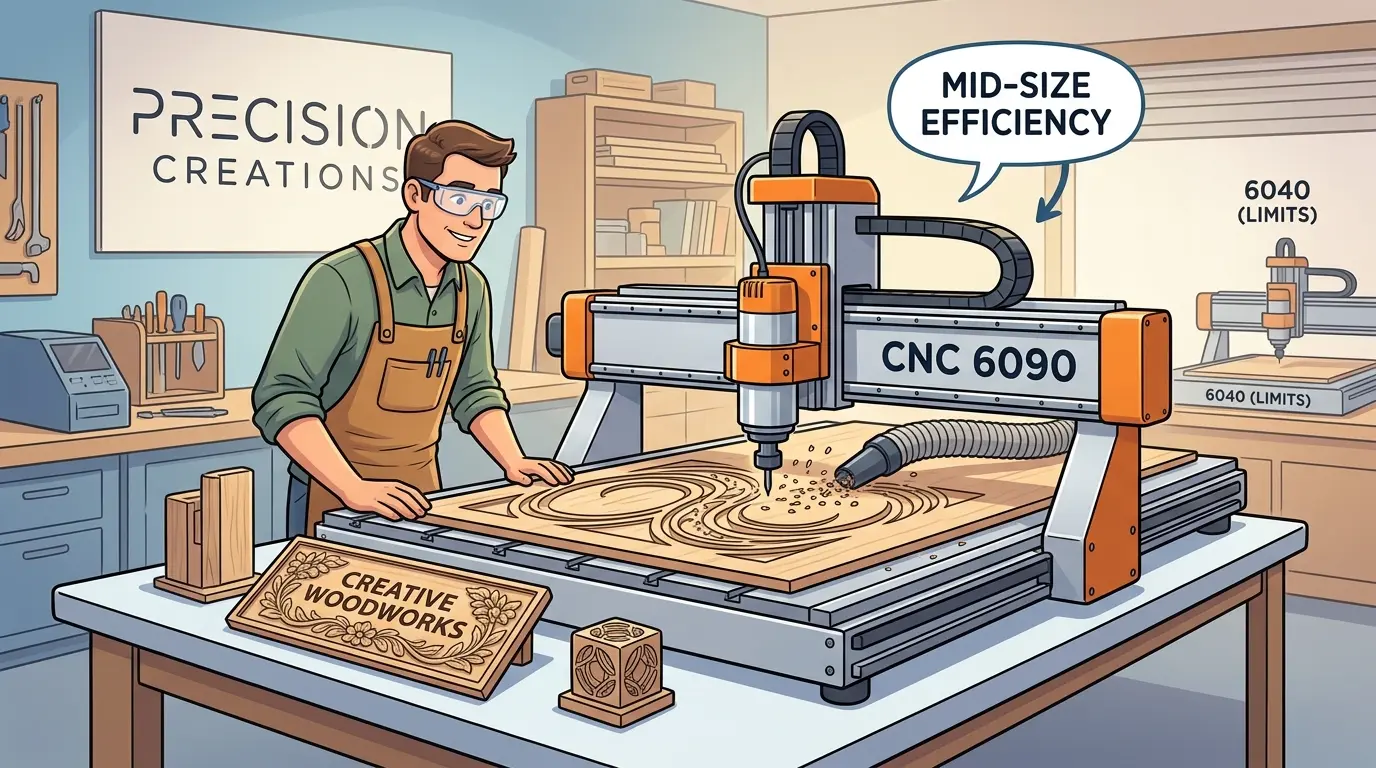
The 6090 router sits in an awkward but useful part of the CNC market. It is bigger than the compact classes that most buyers start with, but still far smaller than a true full-sheet platform. That middle position gives it real value and real risk. It can remove a recurring setup burden that smaller tables keep imposing. It can also become the machine people buy when they want progress to feel visible, even though the real production problem is already asking for something else.
That is why the 6090 decision should not start with dimensions alone. The practical question is whether your shop keeps losing time, accuracy margin, or operator patience for the same repeated reason on a 6040-size table. If that friction shows up every week, then 6090 may be the right mid-size answer. If it appears only in occasional edge cases, or if the business is already moving toward sheet-based panel processing, the upgrade can become a comfortable delay rather than a durable solution.
The useful way to judge a 6090 is through scenarios. Where is the current machine slowing work down? Which jobs would genuinely become more stable on the larger table? And at what point does the argument stop being about table size and become a broader production-planning decision? Those are the questions this guide focuses on.
The Upgrade Question Usually Starts With One Repeated Delay
Most good 6090 purchases begin with a problem the shop can describe in plain language. Parts keep fitting on the 6040 table, but the setup does not. Clamp locations keep stealing the same corner of the toolpath. Jobs that should be single-setup keep turning into two-step work. The operator keeps rotating panels or template boards for no reason other than the smaller work zone running out before the geometry does.
That pattern matters more than the size difference itself. A mid-size router earns its keep when it removes repeated delay, not when it simply gives the shop a larger number to talk about. If the same compromise keeps appearing on normal work, then the larger table may be carrying real operational value. If the issue only shows up on rare exceptions, the shop may be reacting to irritation rather than solving a true production burden.
Buyers who stay focused on the repeated delay usually make better decisions here. They are not buying extra space because bigger looks safer. They are buying extra space because the current routine keeps burning time in the same exact way.
Scenario One: The Part Fits On 6040, But The Setup No Longer Fits
This is the most common and most legitimate reason to move up. The workpiece technically fits on the smaller machine, yet the setup is already strained before cutting starts. Clamps land where lead-ins should be. Stops and tabs compete for the same narrow margin. Dust extraction becomes awkward because the safe path around the workholding gets too tight.
In this situation, 6090 is not just a bigger table. It is a cleaner staging area for the same kind of work. The added room can turn an unstable layout into a calm one, and that change often matters more than raw travel numbers.
Signs, acrylic display parts, routed templates, custom fixture boards, and moderate-size plywood or composite components often fall into this category. They do not need a sheet-processing machine. They need a table that stops turning normal work into a layout puzzle.
The test is simple: if a job fits on 6040 only because the operator keeps making compromises, then the smaller table is already charging a tax. If the larger table removes that tax on recurring work, the upgrade is doing its job.
Scenario Two: The Shop Keeps Paying For Avoidable Multi-Setup Work
Another strong reason to consider 6090 is when the smaller machine keeps forcing jobs through avoidable extra setups. That extra work rarely looks dramatic on one part. Over a week, it becomes expensive.
The cost is not only in cutting time. It shows up in re-zeroing, re-clamping, rechecking part position, cleaning up between steps, and the mental drag of restarting a process that should have stayed continuous. Every additional setup adds another chance to introduce inconsistency, especially when custom work and small batches dominate the order mix.
The shops that benefit most from 6090 in this scenario are not necessarily the busiest shops. They are the shops where setup repetition is choking flexibility. That often includes sign makers, mixed-material prototype teams, small woodworking operations, and custom job shops doing moderate-size routed parts where the next order rarely looks identical to the previous one.
If a mid-size router allows the part to be completed in one calm setup instead of two fragile ones, the gain is real. That improvement may not look spectacular in a spec sheet. It often looks very good in a production schedule.
Scenario Three: The Work Is Growing, But It Is Not Yet Full-Sheet Work
This is where many buyers get confused. Their jobs are getting bigger, their blanks are getting less convenient on a 6040, and the business feels as if it is moving upward. That does not automatically mean the shop should jump to a 4×8 or a nesting machine. It also does not automatically mean 6090 is the right bridge.
The deciding factor is whether the job mix still behaves like mid-size routing. If the work mainly involves larger signs, more generous fixture boards, repeated custom panels that still do not require full-sheet handling, and parts where extra layout room is more important than industrial throughput, 6090 can be the honest answer. It adds usable freedom without dragging the shop into a full sheet-oriented workflow it may not need yet.
But the buyer has to stay clear-eyed. Once the order mix starts to revolve around large cabinet components, repeated board handling, nested panels, or consistent weekly throughput built around sheet stock, the decision is already getting bigger than a mid-size router comparison.
That is the point at which 6090 stops being a natural next step and starts becoming a temporary comfort purchase.
What 6090 Changes In The Daily Routine
The appeal of this size class is not abstract. It changes very specific parts of the operator’s day.
In a good match, a 6090 can reduce:
- Forced part rotation during routing
- Clamp conflicts near entry or finishing paths
- Repeated re-zeroing caused by multi-setup jobs
- The cramped feeling that slows down layout decisions
- The need to improvise fixture plans on parts that are only slightly too large for a 6040
Those are not small improvements. They affect accuracy, speed, and operator confidence at the same time. A machine that gives the process more room to stay orderly usually feels more repeatable, even before cycle time is discussed.
At the same time, buyers should not confuse a smoother routine with an entirely different category of production. The 6090 class can make work calmer. It does not automatically make work industrial in the heavy-duty sense many buyers imagine.
That distinction is especially important when the larger table encourages the shop to accept jobs that are only marginally within the machine’s comfort zone. The table can feel generous enough to invite bigger commitments before the surrounding process is actually ready for them.
Why Workholding Often Decides The Argument
On paper, the difference between 6040 and 6090 sounds like a capacity question. In practice, it is often a workholding question.
If the larger table leaves genuine room after clamps, tabs, stops, and safe tool travel are accounted for, then the upgrade is solving something real. If the parts technically fit yet the fixture plan still feels crowded, then the added dimensions are not doing as much as the buyer hoped.
This is why buyers should pay attention to how the extra area will actually be used. Is it going to support cleaner layouts and better tool access? Or is it simply going to spread the same weak fixture logic over a slightly larger surface?
That is also why a table-size decision sometimes begins to reveal a larger workflow question. If hold-down is now the main factor limiting part stability, cut quality, and repeatability, the shop may be inching toward a very different routing model. When that happens, it helps to study what actually changes when shops move from general routing into a nesting-style workflow because the true issue may no longer be table dimensions alone.
The point is not that every 6090 buyer should leap into nesting. The point is that hold-down problems often expose whether a size upgrade is still enough.
The Ownership Burden Grows With The Opportunity
Many buyers imagine the larger table only in terms of what it allows them to cut. They do not think enough about what it asks them to manage. Spoilboard care, hose movement, dust collection behavior, job recovery, and general cleanup all become more important as the working area grows and the shop starts trusting the machine with larger or more valuable parts.
That does not make 6090 undesirable. It simply means the shop has to support the larger daily routine that comes with the extra freedom. The machine becomes more helpful only if the surrounding habits mature alongside it.
This is one reason mid-size purchases can feel excellent during selection and more complicated a few weeks later. The operator immediately appreciates the added space, but the rest of the routine has to catch up. If spoilboard resurfacing remains inconsistent, if dust handling is weak, or if interrupted-job recovery is poorly managed, the bigger table can start exposing those issues faster than the smaller one did.
The right way to interpret that is not disappointment. It is clarity. The shop is learning what parts of its process are ready for a mid-size machine and what parts still need discipline.
Where Buyers Still Overread The Class
The most common mistake is treating 6090 as a safe production bridge. It looks like the reasonable midpoint between a compact router and a large-format machine, so buyers assume it must be the least risky answer. Sometimes it is. Sometimes it merely softens the pain of waiting for the real answer.
The class becomes misleading when buyers assign it problems that belong to another category:
- Regular sheet-scale panel work
- Repeated weekly cabinet output
- Workflows that depend on broad material handling efficiency
- Production systems where drilling, labeling, or downstream transfer already matter as much as cutting
- Order mixes that are no longer being limited by layout space alone
Once those pressures are driving the decision, the shop is no longer asking a clean 6040-versus-6090 question. It is asking what kind of production model it needs next.
That is the moment when a mid-size router can become the easiest answer to approve and the hardest one to justify six months later.
The Point Where 6090 Stops Being The Honest Answer
There is a clear boundary where a 6090 ceases to make sense, even if the extra room sounds attractive.
It usually happens when the primary pain is no longer setup crowding on moderate-size work. Instead, the real pain becomes panel handling, material utilization across sheet stock, batching, or the need to integrate routing into a larger furniture or panel-processing flow.
At that stage, the shop should stop asking whether 6090 is enough and start asking what type of machinery the workflow is actually describing. If the machine choice is becoming part of a bigger woodworking-equipment plan rather than a stand-alone router discussion, then the comparison should widen immediately.
That broader comparison is where Pandaxis becomes more useful as a category reference. Buyers who are no longer sure whether they need a bigger general router or a different production path altogether can use the Pandaxis machinery lineup to compare router-adjacent woodworking categories in a more realistic way.
In other words, once the argument is no longer about repeated setup tax on mid-size parts, the router-size debate is already too narrow.
How To Decide Without Buying For Ego
Mid-size machines are particularly vulnerable to emotional buying. The table is visibly bigger, the purchase feels like progress, and the buyer can tell himself he is making a forward-looking move. None of that is the same as solving the right problem.
The cleanest decision comes from answering a few blunt questions:
- Which exact jobs are suffering on 6040 often enough to justify the change?
- Will those jobs become single-setup or more stable on 6090 in a meaningful way?
- Is the current limitation really table room, or is it weak process discipline?
- Is the business still centered on mid-size routing, or is it drifting toward sheet-based production?
- If the shop doubles the same kind of work six months from now, will 6090 still fit the pattern honestly?
If the answers point to recurring setup friction on mid-size parts, the case is strong. If the answers keep drifting toward larger panel flow or toward problems unrelated to table size, the case weakens quickly.
That is why the better purchase is not the larger router by default. It is the router that removes the right delay at the right level.
When A Mid-Size Router Makes More Sense Than A 6040
It makes more sense when the shop keeps paying the same avoidable setup penalty on the smaller table, when the extra working area becomes genuinely usable after workholding is counted, and when the workload still belongs to mid-size routing rather than to a larger sheet-based model.
That is the practical answer hidden inside the model numbers. A 6090 is not automatically smarter, safer, or more future-proof. It is simply more appropriate when the operator’s recurring problem is layout friction on mid-size work and when the larger table solves that friction without pretending to be the next production category.
If that is your situation, 6090 can be a disciplined and efficient upgrade. If the business is already moving toward panel throughput, integrated furniture processing, or full-sheet logic, then the honest move is not to stretch the mid-size story. It is to admit that the machine comparison has already become something larger.