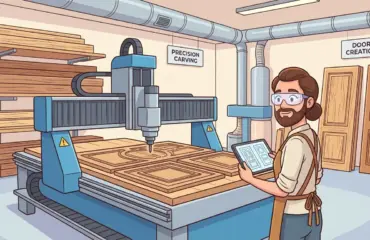
A 5×10 router usually enters the conversation when the shop has outgrown the habit of cutting large material down early just to make it fit a smaller bed.
That is the real economic trigger. Once a factory is spending too much time pre-cutting, repositioning, or breaking long work into awkward stages, the cost is no longer in spindle time alone. It is in every extra touch before the spindle even starts.
If The Sheet Must Be Broken Down Early, The Process Is Already Paying A Tax
Shops usually begin needing a 5×10 router when the current route keeps forcing avoidable compromises such as:
- Pre-Cutting Long Panels Before Routing.
- Repositioning Material During The Job.
- Splitting Nests That Would Be Cleaner On A Larger Bed.
- Building Extra Handling Steps Into Straightforward Orders.
These are recurring labor taxes. A larger router only makes sense when it removes those taxes on enough jobs to matter every week.
Review Real Order History, Not The Best-Looking Future Scenario
The most useful evaluation method is still simple: review actual work history.
How often did oversized or long-format work appear?
How often did operators pre-cut boards only because of bed limits?
How often did layout efficiency fall because machine size, not part logic, was dictating the nest?
If those problems show up frequently, a 5×10 format may be commercially justified. If they show up only occasionally, the shop may be trying to buy around rare exceptions instead of fixing a recurring loss.
The First Big Change Happens Upstream, Not At The Spindle
A 5×10 router changes the first half of the process more than many buyers expect.
It can let large parts stay intact longer, reduce upstream breakdown, and give programmers more freedom to place parts according to job logic instead of table limits.
That can help with:
- Long Furniture Parts.
- Oversized Doors And Panels.
- Wall Systems And Architectural Components.
- Display And Fixture Work.
- Counter And Panel Jobs That Become Awkward On Shorter Beds.
But the gain only survives if the rest of the cell stays organized after the cut.
Nesting Freedom Only Matters If The Shop Can Use It Well
One advantage of a 5×10 table is that programmers can nest according to job logic instead of only to bed restrictions.
Longer parts can remain intact. Mixed jobs can sometimes be laid out more naturally. Offcut logic can become cleaner.
But a larger table can just as easily become a larger place to make poor nesting decisions if file naming, release discipline, material allocation, or operator instructions stay inconsistent.
Better bed size creates more options. It does not automatically create better decisions.
Loading And Offload Usually Decide Whether The Table Feels Productive
Bigger tables ask for better handling discipline.
Buyers should look directly at:
- How Sheets Reach The Machine.
- Whether Loading Stays Safe And Repeatable On Every Shift.
- How Finished Parts Are Removed.
- Where Offcuts And Skeletons Go.
- Whether Traffic Around The Cell Stays Clean.
If the plant cannot support those routines calmly, the larger router may replace one kind of friction with another.
Floor Space Around The Router Matters Almost As Much As The Bed
Large-sheet work needs approach space, turning space, offload space, and safe walking space.
If those are missing, the cell becomes physically bigger on paper but operationally narrower in reality.
That is especially important in growing factories where the router is being placed into an already crowded layout. A 5×10 router often needs a more honest cell boundary so operators can load and unload without constant interference from nearby carts, stacked panels, or crossing forklift traffic.
Hold-Down Quality Matters More On A Large Bed
Larger work envelopes make workholding more important, not less.
Flatness, vacuum zoning, spoilboard discipline, and part-release behavior all matter more when the job covers a larger area and the consequences of movement are harder to hide.
If the shop already struggles with spoilboard care, hold-down stability, or remnant management, a bigger table will usually expose that weakness more clearly.
The Real Return Survives Only If Downstream Stations Are Ready
Routing is still only one stage in the line.
In cabinet and furniture work, that means checking whether routed parts can move cleanly into boring and drilling machines and then toward edgebanders without losing job identity, orientation, or stack logic.
If the router releases bigger or denser nests but the plant cannot label, separate, and hand them off clearly, the gain at the cutting stage will get lost in the middle of the line.
Remnant Policy And Job Identity Become More Important
Large-sheet processing creates a clearer need for remnant policy.
If valuable material remains after the main nest, the factory must decide whether the remnant is reusable, how it is labeled, where it is stored, and how it re-enters planning.
The same is true for job identity. Bigger nests can release more parts in one cycle, which makes separation and orientation control more important.
Larger-bed buying cases should therefore include material governance, not just cutting capacity.
Sometimes The Shop Needs A Bigger Table. Sometimes It Needs A Better Model.
If the goal is better large-sheet nested flow, it can make sense to compare the router path against CNC nesting machines or to step back and review the whole connected woodworking line design.
Some shops really do need more bed area. Others are blaming bed size for what is actually a flow problem in loading, release, labeling, or handoff.
Strong Signs The 5×10 Format Fits
The case is usually strong when several of these are already true:
- Large-Sheet Work Is Recurring, Not Occasional.
- Pre-Cutting Before Routing Is Happening Too Often.
- Repositioning Is Eating Operator Time.
- Longer Parts Would Move More Cleanly Through A Bigger Table.
- The Factory Already Has Enough Staging And Offload Discipline To Support The Footprint.
- Programmers Are Regularly Forced Into Weaker Nests Because Of Bed Limits.
When those signs stack together, the bed size is usually solving a real bottleneck.