
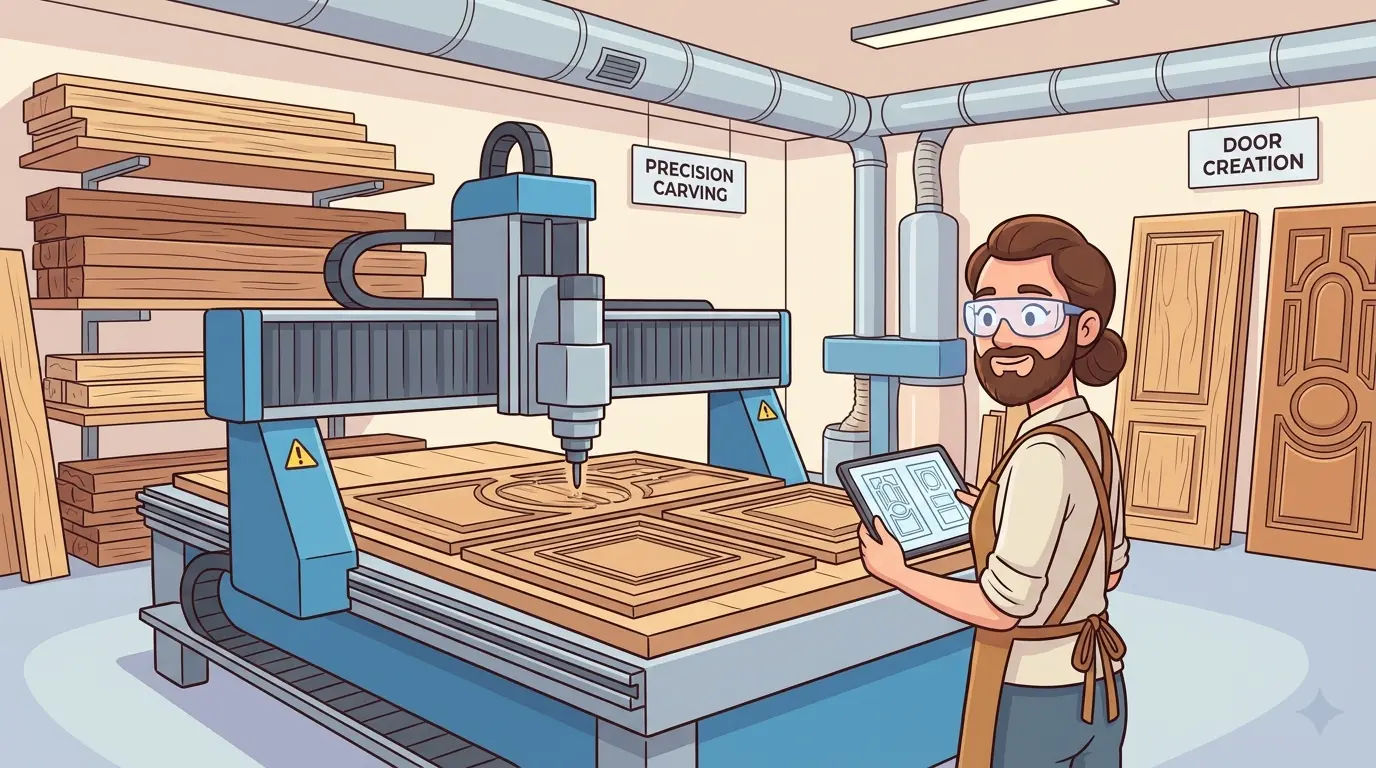
Door production is one of the fastest ways to expose whether a CNC machine is truly suited to woodworking production or only suited to a clean showroom demonstration. A machine may cut simple sample panels convincingly and still struggle once the schedule fills with slab doors, narrow rails, shaker parts, decorative routed faces, painted components, laminated panels, and short-run custom orders. That is because door work does not only test cutting ability. It tests part stability, surface quality, hold-down logic, labeling discipline, hardware prep, and downstream handoff.
So the smartest way to choose a CNC machine for doors is to stop looking at the machine in isolation and start at the other end of the workflow. Ask what has to be true by the time the part reaches drilling, sanding, assembly, coating, or packing. Work backward from there. The right machine is the one that keeps those later stages calm instead of feeding them more correction work.
This approach matters because “door production” is not one workload. It is several production behaviors under one label, and each one punishes a different kind of machine weakness.
Start At The Handoff, Not At The Spindle
Many buyers begin by asking how fast the machine cuts. That is rarely the most useful first question in door work. The better question is what condition the part needs to be in when it leaves the CNC.
Does it need to move directly into edge processing, drilling, sanding, assembly, coating, or hardware prep with minimal intervention? Does the shop need the parts labeled and organized clearly enough that downstream stations do not lose time sorting them? Does the door surface need to be clean enough that visible finish work does not turn into a correction loop?
When the buying process starts there, the machine comparison becomes more honest. Instead of rewarding whatever spindle spec looks strongest, the shop starts rewarding the machine behavior that reduces rework, keeps part identity clear, and feeds the rest of the line in a usable state.
That is usually how good door-machine decisions separate themselves from generic router shopping.
Slab Doors Reward Panel Flow More Than Demo Speed
If the dominant door family is slab work from sheet goods, the machine’s biggest job is usually not artistic cutting. It is disciplined panel handling. Throughput comes from how cleanly the shop can load sheets, nest parts, separate output, and keep the downstream order straight.
That is why slab-door producers should look hard at whether the machine supports orderly panel flow rather than just strong-looking feed claims. In these environments, repeated loading, part sorting, labeling, and material yield matter every day. The machine has to help the shop move through sheets without turning every shift into an exercise in unloading confusion.
For many of these workflows, the real comparison belongs in the world of CNC nesting machines rather than in broad router language. The value comes from panel-processing behavior: how well the machine fits repeated sheet work, not how impressive it appears during one clean sample program.
If slab doors are the core workload, buyers should test whether the machine supports cell rhythm across a full shift. A machine that looks fast but creates sorting errors, inefficient loading, or unstable yield discipline may still be a poor slab-door machine.
Frame Doors And Shaker Work Expose Referencing Discipline
The moment door work shifts from slab panels to rails, stiles, intermediate members, and repeated component families, the machine starts getting judged by a different standard. Here, the question is less about large-sheet rhythm and more about how cleanly the machine holds truth across repeated smaller or longer parts.
Shaker and frame-style work often exposes referencing and part-support weakness quickly. Narrow parts move more easily. Long members punish unstable hold-down. Repeated profiles reveal small variation more clearly because fit-up later depends on consistency, not only nominal size.
This is where a shop needs to be honest about what currently causes trouble. If assembly keeps revealing small fit differences, if operators are constantly compensating for part movement, or if long and narrow pieces feel less predictable than the machine samples suggested, the CNC decision should focus on stability, support, and repeat accuracy.
Door work does not tolerate sloppy truth very well. The parts may still get cut, but the inconsistency shows up later when the line tries to fit everything together.
Decorative Faces Punish Motion Quality Harder Than Buyers Expect
Routed faces, visible contours, and decorative profiles change the buying question again. Once the surface itself becomes visible to the customer, the machine is no longer only making geometry. It is affecting finish burden. Small vibration problems, rough interpolation, chatter, or uneven motion quality become expensive because sanding, filling, and surface correction move downstream into visible labor.
This is one reason a fast demo cut can be misleading. A machine may remove material quickly and still leave too much work behind. In decorative door production, the quality test is not simply whether the toolpath completed. It is how much cleanup the line now has to absorb before the part looks ready for the next step.
Buyers should ask what the routed surface looks like on real door materials, under realistic production settings, and across repeated parts. In visible door programs, the winning machine often leaves less correction work behind, even if it is not the loudest machine in a speed comparison.
That is why decorative door shops should judge the CNC partly through sanding labor, not just through cutting metrics.
Hold-Down Truth Shows Up On Narrow And Edge-Near Parts
Weak hold-down is one of the fastest ways to lose money in door production. The problem often hides during easy demonstration parts and appears later on long rails, narrow stiles, shaped edges, or components where the cut runs close to the part boundary. If the part shifts, even slightly, the damage is not always dramatic enough to trigger immediate rejection. Sometimes it just creates subtle inconsistency that shows up later in fit, finish, or drilling alignment.
That is why buyers should not judge the machine only on its friendliest samples. They should judge it on the door geometries that are hardest to hold cleanly. Door programs frequently include exactly the shapes that challenge hold-down systems the most, and a machine that cannot keep those parts stable will generate trouble that no brochure language can cancel.
In practical terms, this means asking how the table, vacuum strategy, spoilboard condition, and cut sequencing work together. The part does not care how much power the spindle has if the work is no longer truthfully supported during the cut.
Tooling Strategy Decides Whether Changeovers Stay Manageable
Door work rarely lives inside a one-tool world. Even relatively straightforward programs may combine panel cutting, profiling, light grooving, hinge or hardware prep, finishing passes, and material-specific tooling. Once the product mix includes several door families, tool planning becomes a real production variable instead of a background detail.
That matters most in shops with mixed custom work. In those environments, changeover discipline can decide whether the machine spends its day cutting parts or waiting on setup adjustments. A machine that looks broadly capable can still be commercially weak if the tool strategy around real door jobs becomes too manual, too interrupted, or too dependent on one highly experienced operator.
Buyers should therefore map the door program honestly before treating tooling as a solved subject. Which cutters stay in frequent rotation? Which operations are routine enough to deserve a smooth path? Which jobs create the most non-cutting time? The answers will often tell the shop more about machine fit than another round of abstract performance comparisons.
Hardware Prep Can Quietly Become The Real Bottleneck
Many shops focus so hard on cutting and shaping that they delay the question of boring and hardware preparation. Then the line starts losing time after the CNC, not on it. Hinge positions, latch prep, repeated connector drilling, and hardware alignment can all drag finished doors back into secondary handling if they were never planned as part of the machine decision.
This is a common turning point in door-production investment. A shop thinks the router or nesting platform is the hero machine, but the real constraint is repeated drilling accuracy or the number of handling steps needed before the part is truly ready. In those cases, it may be more honest to think about how boring and drilling machines support the line rather than expecting one stage to carry every burden alone.
That is why a door-machine decision should always include the question, “What still happens to the part after cutting?” If the answer contains too much rehandling, the shop is not looking at the full workflow yet.
Surface Cleanliness Is Part Of Finish Control
In door work, cleanliness is not only about safety or housekeeping. It is partly about finish protection. Fine dust, recut debris, table residue, and poor extraction discipline can all mark surfaces, interfere with painting or laminating, and create more cleanup before the part is ready for the next station.
This matters most in painted and laminated door programs, where even small contamination can become visible labor later. A machine that cuts well but leaves the part dirty or hard to handle cleanly may still be the wrong choice for shops selling appearance-sensitive work.
That is why buyers should pay attention to extraction behavior, spoilboard condition, chip evacuation, and how clean parts emerge during ordinary production. In rough processing, a little debris may be tolerated. In visible door production, it often turns into avoidable correction work.
The real question is whether the machine supports the finish standard the shop is actually selling, not just whether it clears material fast enough.
Mixed Order Shops Need Setup Discipline More Than Hero Specs
Some door producers are not high-volume slab specialists or dedicated routed-face programs. They live in mixed custom work. One shift may include several door styles, several materials, and several order sizes. In that environment, the machine’s commercial value is often determined less by peak output and more by how calmly it handles change.
Setup repeatability, job transition logic, tooling discipline, part identification, and operator burden all become critical. A machine with strong headline specs may still frustrate the shop if it creates too much non-cutting time every time the order mix changes.
This is why mixed-order buyers should study the day between jobs, not only the cut inside the job. How long does the machine stay in a productive rhythm before the next change interrupts it? How much judgment is required to recover? How much of the process depends on one expert operator remembering the unofficial workarounds?
When those burdens are high, the machine can still be technically capable and commercially weak.
The Best Door Machine Fits The Line, Not Just The Cell
No door shop runs on cutting alone. The machine sits inside a broader production route that may include loading, sorting, labeling, drilling, edge processing, sanding, assembly, finishing, and packing. A CNC that looks good in isolation can still perform poorly as part of the whole line if it sends disorder, rework, or unstable timing downstream.
That is why better shops increasingly evaluate these purchases through the lens of line fit. The machine should help the factory behave more predictably across connected steps. In many cases, it is worth stepping back and thinking about a connected woodworking production line rather than letting the buying decision collapse into a standalone CNC comparison.
Line fit usually reveals the better decision. The winning machine is often the one that reduces friction after the cut: clearer part release, steadier handoff, less finish correction, easier hardware preparation, and fewer hidden delays between departments.
When A General CNC Is Still Enough
Not every woodworking shop needs a highly specialized door solution immediately. A capable general machine may still be enough when the workload is relatively simple, throughput is modest, and the downstream burden remains under control. But the shop should be honest about the warning signs that the general platform is being stretched beyond its comfortable role.
Common signs include:
- Too much sanding or profile correction after routing.
- Too much instability on narrow or shaped door parts.
- Too much rehandling for hardware preparation.
- Too much setup-dependent variation between shifts or operators.
- Too much part confusion once mixed orders begin to stack.
When those symptoms become normal, the machine is no longer merely busy. It is becoming a drag on the line. The decision point usually arrives before a major breakdown. It arrives when accumulated friction starts costing more than the shop wants to admit.
How Pandaxis Fits The Door Conversation
Pandaxis is directly useful here because door production sits inside the woodworking and panel-processing workflows the brand actively addresses. If slab and nested panel work dominate, the CNC nesting category is the natural starting point for evaluating the cell. If repeated drilling and hardware alignment shape the real bottleneck, the boring and drilling category helps place that need correctly instead of treating it as a minor afterthought. And when a buyer needs to compare several woodworking routes at once, the Pandaxis machinery lineup gives the broader category view.
The right CNC machine for doors is the one that matches the dominant door behavior in the shop, keeps the hardest parts stable, leaves less visible correction behind, and hands parts to the next station in a cleaner, calmer state. Buyers who work backward from the real production sequence usually make stronger decisions than buyers who stay inside generic router language.
In the end, a door machine should not be judged by how impressive it sounds in the abstract. It should be judged by whether the rest of the door line starts moving with less correction, less confusion, and less wasted effort once the machine is in place. That is the result the shop can actually feel.