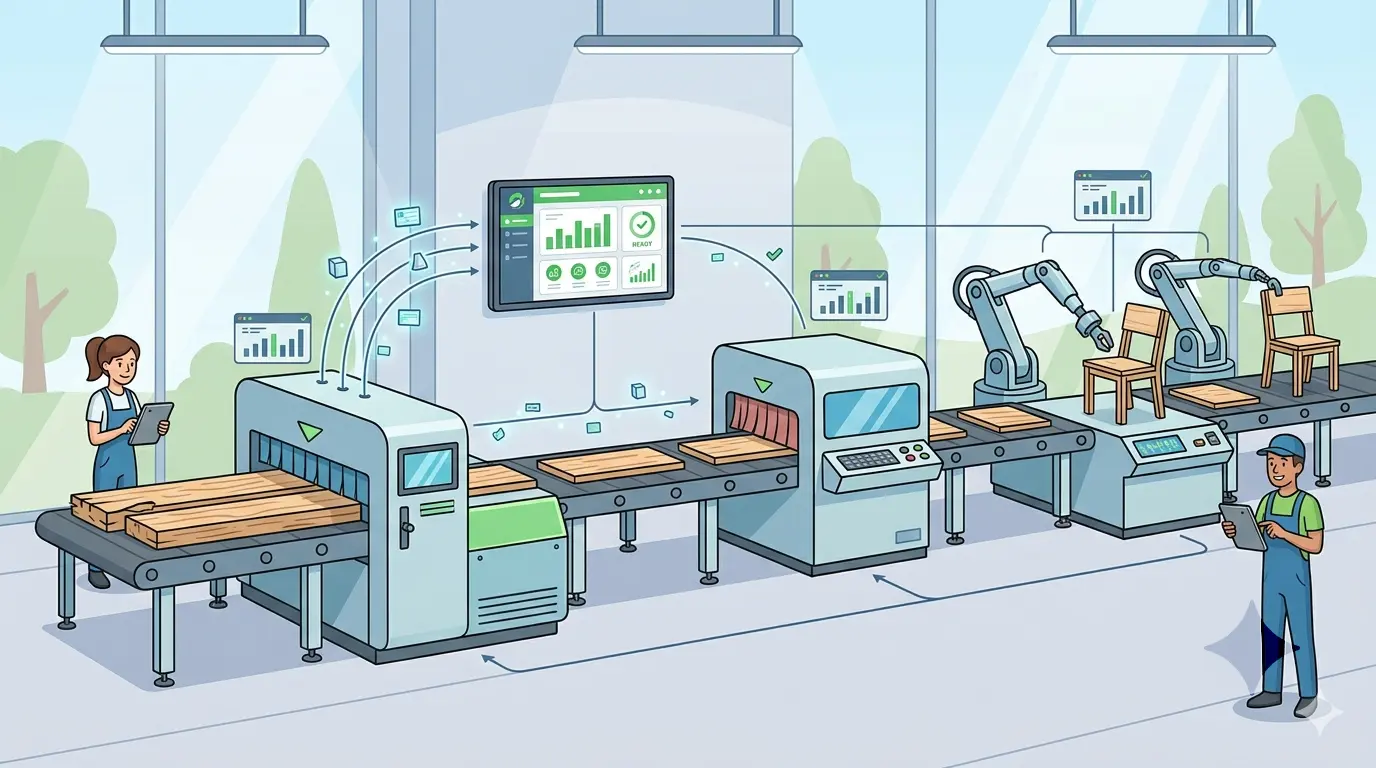
A smarter woodworking line is not created by placing more automatic machines on the floor and hoping the software layer will make them work together. In real cabinet, wardrobe, and panel-furniture production, the line becomes smarter when the right part reaches the right station in the right sequence, with fewer manual checks and less rework.
That means connected machines should be evaluated as a workflow decision, not just an automation upgrade. The objective is to improve throughput, repeatability, finish quality, drilling accuracy, edge quality, and assembly readiness at the same time. If one machine becomes faster while part identity, buffering, and batch release remain weak, the factory usually gets more motion without better flow.
Start With The Production Model, Not The Hardware Wishlist
Before choosing equipment, define what the line is actually expected to do every day. A factory producing repeated rectangular cabinet parts has a different connection logic from a workshop handling mixed geometries, frequent job changes, and shorter custom runs.
That is why the first question should not be which machine is most advanced. It should be which production model the line must support.
In practical terms, connected production usually needs to solve four problems first:
- Stable Part Release Into Each Cell
- Clear Part Identity Between Stations
- Predictable Reference Quality For Downstream Processing
- Faster Detection Of Bottlenecks, Not Faster Creation Of New Ones
If you are reviewing several machine families together, the broader Pandaxis machinery catalog is most useful as a planning map for the full workflow rather than as a shopping list of isolated upgrades.
Define The Handoffs Before You Add More Automation
In most woodworking plants, line performance is decided less by the individual machine cycle and more by the handoff between machines. That is where connected production earns its value.
| Line Stage | What Must Stay Connected | Workflow Outcome | What Happens If It Breaks |
|---|---|---|---|
| Front-End Cutting | Job priority, material selection, part sequence | Cleaner batch release and better material utilization | The next stations receive mixed or late parts |
| Edge Processing | Part identity, edge order, orientation | Better glue-line consistency and less rework | Operators stop to verify parts manually |
| Drilling And Hardware Prep | Datum logic, handed parts, program matching | Better drilling accuracy and easier assembly | Correct parts arrive with the wrong hole logic |
| Surface Preparation | Thickness targets, defect feedback, batch grouping | More repeatable finish quality and fewer downstream corrections | Sanding or calibration becomes a hidden quality filter |
| Sorting And Assembly Release | Complete batch logic and exception handling | Smoother assembly flow and fewer missing components | The line produces inventory piles instead of usable kits |
This is the core discipline behind connected machines. The line should not rely on operators to recreate the production logic by memory at every transfer point.
Choose The Right Front-End Logic For Your Part Mix
The front end usually determines whether the rest of the line behaves predictably. If the factory mostly sizes sheet goods into repeated rectangular parts, dedicated panel saws are commonly a strong fit because they help standardize cutting, batch release, and downstream flow.
If the production mix includes more irregular part geometry, nested layouts, routing work, and higher customization, CNC nesting machines may be the better front-end choice because they can combine cutting with more integrated machining logic.
Neither approach is universally better. The practical tradeoff is straightforward:
- A Panel-Saw-Led Front End Usually Favors High-Volume Rectangular Panel Processing, Stable Repetition, And Strong Material Flow.
- A Nesting-Led Front End Usually Favors Mixed Geometry, More Flexible Routing Logic, And Greater Integration At The First Machining Stage.
The smarter decision is the one that gives downstream edge processing, drilling, sorting, and assembly a cleaner starting point. A machine that looks more advanced on paper is not automatically the better line anchor.
Connect Edge Processing To Part Identity, Not Just Part Arrival
In many factories, edge processing is where weak line discipline becomes expensive. Parts may already be cut correctly, but once they arrive in the wrong sequence, with unclear orientation, or without stable edge reference, the cell loses time and quality together.
That is why edgebanders should be connected to part identity, edge order, and release logic rather than simply fed as fast as possible. A smarter line makes it obvious which edge comes next, which visible surfaces matter most, and which parts belong together as a batch.
This is also where buyers need to be honest about automation level. A more automated edge-banding cell is not always the right answer if upstream cutting still releases highly variable work in unstable order. In some factories, improving labels, sorting, and buffer discipline creates more value first than adding another level of edge-banding automation.
Decide Where Drilling Belongs In Your Reference Strategy
Drilling is often treated as a secondary operation, but in furniture production it frequently decides whether the part will assemble cleanly. A panel can look dimensionally correct and still create hardware-fit problems if handedness, hole logic, or datum references are inconsistent.
That makes boring and drilling machines a connection point, not just a machining point. The line has to define whether drilling should happen before or after edge processing, how left-hand and right-hand parts are separated, and how the correct program follows the part through the cell.
There is no universal rule for sequence. Some factories prefer to establish finished edge condition first and drill afterward. Others drill earlier because the product structure and line discipline support that approach. The better choice is the one that protects reference consistency and reduces manual correction at assembly.
When the connection is weak, the drilling station becomes a manual interpretation zone. Operators spend time checking orientation, confirming programs, and correcting upstream confusion. When the connection is strong, the drilling cell supports faster hardware preparation, more repeatable fit, and smoother assembly handoff.
Treat Surface Preparation As A Line-Control Issue
Factories often think about sanding or calibration only as a finishing concern. In reality, it is also a control point for consistency. If part thickness, surface condition, or defect feedback is unstable upstream, the sanding stage ends up compensating for problems that should have been prevented earlier.
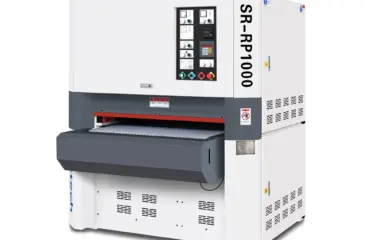
That is why wide belt sanders should be evaluated inside the line rather than as isolated finish equipment. In a smarter production flow, the sanding stage receives predictable batches, consistent part thickness targets, and clear decisions about whether the objective is calibration, finish preparation, or defect removal.
Not every woodworking line needs a sanding cell at the same level of automation. The right fit depends on whether the factory is running veneer, solid wood, coated surfaces, or panel components that need tighter thickness or surface discipline before final finishing or assembly.
Build A Simple Information Layer The Team Can Actually Use
Connected machines do not require every factory to build a complex digital architecture on day one. In many woodworking plants, a practical information layer creates more value than an ambitious but fragile software rollout.
The key is to make information follow the part. Whether that happens through labels, barcodes, digital job tickets, or another tracking method, the line should make a few basics easy to see:
- Which Job Or Batch Is Running Now
- Which Program Version Belongs To Each Part Family
- Which Orientation Rules Apply At The Next Station
- Which Buffer Is Full, Empty, Or Waiting
- Which Parts Are Normal Flow And Which Are Exceptions
The goal is not to add screens everywhere. The goal is to reduce guesswork. A connected line should make it harder to run the wrong part than the right one.
Balance Buffers And Rhythm Across The Line
One of the biggest mistakes in woodworking automation is assuming that faster machines automatically create a faster line. They do not. They create a faster line only when the next station can absorb the parts without confusion, congestion, or starvation.
That is why a smarter production line needs buffer logic and release rhythm between cells. If cutting releases too much work too early, edge processing and drilling turn into sorting operations. If downstream stations consume parts faster than upstream stations can prepare them, operators wait for material instead of processing it.
Good buffering is not wasted floor space. It is controlled breathing room between different machine rhythms. The purpose is to keep the line stable enough that small disruptions do not ripple through the whole plant.
Avoid The Most Common “Smart Line” Mistakes
Factories usually do not struggle because they chose the wrong buzzword. They struggle because they improved one station without redesigning the surrounding process.
The most common mistakes are usually these:
- Automating A Single Bottleneck While Ignoring The Next Constraint In The Line
- Mixing Rush Jobs And Standard Batches Without Clear Release Rules
- Adding Machine Speed Before Part Labels, Orientation Rules, And Exception Paths Are Reliable
- Measuring Success By Cycle Time Instead Of Rework, Fit Quality, And Assembly Stability
- Treating Connected Machines As A Software Project Instead Of A Production-Control Project
This is where tradeoffs matter. A rigid, highly automated line can underperform in a factory with unstable scheduling and frequent custom changes. A more flexible setup can outperform it when the order mix still depends on fast adjustments and operator judgment.
What A Smarter Connected Line Usually Looks Like
In day-to-day production, a smarter connected line is usually recognizable by behavior rather than by technology labels.
It often looks like this:
- Material Is Staged According To The Actual Production Sequence.
- Front-End Cutting Releases Parts In A Controlled Batch Logic.
- Part Identity Stays Clear Through Sorting, Buffering, And Transfer.
- Edge Processing And Drilling Receive Parts In The Orientation They Expect.
- Surface Preparation Happens Against Stable Thickness And Finish Targets.
- Assembly Receives Components That Need Less Checking And Less Correction.
That is the real definition of smarter production. Information stays connected to the part, machines support the same workflow logic, and every station adds value without creating avoidable friction for the next one.
Practical Summary
Building a smarter woodworking production line with connected machines is mainly about flow control, reference consistency, and part identity discipline. The best results usually come from choosing the right front-end logic, protecting handoffs between cutting, edge processing, drilling, and finishing, and adding only as much automation as the factory can actually support with stable scheduling and clear data flow.
For some factories, that means a panel-saw-led line with disciplined batching. For others, it means a nesting-led flow with more integrated machining at the front end. In both cases, the line becomes smarter when machines are connected by usable production logic, not just by proximity or software claims.