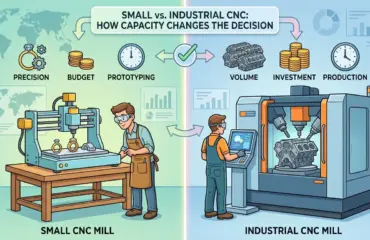
Budget discussions go wrong when buyers talk about money before they talk about work. One company has a modest budget and needs internal prototype access. Another has a larger budget but needs stable customer-facing production. Those are different buying problems even when the word budget appears in both conversations.
The best CNC machine for a given budget is therefore not simply the cheapest option in a category. It is the option whose total cost structure matches the production goal the business needs to protect.
Start By Naming The Production Goal Before Naming The Number
Before comparing any machines, define what success looks like. Is the machine being purchased for:
- Learning And Training?
- Internal Prototyping And Development?
- Custom Low-Volume Commercial Work?
- Repeat Small-Batch Production?
- Line-Oriented Or Highly Repetitive Manufacturing?
Once the goal is clear, budget planning improves immediately. Without that step, buyers often compare machines that are solving very different business problems.
Use Budget Bands As Planning Tools, Not As Universal Price Promises
The ranges below are broad planning bands in USD-equivalent terms. They are not universal market quotes. Real pricing changes with machine size, spindle package, automation, tooling, shipping, commissioning, and regional service.
| Planning Budget | What It Usually Buys | Best-Fit Production Goal | Common Buying Mistake |
|---|---|---|---|
| Under $10,000 | Desktop Or Light Benchtop Access | Learning, Education, Light Prototyping, Small Internal Jobs | Expecting Industrial Uptime Or Broad Commercial Throughput |
| $10,000-$50,000 | Stronger Benchtop Or Entry Stand-Alone CNC | Custom Work, Internal Tooling, Prototype-To-Light Commercial Use | Assuming This Range Automatically Covers Mature Production |
| $50,000-$200,000 | Serious Stand-Alone Commercial Equipment | Mixed Commercial Work, Repeat Small-Batch Production, Shop Growth | Buying General Capability When The Real Need Is Process Discipline |
| $200,000+ | Production-Oriented Industrial Equipment Or Multi-Stage Cells | Protected Workflow, Higher Throughput, Better Repeatability, Stronger Support | Judging By Core Machine Specs While Underestimating Integration Scope |
This table is simplified on purpose. The point is not to pretend every market fits one neat price ladder. The point is to make buyers ask what level of operating risk they are actually funding.
Lower Budgets Work Best When The Goal Is Access
At the lower end of the budget range, buyers are usually purchasing access rather than protected output. That can still be a good investment. Entry-level budgets often work well when:
- The Work Is Small Or Light-Duty.
- The Team Expects To Learn Gradually.
- Throughput Pressure Is Modest.
- The Machine Is Not Carrying Mainstream Commercial Delivery Risk.
This is where desktop or lighter benchtop platforms can create real value. They shorten feedback loops and let teams start using CNC without waiting for industrial capital approval.
The mistake is treating this budget band as if it should also carry stable customer-facing production. When buyers expect low-cost hardware to protect high-value delivery promises, the machine usually gets paid for twice: once in the quote and again in delay, rework, or the next upgrade.
Mid-Level Budgets Usually Buy Flexibility Better Than They Buy Full Production Protection
The middle of the market is the most misunderstood range. Buyers gain stronger structure, better motion behavior, larger envelopes, and more supportable controls. What they do not automatically gain is line-level production architecture.
This budget band is often strong for:
- Custom Fabrication.
- Mixed Job Work.
- Signage And Display Output.
- Light Furniture Or Cabinet Component Work.
- Prototype-Plus-Commercial Hybrid Environments.
Its real strength is adaptability. That is valuable when the workload is still varied. It becomes less valuable when the workflow has already stabilized enough that handoff speed, staffing consistency, and repeatable setup now matter more than broad flexibility.
Higher Budgets Should Buy Protected Workflow, Not Just Bigger Hardware
Once budgets move into more serious industrial territory, buyers should stop thinking mainly about envelope and start thinking about workflow protection.
Better equipment at this level should improve:
- Repeatability.
- Setup Stability.
- Serviceability.
- Recovery From Routine Interruptions.
- Support Quality.
- Integration With The Rest Of The Process.
The return is not only faster cutting. It is fewer interruptions, fewer avoidable mistakes, and less dependence on operator heroics. Buyers comparing this class of equipment may also want to review what makes industrial CNC equipment worth the investment before reducing the decision to raw specification language.
Budget Is Really A Risk Map
One practical way to simplify the decision is to translate budget into risk tolerance.
| Budget Logic | Main Risk The Buyer Is Accepting |
|---|---|
| Access-Focused Budget | Accept Capability Limits In Exchange For Lower Capital And Faster Entry |
| Flexible Commercial Budget | Accept More Manual Workflow In Exchange For Broader Job Variety |
| Production-Focused Budget | Spend More Up Front To Reduce Output Risk, Setup Variation, And Support Fragility |
This is a more useful frame than asking which machine is “best for the money.” Different buyers need protection from different kinds of failure.
Always Include Ownership Costs Around The Machine
Machine price alone is not the real budget. Buyers should also budget for the surrounding system, including:
- Tooling.
- Hold-Down Or Fixturing.
- Dust Collection, Coolant, Or Extraction.
- Training And Commissioning.
- Inspection Tools.
- Maintenance Time And Spare Parts.
- Installation And Material-Handling Requirements.
This is especially important in the middle of the market, where buyers often step up from entry-level expectations and assume the machine alone now equals a complete production solution. In practice, ownership gaps still matter a great deal.
If quotation scope still feels loose, it helps to compare machinery proposals line by line before assuming the lowest number is truly cheaper.
Ask What Failure Actually Costs In Your Workflow
One of the best budget questions is not “What can we afford?” It is “What does failure cost us?”
If failure means slower internal prototype cycles, the business can accept more limitation. If failure means missed delivery, scrap panels, weak repeatability, or unstable customer output, then the machine belongs in a higher-protection buying category.
That is why the same budget can mean very different things for a school, a design lab, a sign shop, or a cabinet producer. Budget is not merely buying capability. It is buying a certain level of operational risk.
Production Goals Change Faster Than Many Buyers Expect
A second challenge is that businesses often outgrow the original role of the machine. A platform purchased for experimentation can quietly become responsible for short-run customer work. A shop that started with varied custom jobs can discover that repeat panel output is now its core revenue.
That is why buyers should decide up front whether the machine is meant to be:
- A Learning Platform.
- A Flexible Revenue Asset.
- A Bridge Toward More Industrial Equipment.
- A Long-Term Production Core.
Without that clarity, teams often expect one machine to serve several incompatible stages of growth.
In Woodworking, Budget Eventually Becomes Process Design
Woodworking and panel processing make this especially visible. A small custom shop may do well with flexible stand-alone equipment. A growing cabinet or furniture producer often reaches a point where the real constraint is not “we need a CNC” but panel flow, drilling consistency, edge finish, sanding balance, and part movement between stations.
At that point, budget planning should shift from single-machine comparison toward process design. Buyers may need to compare CNC spend against other stages in the Pandaxis machinery lineup or against routes such as CNC nesting machines if flexible cutting is the true bottleneck.
The budget question changes from “Which CNC can we afford?” to “Which stage deserves capital first?”
A Bigger Stand-Alone CNC Is Not Always The Best Next Use Of Money
As output pressure rises, many buyers assume the next move must be a larger or more capable stand-alone CNC. Sometimes that is correct. Often it is not.
If the real problem is batch panel sizing, a panel-saw style route may improve output more directly. If the real issue is transition from cutting into assembly, drilling or edgebanding may deserve the money first. If the real issue is labor absorbed by loading and unloading, automation may matter more than spindle-side capability.
This is why production goals need to be translated into bottlenecks before budgets are allocated.
End The Budget Conversation With Named Tradeoffs
Before approving a purchase, the team should be able to state clearly:
- What Production Goal The Machine Must Support.
- What Constraint It Is Expected To Remove.
- Which Limitations Are Acceptable At This Budget Level.
- Which Limitations Would Create Unacceptable Workflow Risk.
- Whether The Machine Is A Bridge Purchase Or A Long-Term Core Asset.
If those points are still unclear, the budget conversation is probably too abstract.
Let Budget Follow Production Intent
The best CNC machine for a given budget depends on the production goal the machine must serve. Lower budgets are usually strongest for access, learning, and limited internal capability. Mid-level budgets often buy flexibility well for mixed commercial work. Higher budgets should buy process stability, serviceability, and stronger protection against workflow failure.
The safest path is to define the workload first, identify the cost of failure, and then match the machine category to that reality. When budget follows production intent, the decision gets much clearer.