Español
  Italiano
  Deutsch
  Français
  Português
  العربية
  Türkçe
  Русский
  Tiếng Việt
  한국어
한국어  日本語
日本語  简体中文
简体中文 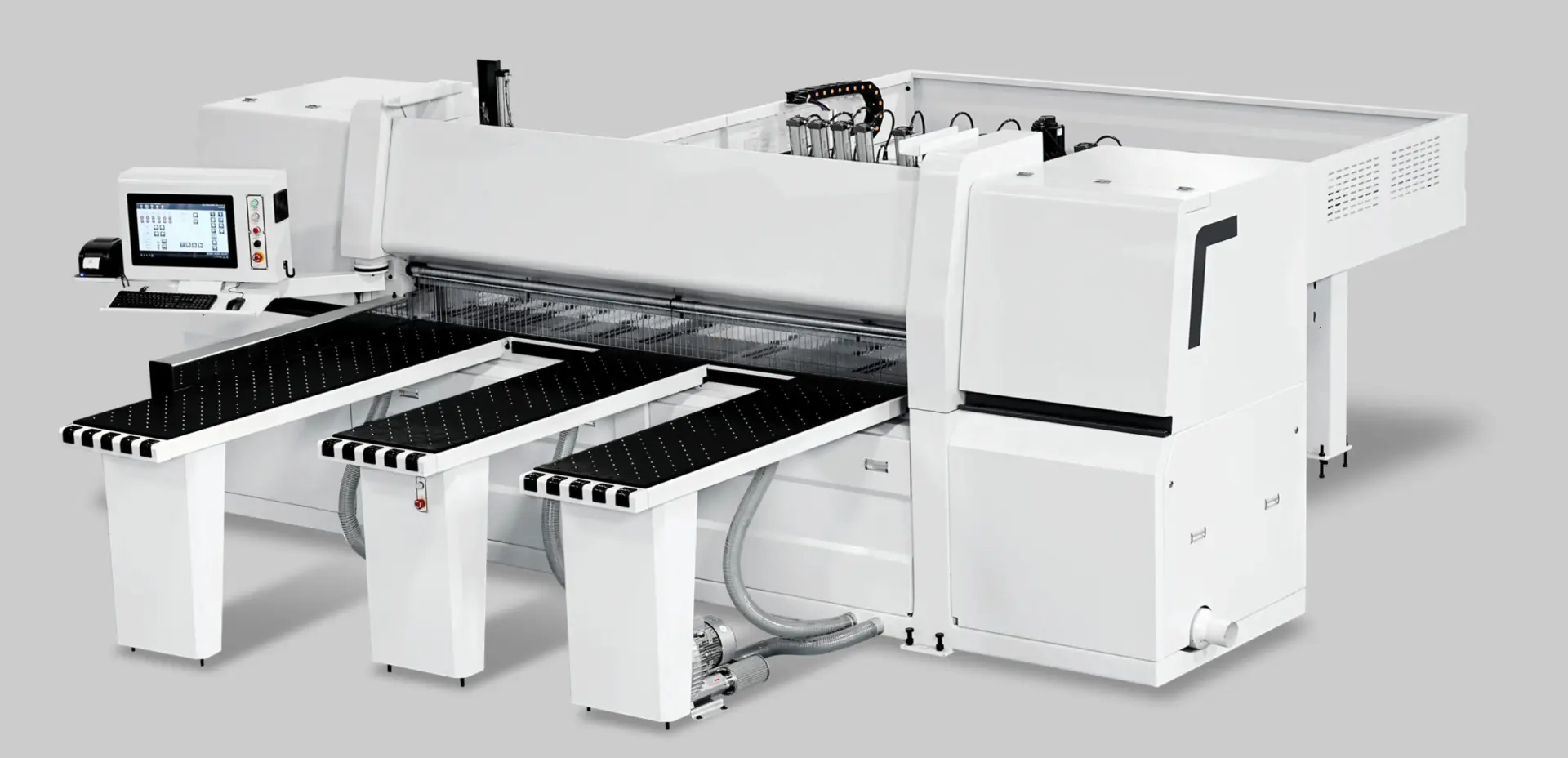
Wood cutting decisions often go wrong because buyers begin with machine specifications instead of production flow. Spindle power, bed size, feed capability, and travel dimensions all matter, but they do not answer the question that really decides return on investment: which machine layout moves your actual materials through your actual workflow with the least waste, the fewest corrections, and the smallest amount of labor friction? A cabinet factory cutting melamine-faced panels is not solving the same problem as a solid-wood workshop, a custom furniture shop, or a mixed producer trying to combine sheet breakdown with routed features and drilling.
That is why a useful guide should begin with three practical variables: materials, accuracy, and throughput. Materials determine how stock behaves at the cut and what edge condition matters afterward. Accuracy determines whether the next station can trust the part without adjustment. Throughput determines whether the cutting station supports the pace of the line or quietly becomes the constraint every other department works around. Once those three variables are connected, equipment selection becomes much more disciplined.
In industrial woodworking, “wood cutting machine” is not a single class. It can mean a panel saw, a CNC nesting system, a sliding table saw, or other cutting-centered equipment depending on the job. No category is universally best. The right answer is the one that aligns with the daily production logic of the factory rather than with the most impressive demo clip.
| Main Production Need | Best-Fit Machine Logic | Why It Fits |
|---|---|---|
| Repeated rectangular panel breakdown at volume | Panel saws | Strong fit for fast, repeatable sheet sizing in batch workflows |
| Flexible panel cutting with routing, drilling, and nested shapes | CNC nesting machines | Reduces handoffs in high-mix panel production |
| Mixed custom work, operator-led precision, smaller batch rhythm | Sliding table saws | Preserves flexibility where job variety is high |
“Wood” Covers Material Families That Behave Very Differently
One reason buyers mismatch equipment so often is that they treat wood as one material category. In real production, MDF, particle board, plywood, melamine-faced panels, veneered boards, solid hardwood, softwood, and specialty composites create very different cutting demands. Some materials mainly test edge cleanliness and laminate behavior. Others expose tear-out, grain sensitivity, moisture effects, dust load, or support weakness during processing.
That means the machine decision should start with the actual material mix, not with a generic wish list. If the line runs mostly sheet goods for cabinet production, the cutting logic usually points toward repeatable sheet handling and fast breakdown. If the shop spends most of its time on solid-wood components, cut flexibility, grain behavior, and operator judgment may matter more. Mixed shops need to know which material family causes the most rework and which one dominates machine hours.
The strongest purchase usually fits the dominant material family, not the most unusual one. Buying around exceptions often creates a machine that looks versatile on paper and awkward in daily production.
Accuracy In Woodworking Means Downstream Fit, Not Just Positional Capability
Woodworking buyers often ask about accuracy as if it were a single number. In practice, production accuracy is the ability of the whole route to produce parts that fit downstream without argument. A cabinet side should match boring positions. A shelf should drop into place cleanly. A panel edge should arrive ready for edgebanding or finishing. A cut part can be technically precise at the machine and still create assembly trouble if the material shifts, the tool is dull, or the route is badly matched to the substrate.
That is why accuracy should be judged at the line level. Does the cut reduce hand cleanup? Do repeated parts assemble without force? Do routed features land where the next operation expects them? Does the edge remain clean enough for the finish standard the shop sells? These questions are more useful than isolated positioning claims because they connect machine performance to commercial output.
Different machine families reach that result differently. A panel saw improves repeatability on repeated rectangular work because the route is aligned with the part geometry. A nesting machine improves assembly readiness by combining cutting with routing and drilling in one logic. A sliding table saw supports accurate custom work where operator control and adaptability still matter. Each route can be accurate, but each achieves useful accuracy in a different production context.
Throughput Is Shaped By Handling As Much As By Cutting Speed
Cutting speed alone is a weak measure of productivity. A machine only creates usable throughput when stock arrives efficiently, leaves in an organized state, and reaches the next process without confusion or backtracking. In panel furniture and cabinet production, loading, offloading, labeling, stacking, sorting, and transfer to drilling, edge processing, sanding, or assembly often shape output as much as the cut itself.
This is why equipment should be evaluated as part of a route, not as an isolated performance island. A machine that looks fast in a demo can still underperform if sheet handling is chaotic or if downstream departments cannot absorb what it produces. A less dramatic machine can improve whole-line output if it reduces handoffs and keeps more of the route under one stable process logic.
Factories planning growth often benefit from thinking first about how to build a connected production line rather than asking a cutting station to solve problems the rest of the plant is not ready for. Throughput is a system result.
Panel Saws Win When The Factory Lives On Repeated Sheet Breakdown
If the order book is dominated by rectangular panels, repeated cabinet components, and fast sheet sizing, panel-saw logic is often the strongest fit. The machine is not chosen because it is the most flexible. It is chosen because it aligns tightly with the work. High-volume breakdown rewards predictable loading, clean repeated cuts, and a route built around turning large sheets into production-ready blanks quickly.
This is why many cabinet and furniture factories still center their cutting department around panel saws. They are not chasing decorative freedom. They are trying to move panel stock through the line with minimal variation and minimal wasted motion. If the majority of parts remain rectangular until later operations, that saw-based logic is hard to beat.
But panel saws are not universal answers. Once part shapes become more variable, once nested cutouts become common, or once drilling and routing integration start to matter, the plant may need a different route. The correct response is not to force a saw to solve every job. It is to recognize when the work has changed.
CNC Nesting Machines Matter When Flexibility And Integration Become The Real Value
Nesting becomes much more compelling when cutting is no longer only about rectangles. If the shop needs shaped panels, internal cutouts, variable layouts, routed features, or integrated drilling inside the same route, then a nesting machine can reduce handoffs and simplify the path from sheet to assembly-ready component. That is especially valuable in custom cabinetry, wardrobes, interior fit-out, and other high-mix environments where flexible processing matters as much as raw output.
The real productivity value of nesting is not only its ability to cut shapes. It is its ability to keep more of the work in one controlled flow. That often means less handling, less manual repositioning, and better organization downstream because the machine is not merely cutting panels. It is helping define how panels move through the rest of the line.
This is why buyers should choose nesting when flexibility is central to the business model, not simply because routing sounds more advanced. Flexibility has value only when the orders actually use it. Where it does, nesting can outperform simpler cutting routes because it removes labor steps that are otherwise hard to see in a machine comparison.
Sliding Table Saws Still Fit Many Serious Woodworking Businesses
Sliding table saws remain important because many factories and workshops are not running high-volume automated panel lines, yet still need accurate cutting with strong operator control. In custom furniture, smaller workshops, mixed-material production, and lower-volume job environments, a sliding table saw can be the most practical center of the cutting process.
Its advantage is not maximum automation. Its advantage is controlled flexibility. Skilled operators can respond to variable jobs, changing dimensions, and mixed materials without forcing the business into a larger automated structure too early. For many growing shops, that is economically sensible because it keeps cut quality useful while preserving workflow adaptability.
The mistake is to treat the sliding table saw as a lesser choice simply because it is less automated. In the right environment, it is the correct amount of machine: flexible enough for variable jobs, accurate enough for quality work, and not burdened with a heavier system than the order mix can justify.
Edge Quality Is Usually A Material And Process Question Before It Is A Machine Question
Shops sometimes blame the machine first when cut quality disappoints. Often the real issue sits in tooling, dust extraction, support conditions, or process mismatch with the material. Laminated panels expose chip-out problems quickly. MDF exposes tooling and dust weaknesses through edge finish and wear. Solid wood reveals grain-related issues that feed strategy and cutter choice can either manage or aggravate.
This is why machine comparisons should always be tied back to the broader cutting process. A strong machine route includes correct tooling, stable support, and reliable dust control. Without those, even an otherwise suitable machine can produce weak results.
The same principle applies to support and hold-down. If the sheet is not supported well, accuracy and edge quality both suffer. If spoilboard or feed conditions are poor, routed output becomes less trustworthy. Buyers should therefore evaluate not only the equipment family, but whether their shop is ready to run that family correctly every day.
The Best Cutting Station Is The One That Balances With The Next Department
A cutting station should not be chosen in isolation from the next process. If the line cuts faster than drilling, edging, sanding, or assembly can absorb, work-in-process grows and floor space tightens. If the cutting department cannot feed those departments predictably, the rest of the line loses time waiting or compensating. In both cases, the cutting choice has failed at the route level even if the machine itself is technically strong.
This is why buyers should review where the line slows down now. Do panels wait before drilling? Do routed parts arrive faster than assembly can sort them? Does edge quality force manual cleanup before edgebanding? Are operators spending more time moving parts than actually cutting them? These are not secondary details. They are the signs that reveal which machine family the business is actually ready to benefit from.
In many factories, the right cutting machine is the one that makes the next department calmer, not simply the one that looks fastest at the spindle.
Automation Depth Should Match The Business Model, Not Aspirational Growth Alone
Some businesses clearly need more automation because order volume, labor structure, and product mix demand it. Others do not. Buying too far ahead of the business creates complexity that is expensive to support. Buying below the needs of the business leaves recurring bottlenecks untouched. The correct wood cutting machine is therefore the one whose automation depth matches the real rhythm of the workshop.
Before buying, review several months of work honestly. Which materials dominate machine time? How many parts remain rectangular? How many require nested shapes or integrated machining? Where does rework begin now: at the cut, at edge finishing, at boring alignment, or at assembly? How much labor is spent moving sheets and sorting parts instead of cutting them? These answers usually reveal whether the plant really needs faster sheet breakdown, more integrated routing, or more operator-led flexibility.
If the line cannot answer those questions clearly, the business is not ready for a machine comparison yet. It still needs a workflow diagnosis.
A Good Purchase Usually Starts With A Cut-Report, Not A Catalog Download
Before committing to a new cutting platform, many factories would benefit from a simple internal cut report. For one month, record which materials run most often, where edge defects appear, how much time is spent on loading and sorting, how often parts need correction before the next process, and which downstream station complains most often about cut quality or timing. This does not need to be a complex digital transformation project. It just needs to be honest.
That short report often changes the buying conversation. A plant may discover that its real problem is not insufficient spindle power but poor sheet handling. Another may discover that its saw route is dimensionally strong but no longer fits a product mix dominated by shaped panels and integrated machining. Another may discover that its flexible manual process is still economically correct because the order book is far more varied than management assumed.
The point of the cut report is to turn “we need a better wood cutting machine” into “we need faster rectangular breakdown,” or “we need fewer handoffs on routed panel work,” or “we need better control in low-volume custom cutting.” Once the problem is named properly, the right machine family is usually much easier to defend.
How This Fits Broader Pandaxis Equipment Planning
Pandaxis is most useful in this topic when the cutting question is viewed as part of a larger woodworking route. Buyers comparing breakdown, routing, and flexible saw-based workflows can move naturally from category-level review into broader line planning by using the Pandaxis machinery lineup alongside category pages for panel saws, CNC nesting machines, and sliding table saws. The central idea stays the same: do not buy “a wood cutting machine” in the abstract. Buy the cutting workflow that best fits the material family and production rhythm you already have.
Choose The Cutting Workflow That Removes The Most Daily Friction
The best CNC wood cutting machine is not defined by one specification. It is defined by how well it fits the materials your shop actually processes, the downstream fit your line actually needs, and the throughput your other departments can actually absorb. Panel saws usually fit repeated sheet breakdown. CNC nesting machines usually fit flexible panel processing with integrated routing and drilling. Sliding table saws usually fit lower-volume or custom work where operator-led control still matters.
If the decision still feels unclear, step back from the machine names and look at the daily friction. Which material family causes the most trouble? Which parts trigger the most correction later? Which station most often slows the line? The right purchase usually becomes obvious once the question changes from “Which cutter is strongest?” to “Which cutting workflow removes the most production friction every week?”