When buyers compare a steel laser cutter with an aluminum laser cutter, the most useful question is usually not whether they need two completely different machine categories. The real issue is whether the laser system, cutting head control, assist-gas strategy, and material-handling plan are matched to the material behavior that dominates the production schedule.
That distinction matters because steel and aluminum do not place the same demands on the cutting process. A machine that looks productive on mild steel parts can become harder to stabilize when aluminum enters the mix, especially if the shop also expects consistent edge quality, low scrap, and minimal operator intervention. In practice, this is a workflow decision as much as a machine decision.
Why This Usually Is Not A Simple Material Label Decision
In industrial buying language, a “steel laser cutter” and an “aluminum laser cutter” often describe different production priorities more than completely separate machine classes.
Many fabrication shops want one laser platform to process multiple materials. That can work well, but only if the buyer understands what changes when the material changes. Aluminum often pushes the machine toward stricter process control, while steel workloads can vary widely depending on whether the shop mainly cuts carbon steel, stainless steel, or a mix of both.
That is why a strong buying process starts with material behavior, part mix, and downstream requirements rather than with the marketing label attached to the machine.
How Steel And Aluminum Behave Differently In Cutting
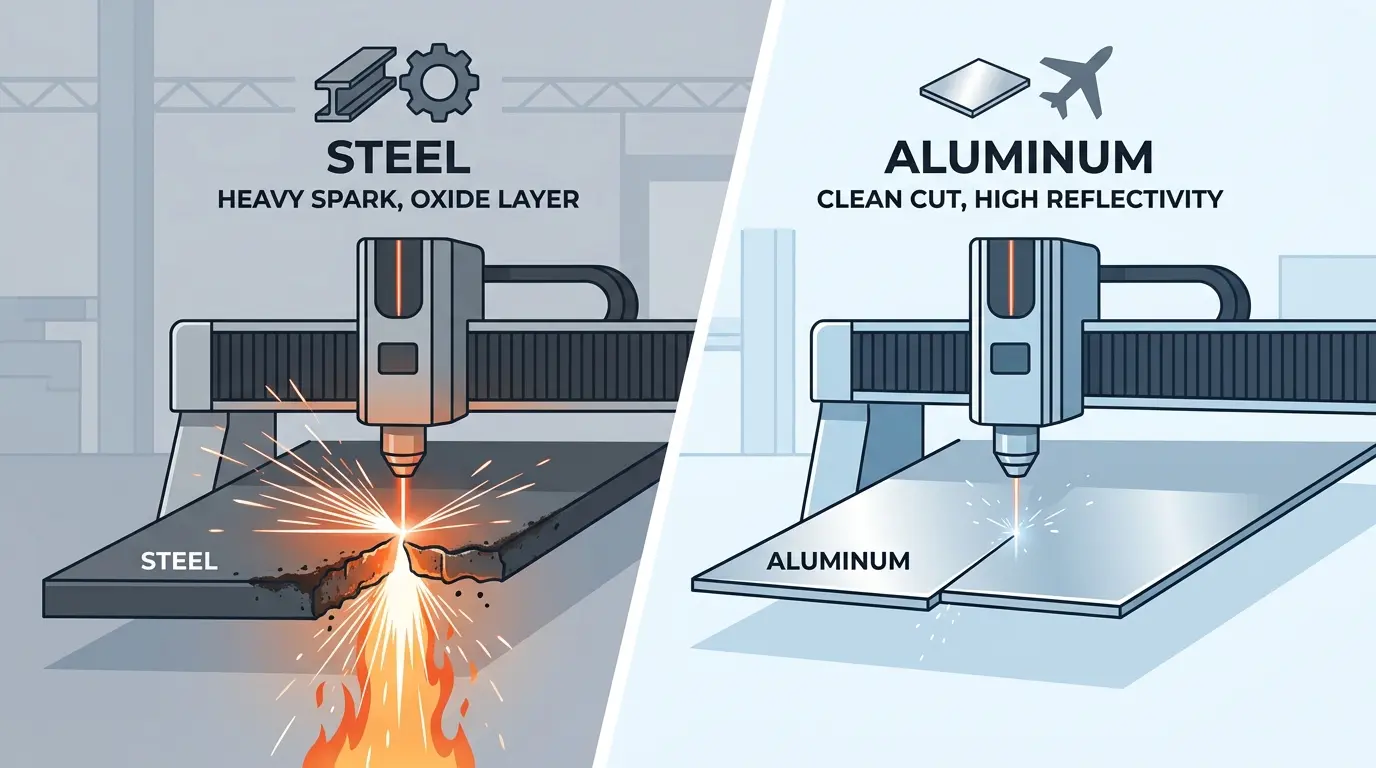
Steel and aluminum respond differently to laser energy, and those differences shape machine selection.
| Process Factor | Steel Workflow Reality | Aluminum Workflow Reality | Why It Matters |
|---|---|---|---|
| Reflectivity | Usually More Straightforward To Process Across Common Steel Work | Commonly Treated As More Demanding In Reflective-Material Processing | Reflective behavior affects process stability and confidence during startup and piercing |
| Heat Movement | Heat Response Is More Familiar Across Many Fabrication Workflows | Higher Thermal Conductivity Often Pushes Buyers Toward Tighter Process Control | Faster heat movement can affect edge quality, piercing consistency, and small-feature performance |
| Edge Priorities | Carbon Steel And Stainless Steel Often Have Different Edge Expectations | Buyers Often Focus On Clean Edge Quality And Reduced Rework | The acceptable cut condition changes the real machine requirement |
| Nozzle And Optics Discipline | Important In All Metal Cutting | Often Even More Important When Aluminum Is A Core Material | Process contamination and unstable setup can show up quickly in aluminum work |
| Programming Sensitivity | Important For Nested Parts And Mixed Thicknesses | Often More Sensitive On Small Parts, Fine Features, And Heat-Sensitive Layouts | Path strategy affects scrap, dross risk, and downstream fit |
| Operator Margin For Error | Depends On Material Family And Production Standard | Often Narrower When Aluminum Quality Must Stay Consistent | Shops need the machine and team to stay stable over long production runs |
The practical takeaway is simple: aluminum does not just change the material on the table. It often changes how disciplined the entire cutting process must be.
Why Steel Is Not One Single Production Case
One common mistake is treating steel as if it were a single cutting profile.
In real fabrication, carbon steel and stainless steel usually create different priorities:
- Carbon Steel Often Pushes The Discussion Toward Throughput, Thickness Mix, And Downstream Welding Or Coating Fit.
- Stainless Steel More Often Pulls The Discussion Toward Cleaner Edges, Lower Oxidation, And Cosmetic Consistency Before Bending, Brushing, Or Assembly.
That matters because a shop comparing steel with aluminum is often actually comparing aluminum against a specific steel workload, not against an abstract material category.
If the production mix is mostly carbon steel brackets, frames, or structural parts, the buying logic is different from a shop cutting stainless enclosures and visible fabricated components. Aluminum enters those two environments in very different ways.
What Changes When Aluminum Becomes A Core Production Material
When aluminum is only an occasional material, buyers may accept a machine that is optimized mainly for steel and adjusted when aluminum orders appear. When aluminum becomes a daily production material, the machine choice usually becomes more demanding.
Buyers commonly start paying closer attention to:
- Beam Stability Across Long Production Runs
- Cutting Head Responsiveness And Height Control
- Gas Delivery Consistency And Nozzle Condition
- Pierce Stability On Mixed Geometries
- Scrap Reduction On Small Or Heat-Sensitive Parts
- Operator Training And Process Repeatability
This is where many quotation comparisons go wrong. Two machines may both be presented as capable of cutting aluminum, but one may be much better suited to stable daily aluminum production because the supporting systems are stronger, not just because the headline power is different.
Assist Gas And Edge Expectations Change The Economics
Material selection affects operating cost as well as cut quality.
Steel and aluminum are often evaluated with different gas strategies depending on the part requirement. Carbon steel work may be judged around productivity and downstream suitability, while stainless steel and aluminum are more often discussed around cleaner, lower-oxidation edge expectations. That changes not only cut appearance but also gas consumption, secondary finishing burden, and cost per part.
For buyers, the important point is not to assume that one material mix automatically creates the same running cost profile as another. A machine that looks attractive when quoted against steel-heavy work may perform very differently once aluminum becomes a larger share of the schedule.
What Buyers Should Compare Before Looking At Price
Before comparing vendors or power ranges, buyers should define the actual workload.
Use questions like these:
- What Percentage Of Weekly Orders Is Steel Versus Aluminum?
- Within Steel, Is The Shop Mostly Cutting Carbon Steel Or Stainless Steel?
- Which Parts Are Cosmetic, And Which Parts Are Primarily Structural?
- How Much Labor Is Currently Spent On Deburring, Cleanup, Or Edge Correction?
- Are Aluminum Jobs Occasional, Or Do They Need Stable Daily Throughput?
- What Thickness Range Dominates Real Orders Rather Than Rare Quote Requests?
- Does The Factory Need A Standalone Laser Cell Or A More Automated Material-Handling Workflow?
- Which Material Creates The Highest Risk Of Scrap, Delay, Or Rework Today?
Without that clarity, a buyer can easily overvalue maximum machine capability and undervalue day-to-day process stability.
Selection Priorities At A Glance
| Buying Priority | Steel-Heavy Shops Commonly Focus On | Aluminum-Heavy Shops Commonly Focus On | Practical Reading |
|---|---|---|---|
| Throughput | Stable Output Across Repetitive Steel Jobs | Stable Output Without Quality Drift On Aluminum Orders | The fastest quote is not always the most stable production result |
| Edge Quality | Varies By Carbon Steel Versus Stainless Steel Job Mix | Often Evaluated More Strictly For Clean, Repeatable Results | Downstream finishing expectations should drive the comparison |
| Process Stability | Important, But Often More Forgiving In Familiar Steel Work | Frequently A Primary Decision Factor | Aluminum-heavy work usually exposes weak process control faster |
| Scrap Risk | Tied To Nesting, thickness mix, and part families | Often More Sensitive On Heat-Sensitive Features And Reflective-Material Runs | Scrap economics can change quickly when aluminum volume rises |
| Training Burden | Depends On Job mix and automation level | Often Higher If The Shop Lacks Stable Aluminum Process Discipline | Equipment choice should match operator maturity |
| Expansion Path | Often Built Around Broader Steel Capacity | Often Built Around Better Control For Reflective-Material Work | Future order mix matters as much as current workload |
When One Machine Can Cover Both Materials Well
One laser platform can often cover both steel and aluminum successfully when:
- The Thickness Range Is Reasonably Aligned Across The Job Mix.
- Aluminum Is Present But Not Wildly Different From The Core Steel Work.
- Quality Standards Are Clearly Defined By Part Family.
- The Shop Has Good Process Discipline Around Gas, Nozzles, And Maintenance.
- The Team Understands That Material change means process adjustment, not just program change.
In that situation, one well-selected metal cutting system can simplify layout, training, maintenance planning, and scheduling.
When The Material Mix Starts Justifying A More Specialized Setup
The decision becomes harder when the same machine is expected to handle very different production goals.
That usually happens when:
- The Shop Runs High-Volume Carbon Steel Production But Also Needs Consistent Aluminum Quality.
- Stainless, Carbon Steel, And Aluminum All Have Different Edge And Finish Standards.
- Aluminum Parts Include Fine Features Or Tight Quality expectations that leave little room for process drift.
- The Plant Is Trying To Combine Appearance-Critical Work And Heavy Throughput Work In One Cell.
At that point, the problem is no longer simply whether the machine can cut both materials. The problem is whether one platform can do so without forcing compromises in scheduling, rework, or margin.
The Practical Bottom Line
The best choice is usually not the machine that sounds strongest in a generic steel-versus-aluminum comparison. It is the machine that matches the actual material mix, edge expectations, process discipline, and downstream workflow of the factory.
If the shop is mainly steel-focused and aluminum is secondary, the strongest answer may be a steel-optimized workflow that can still handle aluminum reliably. If aluminum is becoming a strategic part of the order book, buyers should expect process stability, operator discipline, and edge consistency to carry more weight in the decision.
In other words, aluminum often raises the standard for the whole cutting cell. Steel may still dominate the schedule, but aluminum is often the material that reveals whether the machine is merely capable or truly production-ready.
For teams comparing laser investment with broader equipment planning, the Pandaxis product catalog can help frame the laser decision inside a wider factory-capital discussion.