Buying an acrylic laser cutting machine looks straightforward until sample quality has to survive real production pressure. A machine may produce one clean demo part on clear acrylic, but that does not guarantee stable output once the schedule includes different sheet types, frequent job changes, nested small parts, and visual-grade orders that leave little room for edge defects or rework.
For buyers evaluating laser cutters and engravers for acrylic and other non-metallic applications, the practical question is not whether the machine can cut acrylic. The real question is whether it can hold edge appearance, dimensional repeatability, and predictable throughput across the actual jobs your factory runs every week.
Why Acrylic Changes the Buying Decision
Acrylic is often judged more harshly than many other sheet materials because the cut edge is part of the finished result. A part can be dimensionally correct and still become a reject if the edge looks inconsistent, the surface picks up residue, or the output varies too much from one batch to the next.
That shifts the buying decision in several important ways:
- Edge Appearance Matters Almost as Much as Basic Cut-Through
- Process Stability Matters More Than Headline Demo Speed
- Changeovers Matter More When the Queue Includes Different Acrylic Jobs
- Surface Cleanliness and Part Handling Affect Yield Directly
- Recipe Repeatability Matters Because Acrylic Work Is Often Visually Inspected
In other words, acrylic cutting is usually not only a cutting-speed decision. It is a quality-control and workflow-control decision as well.
Start With the Product Mix, Not the Demo Sample
Before comparing machine layouts or supplier presentations, define what the machine will actually do in production. Acrylic work can look similar from a distance while placing very different demands on the process.
| Acrylic Workflow | What Buyers Usually Prioritize | What Commonly Creates Problems |
|---|---|---|
| Clear Display Parts | Visually clean edges, repeatable shape accuracy, consistent finished appearance | Edge inconsistency, residue, and quality drift over longer runs |
| Signage and Branded Panels | Detail quality, contour accuracy, stable repeatability across repeated jobs | Variation between small features and larger perimeter cuts |
| Functional Covers and Guards | Reliable cut-through, dimensional consistency, predictable cycle time | Rework caused by unstable settings or operator-dependent setup |
| Small Nested Components | Tight part spacing, repeatability, efficient sheet use | Motion instability, extra handling time, and sorting delays |
| Mixed Acrylic Job Batches | Fast changeovers and repeatable saved settings | Productivity loss between jobs rather than during the cut itself |
This matters because the right machine for visual-grade acrylic parts is not always selected the same way as a machine for functional acrylic components. If most of your output is judged by appearance, process stability becomes a primary buying factor. If the workload is more utility-driven, repeatable separation and handling efficiency may matter more than cosmetic perfection.
The Machine Criteria That Matter Most
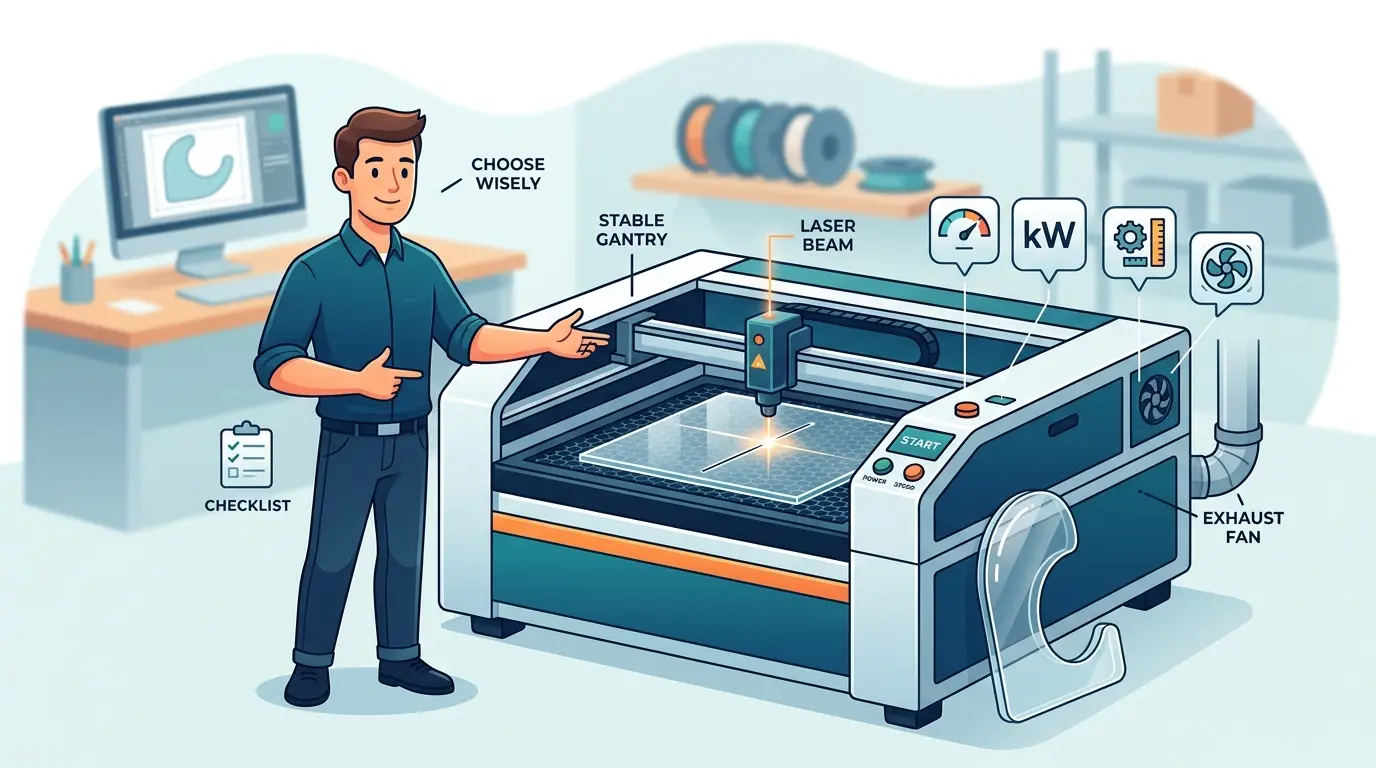
When buying an acrylic laser cutting machine, the useful discussion is not about features in isolation. It is about which machine conditions protect part quality and throughput under day-to-day operating pressure.
| Buying Factor | Why It Matters in Acrylic Production | What To Verify Before Buying |
|---|---|---|
| Motion Stability and Positioning | Helps keep contours, corners, and repeated parts consistent across the sheet | Compare repeated parts from the same job, not only one sample cut |
| Focus Consistency | Supports more stable edge quality across different jobs and sheet conditions | Check whether quality stays consistent across the full working area |
| Air Assist and Extraction Stability | Helps keep the cut zone cleaner and reduces residue buildup during longer runs | Inspect both edge condition and surrounding surface cleanliness |
| Working Area and Sheet Handling | Affects real throughput through loading, alignment, unloading, and sheet utilization | Evaluate your actual sheet sizes and operator handling rhythm |
| Recipe Management and Job Recall | Reduces operator guesswork and shortens changeovers between recurring jobs | Confirm that common acrylic jobs can be saved and repeated easily |
| Access for Routine Cleaning and Maintenance | Acrylic output can drift when optics and extraction conditions are neglected | Check how easily daily cleaning and inspection can be done |
| Operator Workflow Around the Machine | Throughput depends on what happens before and after the cut, not only during it | Watch part unloading, scrap removal, and reloading during a realistic cycle |
Each of these factors affects output quality in a practical way. A machine that looks fast in a short demonstration can still lose production time if operators spend too long recovering stable settings, cleaning around the process, or inspecting for inconsistent results.
Acrylic Variation Can Disrupt Repeatability Faster Than Buyers Expect
Acrylic is often treated as one material category, but real production is usually more complicated. Different acrylic types and surface conditions can change what the machine must control well.
For example, buyers commonly run into differences such as:
- Clear Versus Colored Acrylic With Different Visual Standards
- Cast Versus Extruded Acrylic That Can Respond Differently in Production
- Film-Covered Sheets That Add Handling and Surface-Protection Concerns
- Small Detail Work Versus Large Perimeter Cuts
- Short-Run Custom Orders Versus Repeated Batch Jobs
That is why the best buying test is rarely one attractive sample part. A better evaluation uses the real acrylic stock that consumes the most machine hours in your plant and checks whether the process stays stable across repeated parts, not just one successful pass.
If the machine will spend most of its time on clear visual-grade parts, edge consistency and cleanliness should carry more weight in the decision. If the workload is mixed and changeover-heavy, recipe recall and operator repeatability become just as important.
Throughput Depends on the Whole Workflow, Not Just the Beam
Many buyers compare acrylic laser machines by watching cut speed alone. That is understandable, but it hides the bigger cost drivers.
In production, throughput is usually shaped by the full cycle:
- Loading and Aligning the Sheet
- Selecting or Recalling the Correct Job Recipe
- Running the Cut Without Unplanned Stops
- Removing Parts and Scrap Efficiently
- Inspecting Visual Quality
- Preparing the Machine for the Next Job
If a machine cuts quickly but requires repeated adjustment, cleanup, or extra inspection, the net output can still disappoint. In acrylic work, good parts per shift is a better metric than peak travel speed or the best-looking demo corner.
Factories often improve real output when they:
- Group Similar Acrylic Jobs Together Instead of Constantly Mixing the Queue
- Separate Visual-Grade Parts From Lower-Sensitivity Utility Parts
- Standardize Approved Recipes for Repeated Materials and Part Families
- Measure Rework and Inspection Time Alongside Cut Time
- Keep Cleaning and Extraction Maintenance on a Fixed Routine
This is also why buyers should examine the machine in motion over a realistic run, not only during a short presentation. Long-run stability reveals more than a single sample ever can.
When Laser Is the Right Fit and When Another Process May Work Better
Laser cutting is commonly a strong fit for acrylic when part geometry, edge presentation, and process flexibility matter more than purely mechanical material removal. It is often well suited to shaped parts, signage elements, detailed contours, and applications where non-contact processing helps keep the workflow consistent.
But laser is not automatically the best answer for every acrylic job. For teams comparing several process options across the broader Pandaxis product catalog, the more useful question is what the downstream workflow needs.
| Production Priority | Acrylic Laser Cutting | Mechanical Cutting or Routing |
|---|---|---|
| Detailed Internal Shapes and Fine Contours | Strong Fit | Often Less Efficient for Intricate Geometry |
| Visual-Grade Acrylic Parts | Strong Fit | Application Dependent and May Require More Secondary Finishing |
| Frequent Design Changes or Short Runs | Strong Fit | Application Dependent |
| Simple Repeated Blanks With Limited Detail | Application Dependent | Often Practical |
| Integrated Routing, Drilling, or Mechanical Edge Processing | Limited | Often Stronger Fit |
| Workflow Driven Mainly by Heavy Material Removal | Application Dependent | Often Stronger Fit |
This comparison matters because some buyers try to force all acrylic work through one process. In practice, the better result usually comes from matching the machine to the part type, the finish expectation, and the rest of the production line.
What To Clarify Before You Place the Order
Before buying an acrylic laser cutting machine, it helps to answer a few operational questions clearly:
- Which Acrylic Jobs Actually Consume the Most Machine Hours?
- Are Your Most Important Parts Judged Mainly by Visual Edge Quality or by Basic Throughput?
- How Often Will Operators Change Between Different Acrylic Types or Job Families?
- What Percentage of Parts Need To Leave the Machine Ready for Immediate Assembly or Shipping?
- How Much Output Is Lost Today to Inspection, Cleanup, or Rework Rather Than to Cutting Time?
- Can Your Team Standardize Recipes, Maintenance, and Handling Procedures Across Shifts?
- Are You Buying for the Weekly Production Mix or for the Most Impressive Demo Scenario?
These questions usually expose the real decision criteria faster than a feature checklist does. They help separate a machine that merely cuts acrylic from a machine that fits the way your plant actually runs acrylic work.
Practical Summary
The right acrylic laser cutting machine is usually the one that protects finished-part quality while keeping the workflow predictable. That means looking beyond whether the beam can cut acrylic and focusing instead on motion stability, edge consistency, extraction and cleanliness, job repeatability, operator workflow, and how well the machine holds up across your real product mix.
If your factory depends on detailed acrylic parts, visual-grade output, and frequent job changes, the buying decision should prioritize repeatable quality and stable workflow control over headline demo speed. A machine that stays consistent across repeated runs will usually create more usable output and less hidden production loss than one that only looks impressive in a short trial.