When a fabrication shop compares a fiber laser cutter with a CO2 laser cutter, the real question is rarely just beam source. The decision usually comes from a production constraint: rising power costs, inconsistent throughput across different metals, pressure to reduce maintenance downtime, or the need to quote metal jobs more confidently.
For most metal-focused fabrication workflows, fiber laser systems now set the baseline. But that does not make CO2 technology irrelevant in every case. The better choice depends on your material mix, job profile, operating cost tolerance, and whether your shop is built around metal-only production or a broader mixed-material workflow.
Where The Decision Starts In Real Production
In practical metal fabrication, buyers usually compare these two technologies when they are trying to improve one or more of the following:
- Cut Speed On Daily Production Jobs
- Edge Quality That Reduces Secondary Finishing
- Operating Cost Per Part
- Machine Uptime And Maintenance Planning
- Material Flexibility Across Steel, Stainless, Aluminum, And Other Alloys
- Integration With Automated Loading, Unloading, And Nesting Workflows
If your plant is primarily cutting sheet metal and tube components, fiber laser is often the first system evaluated because it aligns more directly with modern throughput and efficiency expectations. CO2 enters the conversation when a shop has legacy experience with that process, already owns upstream and downstream tooling built around it, or handles a broader material mix beyond metal.
The Core Difference Between Fiber And CO2 Laser Processing
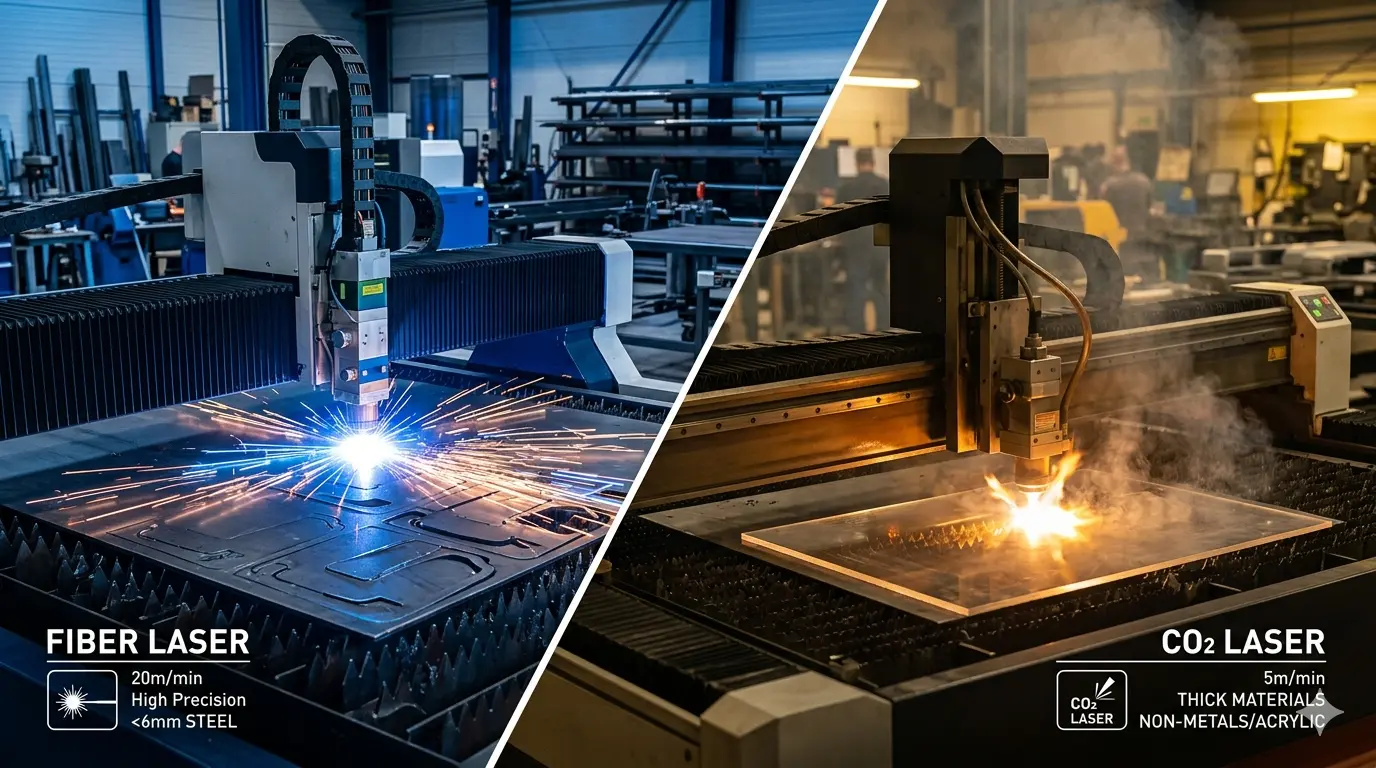
A fiber laser generates its beam through a solid-state source and delivers energy through fiber optics. A CO2 laser generates its beam through a gas-based resonator and uses a different beam path and support system.
That technical difference matters because it changes how the machine behaves on the shop floor:
- Fiber Laser Systems Are Commonly Favored For Sheet Metal Cutting Because They Convert Power More efficiently And Typically Support Faster Processing On Many Thin-To-Mid-Thickness Metal Jobs.
- CO2 Laser Systems Have Long Been Used In Industrial Cutting, But They Usually Involve More Optical Path Maintenance, More Supporting infrastructure, And Higher Energy Demand Relative To A modern fiber setup.
- Fiber Laser Systems Generally Perform Better On Reflective Metals Such As Aluminum, Brass, And Copper, where CO2 workflows have historically been less straightforward.
The result is not just a difference in cutting physics. It becomes a difference in quoting speed, machine utilization, preventive maintenance routines, and the total cost of keeping the line productive.
Fiber Laser Vs CO2 Laser For Metal Fabrication At A Glance
| Decision Factor | Fiber Laser Cutter | CO2 Laser Cutter |
|---|---|---|
| Metal Cutting Fit | Well suited to modern sheet metal fabrication, especially for steel, stainless steel, aluminum, brass, and copper | Can cut metal, but is usually less favored today for metal-first production lines |
| Energy Efficiency | Commonly stronger in wall-plug efficiency and operating cost control | Typically requires more energy for comparable metal-cutting output |
| Thin-To-Mid Thickness Throughput | Often better for fast production on common sheet metal ranges | Usually less competitive on speed for many routine metal jobs |
| Reflective Metal Processing | Commonly a better fit | Typically more limited or less convenient |
| Maintenance Burden | Usually lower optical maintenance complexity | Usually higher maintenance involvement around optics and beam path |
| Mixed Non-Metal Workflow | Less ideal if wood, acrylic, and similar non-metals are a major part of the business | Often more attractive in mixed-material environments that include non-metal processing |
| Legacy Shop Familiarity | Better fit for shops upgrading toward current metal fabrication norms | Can still make sense in facilities already organized around existing CO2 operations |
| Automation Alignment | Commonly easier to justify in high-throughput, automation-oriented environments | More difficult to justify when the goal is maximum metal-cutting efficiency |
When Fiber Laser Is Usually The Better Choice
Fiber laser is usually the stronger choice when metal fabrication is the core business rather than one process among many.
That is especially true if your shop needs:
- Faster Turnaround On Routine Steel And Stainless Jobs
- Better Economics On High-Mix Or Repetitive Sheet Metal Work
- Cleaner Handling Of Reflective Metals
- Lower Ongoing Energy Consumption
- Less Downtime Linked To Beam Delivery Maintenance
- Stronger Compatibility With Automated Fabrication Cells
In these environments, fiber laser technology tends to improve more than just cutting speed. It often helps stabilize quoting assumptions, reduce rework risk from inconsistent cut performance, and support more predictable production scheduling.
For contract fabricators, enclosure manufacturers, HVAC component producers, and general sheet metal shops, those workflow gains are usually more important than the beam-source debate itself.
When CO2 Laser Can Still Make Sense
CO2 is no longer the default choice for a metal-first shop, but it is not automatically the wrong choice.
It can still make sense when:
- The Facility Already Has Proven CO2 Process Knowledge And Support Routines
- The Business Cuts Both Metal And A Significant Volume Of Non-Metal Materials
- Existing Workflows, Fixtures, Or Downstream Processes Are Built Around A CO2-Based Line
- The Shop Is Evaluating Replacement Timing Rather Than Starting From Zero
This matters most in mixed-material plants. A CO2 platform may still be attractive if the same production environment also handles wood, acrylic, signage components, or other non-metal work that aligns more naturally with laser cutters and engravers.
The key point is that CO2 remains easier to defend in a mixed-material strategy than in a pure metal fabrication strategy.
How Material Mix Changes The Economics
Many machine comparisons go wrong because buyers look only at purchase price or nominal cutting capability. In production, the larger question is whether the machine matches the job mix that actually keeps the line busy.
If most of your weekly output comes from:
- Carbon Steel Sheet
- Stainless Components
- Aluminum Parts
- Production Nesting For Repeat Orders
- Short-Run Fabrication With Frequent Changeovers
Fiber laser usually creates the better business case.
If your production schedule is split across metal and non-metal work, the answer becomes less automatic. In that case, the shop should evaluate whether one system is being asked to cover too many process needs, or whether separate technologies create a cleaner long-term workflow.
The wrong decision is often not choosing CO2 over fiber or fiber over CO2. It is forcing one machine into a material mix it was never well suited to handle efficiently.
Questions Buyers Should Ask Before Choosing
Before comparing quotations, it helps to clarify the production model first.
- What Percentage Of Actual Shop Hours Will Be Spent Cutting Metal Rather Than Non-Metal Materials?
- Which Metals Drive Margin Rather Than Just Volume?
- How Important Are Energy Cost And Maintenance Labor In Your Total Part Cost?
- Do You Need Strong Performance On Reflective Metals?
- Is The Goal To Improve One Standalone Process Or To Build A More Automated Fabrication Cell?
- Are You Replacing An Existing CO2 Workflow Or Building A New Cutting Line Around Current Production Needs?
These questions usually make the choice clearer than a spec sheet alone, because they connect technology to workload instead of marketing language.
The Practical Bottom Line
For metal fabrication, fiber laser is usually the more practical and future-facing choice. It is commonly better aligned with modern sheet metal throughput, lower operating burden, stronger reflective-metal capability, and tighter production economics.
CO2 still has a place, but mostly where the workflow is broader than metal fabrication alone or where an established shop has valid reasons to stay with an existing process model.
So the better question is not which technology is universally better. It is which one fits the way your shop actually makes money. If metal cutting is the center of the workflow, fiber laser usually wins that decision. If the operation depends on a wider material mix, CO2 may still deserve a serious look.