Granite marking usually becomes a machinery question when the problem is no longer just making letters visible. The real issue is keeping marks readable, repeatable, and commercially acceptable across heavy stone pieces, changing artwork, and demanding end uses such as memorials, architectural signage, and permanent identification panels.
A granite engraving machine is commonly evaluated when manual methods create too much variation or when stencil-based workflows no longer provide the detail, flexibility, or process control a shop needs. The better buying question is not simply whether the machine can engrave granite. It is whether it can produce the required mark quality at a pace and consistency that fit the rest of the stone workflow.
What Problem Should the Machine Solve?
In stone fabrication, engraving quality is rarely judged by one isolated sample. It is judged by how reliably the shop can repeat the same result on finished work. If line depth varies, corners chip, text loses clarity, or setup time is too long, the engraving step starts slowing delivery and creating rework.
That is why granite shops usually invest in a machine for one or more of these reasons:
- They Need More Consistent Mark Depth And Line Definition
- They Need Finer Detail Than Manual Or Stencil-Led Methods Can Easily Hold
- They Need Faster Changeovers Between Names, Logos, Numbers, Or Artwork Variants
- They Need Better Repeatability Across Memorials, Plaques, Or Architectural Pieces
- They Need Engraving To Fit More Cleanly Into A Larger Stone-Fabrication Workflow
If those are the real constraints, the decision is less about adding a feature and more about stabilizing a production step.
What Actually Determines Durability In Granite Marking?
Durability in granite marking is not only about whether a mark can be seen on the day it leaves the shop. It depends on whether the engraved result remains legible after cleaning, weather exposure, handling, and normal aging of the finished piece.
In practical terms, durable marking usually depends on a combination of factors:
- Sufficient Depth For The Intended Use
- Clean Edge Definition Without Excessive Chipping
- Consistent Stroke Width Across The Full Design
- Stable Positioning Of Heavy Stone During Machining
- Surface Finish And Contrast Requirements After Engraving
This is where many buying mistakes happen. Shops sometimes focus on headline machine capability instead of process stability. On granite, a machine that is only occasionally accurate is not enough. The better result comes from a setup that can hold the stone securely, follow the programmed path consistently, and reproduce detail without turning every job into a manual correction exercise.
Which Machine Or Process Fits The Job?
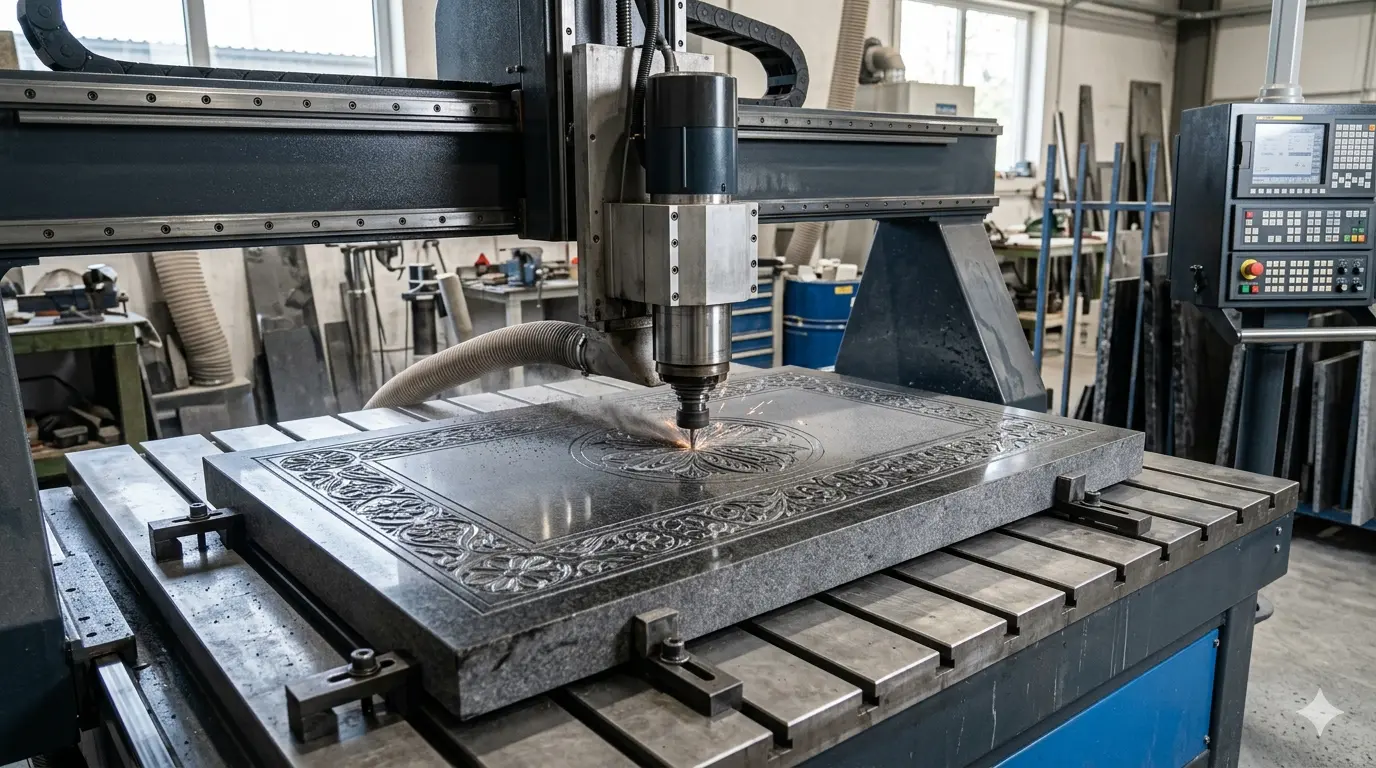
Not every durable granite mark comes from the same production method. Some shops need flexible CNC engraving for varied layouts and repeatable graphics. Others prioritize deep, high-contrast lettering on larger memorial work. The right choice depends on whether the main priority is detail, depth, part size, or production flexibility.
| Option | Best Fit | Main Strength | Main Tradeoff |
|---|---|---|---|
| Dedicated CNC Engraving Machine | Plaques, smaller signs, memorial inserts, and repeated detailed layouts | Strong control over path accuracy and repeatable detail | Less efficient if the shop also needs large-format profiling, cutting, or multi-process stone work |
| Bridge-Type Stone CNC Center | Larger granite pieces and shops combining engraving with other stone operations | Better fit when engraving is one step inside a broader machining workflow | Higher investment and more floor-space demand than a simpler engraving-focused setup |
| Stencil And Blasting Workflow | Deep lettering and repeated monument-style marking | Strong visual depth and long-term readability in the right applications | Less flexible for fine graphics, fast design changes, and mixed detailed artwork |
The important point is that no method is universally better. A CNC engraving machine is often the stronger choice when the shop needs controlled detail, repeatable artwork changes, and consistent positioning on granite parts. A blasting workflow may still be the better fit when the business is centered on deep, traditional lettering at scale.
When A Granite Engraving Machine Makes More Sense Than Manual Or Stencil-Based Work
Granite engraving machines usually add the most value when the shop is trying to reduce dependence on manual skill for repeatable layouts. This often happens when customers expect more variation in names, dates, logos, decorative elements, or serialized identification marks while still expecting stable quality.
That kind of workflow is common in:
- Memorial And Monument Shops Handling Frequent Artwork Changes
- Architectural Stone Suppliers Producing Permanent Building Signage
- Commercial Stone Processors Making Branded Or Numbered Components
- Fabricators That Need Engraving To Align With Routed Or Profiled Features
In those environments, the machine does more than carve lines into stone. It helps standardize placement, improves design repeatability, and reduces the amount of visual variation that comes from manual setup differences between operators or shifts.
Buying Criteria That Matter More Than The Brochure
Granite engraving equipment should be evaluated by workflow fit, not just by the fact that it can machine stone. The strongest buying decisions usually come from looking at how the machine supports daily production discipline.
| Buying Criterion | Why It Matters | What To Clarify Before Buying |
|---|---|---|
| Typical Workpiece Size | Determines whether a compact engraving setup is enough or whether larger-format support is needed | Are you mainly engraving plaques and inserts, or full monument and architectural pieces? |
| Marking Style | Affects whether detail control or deep-cut readability matters more | Is the shop producing fine graphics, small text, deep lettering, or a mix of all three? |
| Job Variation | Shows how much value the shop gets from programmable repeatability | How often do names, logos, layout positions, or artwork files change between jobs? |
| Downstream Workflow | Determines whether engraving must align with cutting, edging, polishing, or installation prep | Is engraving a standalone step or part of a broader fabrication cell? |
| Rework Pressure | Reveals the current cost of inconsistent marking quality | How often are jobs corrected because of poor placement, uneven depth, or chipped detail? |
| Labor Dependence | Indicates how exposed the process is to operator-by-operator variation | Does output quality change noticeably depending on who handles the job? |
| Throughput Expectations | Helps separate equipment sized for occasional marking from equipment supporting steady daily production | Is engraving a specialty task or a regular production stage? |
| Expansion Plans | Prevents buying only for current demand if the shop is moving toward larger or more integrated stone work | Will the next phase of the business require more than engraving alone? |
These questions usually surface the real decision much faster than a generic feature checklist.
Think About The Full Stone Workflow, Not Only The Engraving Head
Granite engraving becomes difficult when buyers treat it as an isolated decorative task. In a real shop, the engraving step is affected by material handling, workholding, stone support, batch organization, and how the finished piece moves into cleaning, finishing, filling, packing, or installation prep.
That is why some shops outgrow a narrow engraving-only mindset and start evaluating broader stone CNC machines when engraving must sit alongside routing, profiling, shaping, or other fabrication steps. The machine choice then becomes less about engraving in isolation and more about whether one platform can reduce handoffs and keep heavy stone parts moving through the shop with fewer repositioning steps.
The workflow benefits can include:
- Better Alignment Between Engraving And Other Machined Features
- Fewer Manual Repositioning Steps On Heavy Granite Pieces
- More Predictable Setup From Job To Job
- Cleaner Scheduling When Multiple Stone Operations Share One Production Plan
This does not mean every shop needs a larger CNC platform. Many do not. But buyers should at least decide whether they are purchasing a marking solution only or a machine that needs to support a broader fabrication model over time.
When A Granite Engraving Machine May Not Be The Right First Investment
A granite engraving machine is not automatically the first answer for every stone business. It may be a weaker priority when the real production issue lies elsewhere.
For example, the investment may need to wait when:
- Most Jobs Depend On Deep Monument Lettering Better Served By An Established Blasting Workflow
- Engraving Volume Is Too Low To Justify A Dedicated Machine Stage
- The Main Bottleneck Is Stone Handling, Not Marking Accuracy
- The Shop Still Lacks Process Control In Finishing, Packing, Or Artwork Preparation
- Most Work Is Outsourced Fabrication With Only Occasional On-Site Marking
In those cases, the better move may be to fix upstream preparation, artwork flow, or material handling first. A machine improves a controlled process more effectively than it rescues a disorganized one.
Practical Questions To Ask Before You Commit
Before buying, it is worth pressure-testing the decision with a few direct questions:
- Do We Need Better Detail, Better Depth, Or Better Repeatability?
- Are Our Granite Jobs Mostly Small And Varied, Or Large And Repetitive?
- Will A Machine Reduce Rework Enough To Change Daily Production Stability?
- Does Engraving Need To Integrate With Other Stone-Machining Steps?
- Are We Buying A Dedicated Marking Solution Or Planning For A Broader Stone Workflow?
- Is The Current Pain Point Really Engraving Quality, Or Is It Setup, Handling, And Job Organization?
Those answers usually make the right equipment direction clearer than a simple price comparison.
Practical Summary
The best granite engraving machine is not the one with the longest feature list. It is the one that matches the shop’s real marking workload, stone sizes, detail requirements, and production flow. For many stone fabricators, CNC engraving becomes the stronger option when they need repeatable layouts, controlled detail, and cleaner integration with digital job changes. For others, especially where deep, high-contrast monument lettering is still the core business, another marking workflow may remain the better fit.
The decision should be made around durability, readability, repeatability, and workflow control together. When those factors are evaluated honestly, it becomes much easier to choose a granite engraving setup that improves production instead of simply adding another machine to manage.