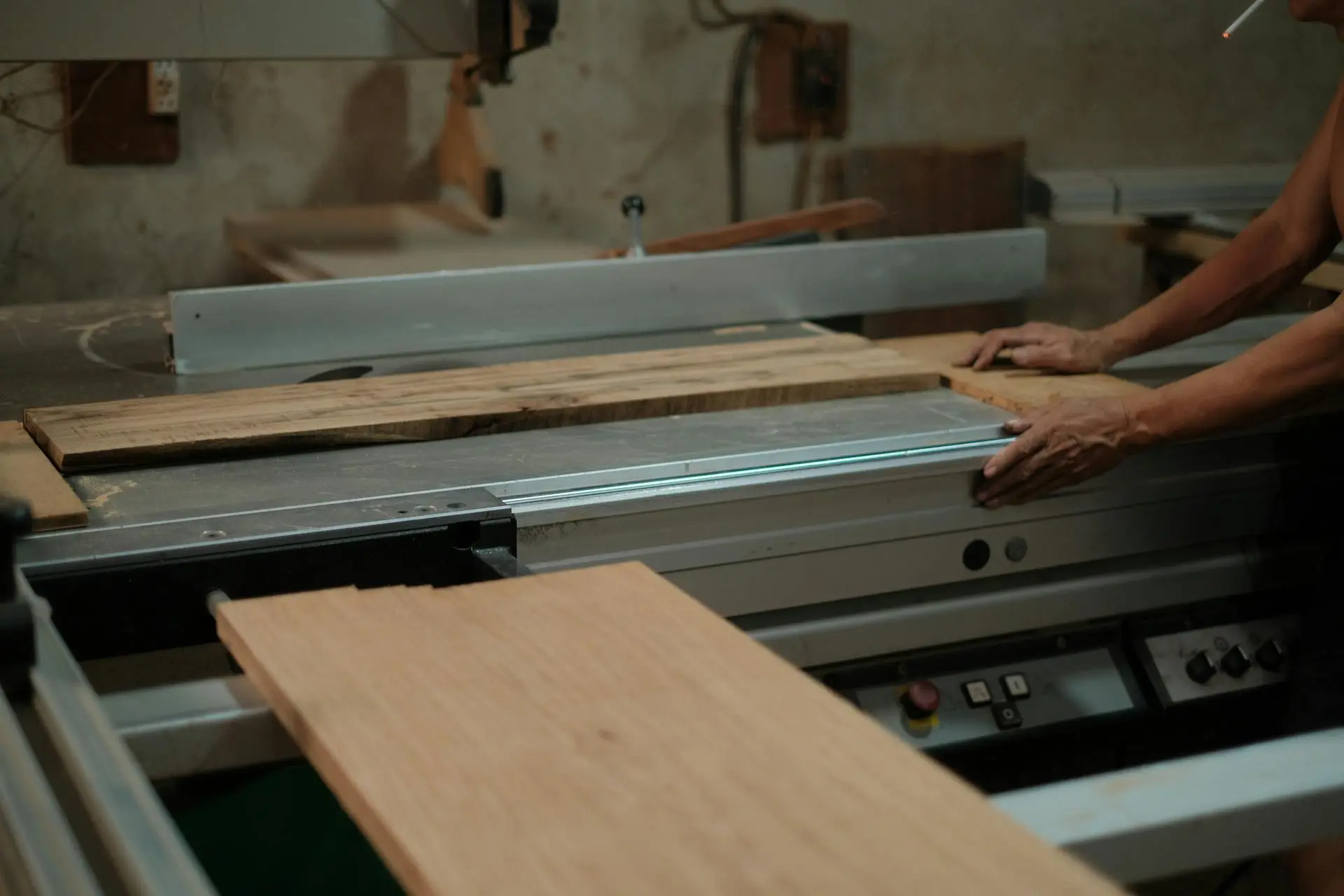
In cabinet and furniture production, panel cutting often decides whether the rest of the shop runs smoothly or spends the day catching up. When sheet goods arrive at edge banding, drilling, and assembly with size variation, chipped edges, or inconsistent squareness, rework spreads quickly through the line.
A panel saw is not the right answer for every shop. But for cabinet and furniture businesses that process large volumes of rectangular panels, it can make the front end of production more stable, more repeatable, and easier to scale. This guide explains where a panel saw fits, when another machine type may be the better choice, and what to evaluate before buying.
What Problem Should a Panel Saw Solve?
A panel saw, often discussed in the same decision space as a beam saw, is mainly a production machine for sizing sheet material into consistent parts. In cabinet and furniture shops, that usually means melamine-faced board, MDF, plywood, particleboard, and similar panel materials.
The real buying question is not simply whether a saw can cut panels. Almost every saw in the category can do that. The better question is whether a panel saw helps solve the problems that are limiting your workflow today, such as:
- Slow front-end throughput
- Too much operator-dependent variation
- Re-cuts caused by inconsistent sizing
- Bottlenecks before edge banding or drilling
- Difficulty keeping batch production organized
If those are the daily pain points, a dedicated panel saw becomes a process decision, not just a machine purchase.
When a Panel Saw Makes Sense
For many cabinet and furniture shops, a panel saw is strongest in structured, repeatable production. It is commonly used where the shop needs reliable panel sizing across repeated cabinet parts, wardrobe components, office furniture panels, or other rectangular workpieces that move through downstream operations in volume.
A panel saw is usually well suited to shops with these conditions:
- A high percentage of work comes from sheet goods rather than solid wood
- Most parts are rectangular rather than highly shaped
- The shop runs repeat orders, standardized modules, or batch production
- Downstream operations depend on consistent part size and squareness
- Management wants better flow instead of more manual cutting labor
In those environments, the main value is not just faster cutting. It is more predictable cutting. That predictability helps production planning, part sorting, and the stability of the whole line.
Panel Saw vs. Sliding Table Saw vs. CNC Nesting
For many buyers, the real decision is not whether to buy a saw at all. It is whether a dedicated panel saw is the best fit compared with a sliding table saw or a CNC nesting machine.
| Machine Type | Best Fit | Main Advantage | Main Tradeoff |
|---|---|---|---|
| Panel saws | Batch cabinet and furniture production with repeated rectangular parts | High throughput and repeatable panel sizing | Less flexible for highly customized or shaped-part workflows |
| Sliding table saws | Smaller shops, mixed jobs, or custom work with more operator control | Flexible cutting and practical fit for varied one-off work | More dependent on operator skill and slower for repeated batch cutting |
| CNC nesting machines | Custom furniture, nested parts, and workflows combining cutting with routing or drilling | Combines several processes in one cell and suits customized production | May not be the most efficient first choice if the main need is only fast panel sizing |
The key point is that none of these machines is universally better. A panel saw becomes the stronger option when rectangular panel sizing is the production bottleneck. A sliding table saw can be the smarter choice when flexibility matters more than throughput. A nesting machine can be better when customization and multi-process integration matter more than dedicated saw output.
Why Workflow Fit Matters More Than the Spec Sheet
Many buying mistakes happen because shops compare machinery only on headline features instead of workflow fit. A cabinet shop should evaluate the saw in relation to how material enters the plant, how parts are sorted after cutting, and how the rest of the production chain behaves.
For example, if your line depends on steady part flow into edgebanders, then cut consistency becomes more important than isolated cutting speed. A faster machine is not automatically the better machine if the cut cell creates sorting problems, handling delays, or downstream interruptions.
Good workflow fit usually shows up in practical outcomes such as:
- Fewer cutting errors passed downstream
- Better repeatability from order to order
- Less manual re-checking of part dimensions
- Cleaner organization around batch processing
- Smoother handoffs into edge processing, drilling, and assembly
That is why the best buying guide is not the one with the longest feature list. It is the one that connects the saw to the way the shop actually produces furniture.
Buying Criteria That Actually Matter
Before choosing a panel saw, look at the factors below in the context of your own production model.
| Buying Criterion | Why It Matters In A Cabinet Or Furniture Shop | What To Clarify Before Buying |
|---|---|---|
| Product Mix | Determines whether the shop is truly repetitive enough for a dedicated panel saw | Are most parts rectangular and repeated, or highly variable and custom? |
| Material Profile | Affects how often the saw will be used and how central it is to the line | What percentage of daily production is panel processing? |
| Throughput Need | Helps decide whether manual-guided cutting is already a limitation | Is panel sizing slowing the rest of the factory down? |
| Repeatability Requirement | Directly affects downstream edge quality, drilling accuracy, and assembly fit | How costly are re-cuts, rechecks, and dimensional inconsistencies today? |
| Labor Model | Changes the value of automation and process standardization | Do you need a system that reduces dependence on individual operator technique? |
| Changeover Pattern | Matters if the shop switches often between jobs, materials, or batch sizes | Are cutting lists stable and repeated, or constantly changing? |
| Floor Layout And Material Flow | Determines whether a saw improves flow or creates handling congestion | How will sheets enter, parts leave, and batches stay organized around the saw? |
| Future Production Direction | Prevents buying only for the current quarter instead of the next few years | Is the business moving toward higher volume, more customization, or both? |
This kind of evaluation usually gives a clearer answer than comparing isolated machine claims.
When a Panel Saw May Not Be the Best Choice
Even in furniture production, there are cases where a panel saw may not be the strongest investment.
It may be less suitable when:
- The shop does mostly one-off custom joinery
- Curved, nested, or irregular parts are a major share of production
- The business mixes large amounts of solid wood with limited sheet processing
- Floor space or material handling conditions make dedicated panel flow difficult
- The real bottleneck is not cutting, but edge finishing, drilling, or assembly
In those cases, a sliding table saw or CNC nesting solution may align better with the work style. The right purchase comes from identifying the actual production constraint, not from buying the most industrial-looking machine in the category.
Questions to Ask Before You Commit
Use these questions to pressure-test the decision:
- Is panel sizing the current bottleneck, or just the most visible step?
- Are most of our parts repetitive enough to justify a dedicated production saw?
- Do we need more flexibility, or more repeatability?
- Will the saw improve the flow into downstream operations?
- Is our shop layout ready for better material handling around a panel-cutting cell?
- Are we buying for today’s jobs only, or for the production model we want to build?
If the answers point toward structured sheet processing, repeated part sizes, and a need for cleaner front-end flow, a panel saw is often a logical fit.
Practical Summary
For cabinet and furniture shops, a panel saw is usually the right investment when the business depends on repeated rectangular panel cutting, stable batch flow, and consistent downstream processing. Its real value is not only in cutting faster, but in helping the whole production line behave more predictably.
If your shop is highly custom, shape-heavy, or still depends on flexible manual cutting, another machine type may be a better match. But if your goal is to bring order, repeatability, and throughput to panel sizing, a panel saw deserves serious consideration as a core production machine.