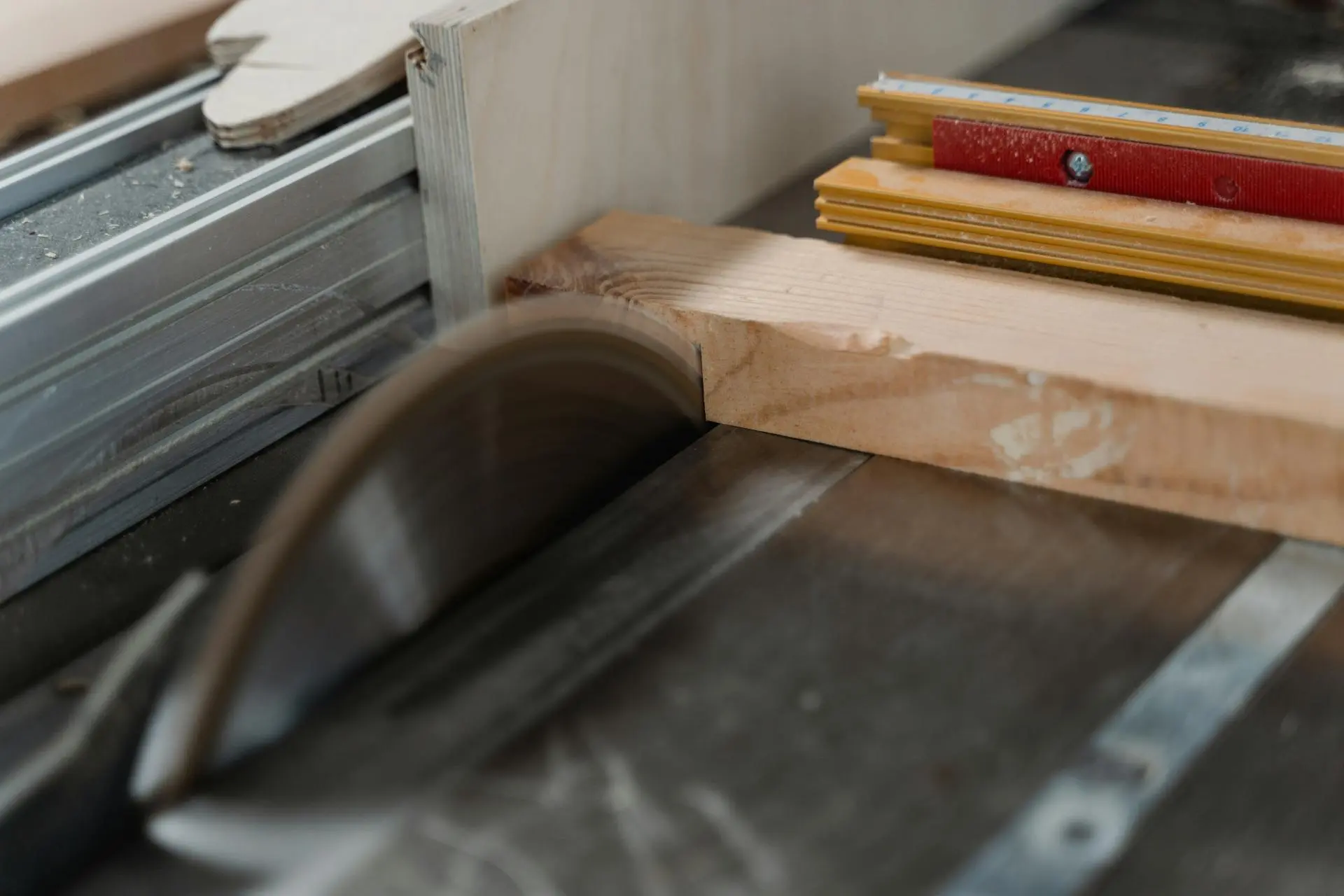
In many wood shops, cut quality problems appear only after the material mix changes. A blade that seems acceptable on raw particle board may start chipping melamine-faced panels, while a setup that leaves clean plywood edges may wear too quickly in repeated MDF cutting. When that happens, the problem is not always the saw itself. More often, it is a blade strategy that treats very different panel structures as if they behave the same way.
That is especially important on a sliding table saw, where flexibility is part of the machine’s value. The same cutting station may be expected to size cabinet parts, trim veneered furniture panels, and process painted or laminated boards in the same week. Good blade selection helps protect cut quality, reduce rework, and keep downstream operations moving with fewer surprises.
Start With The Panel Structure, Not The Blade Label
The phrase “wood panel” is too broad to guide blade selection. Before choosing a blade, the shop needs to define what the cut edge actually has to survive.
In practical production terms, four questions matter first:
- What Is The Core Material: MDF, particle board, plywood, or another engineered panel?
- What Is The Surface Condition: Raw, melamine-faced, veneered, laminated, or paint-grade?
- Will The Edge Be Visible, edge banded, machined again, or hidden in assembly?
- Is The Priority Cleaner Finish, longer blade life, faster cutting flow, or fewer rejects?
Once those questions are clear, blade selection becomes less about catalog language and more about controlling the actual risks in production.
Why Different Panels Behave Differently At The Cut Edge
Sliding table saw blade selection becomes easier when the shop treats panel defects as material-specific problems rather than generic sawing issues.
MDF and HDF tend to challenge blade life and edge smoothness because the board is dense, resin-rich, and abrasive over time. Particle board is less uniform at the edge and is more likely to crumble at corners or show weak-looking cut surfaces when the blade is dull or too aggressive. Plywood introduces another problem entirely: the blade has to cut across alternating veneer layers, which increases the risk of splintering and tear-out on visible faces.
Laminated and melamine-faced panels raise the finish standard even further. The core may be manageable, but the surface layer makes face chipping much more visible and commercially costly. In those jobs, a blade that is merely acceptable on raw board may no longer be acceptable at all.
What Blade Characteristics Matter Most On A Sliding Table Saw
Exact blade specifications should come from the saw manufacturer, tooling supplier, and the panels being processed, but the selection logic usually comes down to a few practical variables.
- Tooth Geometry: Different geometries are commonly chosen for different finish priorities. Triple-chip style cutting is often preferred for abrasive laminated materials and composite panels, while alternate-top-bevel style cutting is commonly favored where veneer protection and cleaner face quality matter more.
- Tooth Count Balance: A blade aimed at cleaner finishing often behaves differently from one chosen to move material more aggressively. Shops should judge that balance by edge quality and workflow results, not by a marketing claim of being universally suitable.
- Carbide Durability And Edge Retention: MDF and other abrasive panels punish weak cutting edges quickly, so wear resistance matters if the shop wants stable quality over longer runs.
- Plate Stability: A stable blade body supports cleaner, more repeatable cuts, especially when the saw is expected to handle different panel sizes and varied daily jobs.
- Compatibility With Scoring Or Finish-Sensitive Setup: On decorative-faced materials, the blade works as part of a complete cutting setup. If the machine includes a scoring arrangement, that setup becomes part of the face-quality result.
The important point is that blade selection should be measured by what happens to the panel after cutting, not only by how versatile the blade sounds on paper.
Panel-By-Panel Blade Priorities
| Panel Type | Main Cutting Risk | Blade Tendency That Commonly Fits | Workflow Outcome |
|---|---|---|---|
| Raw MDF Or HDF | Fuzzy edges, heat buildup, faster wear | A durable finish-oriented blade that stays stable over repeated abrasive cutting | Cleaner edges for paint prep and less edge touch-up |
| Raw Particle Board | Corner crumble and weak-looking cut edges | A clean-cutting blade that avoids overly aggressive entry into a brittle core | Better part integrity before drilling, assembly, or handling |
| Melamine-Faced MDF Or Particle Board | Top and bottom face chipping | A laminate-focused blade strategy that prioritizes face protection and stable finish quality | Fewer visible rejects on cabinet and furniture parts |
| Plywood | Veneer tear-out and splintering | A veneer-friendly blade choice that protects outer plies rather than only chasing blade life | Cleaner visible edges and less manual touch-up |
| Veneered Or Decorative Laminated Panels | Breakout on finish surfaces and damaged edges on exposed parts | A dedicated finish-priority blade instead of a rough-cut compromise blade | Better presentation quality and fewer remakes |
This matters even more when the cut edge is moving directly into downstream finishing or edgebanders. Once the face is chipped or the edge is already unstable, later processes usually add cost rather than recover the part completely.
When A General-Purpose Blade Is Good Enough
Not every shop needs a dedicated blade program for every board family. A general-purpose blade can be a workable choice when production is mixed, the runs are short, and the surface standard is moderate rather than highly finish-sensitive.
A compromise blade setup is commonly acceptable when:
- Most Parts Will Be Edge Banded Or Hidden In Assembly
- Decorative Faces Are Not The Main Quality Risk
- Blade Changes Would Interrupt Production More Than The Result Justifies
- The Shop Needs One Practical Setup For Short-Run Mixed Work
That approach becomes weaker when visible-face quality drives customer acceptance, when a single material dominates production for long runs, or when cut defects immediately create rework at the next station.
When Dedicated Blade Changes Usually Pay Off
Dedicated blade changes make more sense when one panel family stays on the saw long enough to justify protecting the result. That is often true in melamine-heavy cabinet production, veneered furniture component work, or paint-grade MDF jobs where edge quality is visible in the finished product.
On many sliding table saws, planned blade changes are not a sign of inefficiency. They can be the more efficient choice if they reduce chipped faces, slow touch-up, or repeated rejects. A short blade-change interval is often cheaper than running one compromise blade across every material and absorbing the quality loss later.
Signs The Blade Is Mismatched Even If The Saw Is Accurate
Shops often focus on sizing accuracy first, but blade mismatch usually shows up in edge condition before it shows up in dimensions.
Common warning signs include:
- MDF Edges Look Burnished, Fuzzy, Or Rough Instead Of Compact And Clean
- Particle Board Corners Start Breaking Down During Handling
- Melamine Faces Chip Even Though The Saw Is Otherwise Running Straight
- Plywood Shows Splintering On One Or Both Visible Faces
- Feed Resistance, Noise, Or Heat Buildup Increases Faster Than Expected
- One Material Cuts Well While Another Material Degrades Immediately On The Same Setup
Not every defect comes from blade choice alone. Sharpness, alignment, material support, scoring setup, and operator handling still matter. But when the defect pattern changes clearly by panel type, the blade strategy is usually the first place to look.
A Practical Decision Table For Daily Production
| If Your Shop Mostly Does… | Blade Strategy Usually Makes More Sense | Why |
|---|---|---|
| Mixed Cabinet And Furniture Work In Short Runs | A strong general-purpose blade, with dedicated blades kept ready for finish-sensitive jobs | It protects flexibility without forcing blade changes on every small batch |
| Repeated Melamine-Faced Cabinet Parts | A dedicated laminate-oriented blade setup | Decorative faces make chipping too expensive to treat as a minor defect |
| Veneered Furniture Panels And Visible Plywood Parts | A blade chosen around finish quality rather than maximum life | The commercial cost of tear-out is often higher than the cost of more frequent tooling attention |
| Paint-Grade MDF Components | A durable blade strategy focused on edge smoothness and stable wear behavior | Rough edges slow finishing and create more prep work |
| One-Saw Shops That Cannot Change Blades Often | A compromise setup, but only with clear acceptance of where the finish tradeoff will appear | One blade can cover mixed work, but it rarely delivers the best result on every panel |
Practical Summary
Sliding table saw blade selection should begin with the panel, not with the assumption that all sheet goods cut the same way. MDF pushes the shop toward wear resistance and clean edge formation. Particle board demands better edge control and less core breakdown. Plywood and veneered panels need stronger protection against tear-out. Laminated surfaces raise the cost of face chipping enough that a dedicated finish-first blade strategy is often justified.
The most reliable approach is to match blade choice to the board structure, the finish requirement, and the downstream workflow. That does not always mean using a different blade for every job. It does mean deciding consciously where the shop wants blade life, where it needs finish quality, and where a compromise setup is truly acceptable.