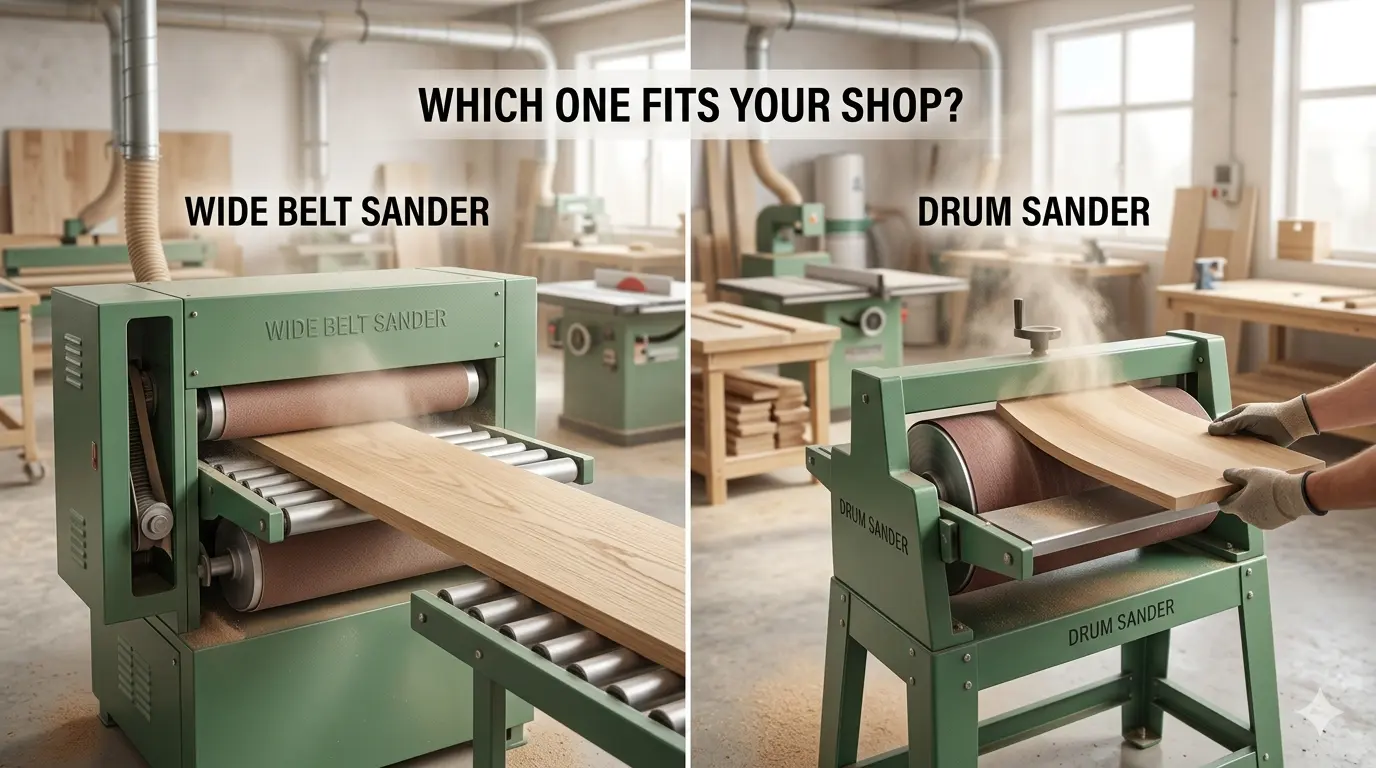
When sanding starts to slow panel flow, the problem is rarely just abrasive speed. It is usually a mix of repeated passes, uneven thickness control, inconsistent surface prep, and too much operator time spent trying to make the next process run smoothly. That is why comparing a wide belt sander with a drum sander is really a comparison between two finishing workflows.
For repeated panel production, more stable calibration, and more consistent surface preparation before coating or assembly, a wide belt sander usually fits better. For lighter daily volume, smaller-batch work, or shops that still need a more compact and flexible sanding station, a drum sander can still be the smarter choice. The right answer depends on where your current sanding process is losing time, consistency, or usable output.
Start With The Bottleneck, Not The Machine Name
Many shops compare sanding machines by category label and miss the real decision criteria. On an actual production floor, sanding performance is usually shaped by:
- How Many Passes A Part Needs Before It Is Acceptable
- How Stable Thickness And Flatness Stay Across A Batch
- How Much The Result Depends On Operator Judgment
- How Well The Sanded Surface Moves Into Coating, Laminating, Or Assembly
- How Efficiently The Machine Handles Panel Width, Part Mix, And Daily Volume
This matters because the faster-sounding machine is not always the better fit. A custom wood shop sanding smaller solid-wood batches has a different requirement from a cabinet producer trying to keep panel calibration and finish prep stable across a full shift.
Why Wide Belt Sanders Usually Win In Repeated Production
Industrial wide belt sanders are commonly selected when sanding needs to behave like a stable production step rather than an occasional cleanup operation. Their main advantage is not just higher processing efficiency on repeated flat work. It is that they usually deliver more repeatable results across batches of panels and components.
In practical terms, that often means:
- Better Thickness Control Before Edge Banding, Drilling, Or Assembly
- More Consistent Surface Preparation Before Sealing, Painting, Or Final Finishing
- Less Time Lost To Repeated Corrective Passes On Similar Parts
- Smoother Workflow For MDF, Plywood, Particleboard, Veneered Panels, And Solid-Wood Components
- More Predictable Output When The Shop Runs Repeated Cabinet, Furniture, Or Interior-Fit-Out Parts
For shops that need sanding to support downstream finish quality rather than simply remove visible tool marks, a wide belt workflow usually creates more stable day-to-day output.
Where Drum Sanders Still Make Sense
A drum sander still has a clear place in many shops. It is commonly used where throughput demands are lower, part sizes vary more, and the team needs a practical way to smooth or lightly calibrate material without moving immediately into a more line-oriented sanding cell.
That often fits:
- Custom Woodworking Shops With Lower Daily Sanding Volume
- Solid-Wood Work Processed In Smaller Batches
- Shops That Need A More Compact Machine Footprint
- Operations Where Sanding Matters But Is Not Yet The Main Production Bottleneck
- Businesses Taking A Step Up From Hand Sanding Or Less Structured Sanding Workflows
The tradeoff is that drum sanders usually ask more of the operator as output rises. When parts get wider, runs get longer, or finish expectations become stricter, more time is often lost to careful feeding, repeated passes, and managing variation from one piece to the next.
Side-By-Side Comparison
| Decision Factor | Wide Belt Sander | Drum Sander | Stronger Fit |
|---|---|---|---|
| Throughput On Repeated Panels | Usually stronger because it suits continuous sanding of repeated flat work | Usually lower when many passes are needed across larger batches | Wide Belt Sander |
| Thickness Calibration Consistency | Commonly stronger for batch repeatability | More dependent on conservative passes and operator monitoring | Wide Belt Sander |
| Flexibility For Lighter Mixed Work | Can be more machine than a smaller shop needs | Often practical for intermittent or lower-volume work | Drum Sander |
| Surface Prep Before Coating | Usually stronger when finish consistency must hold across many parts | Can work well on smaller batches but is slower to scale | Wide Belt Sander |
| Footprint And Entry Complexity | Usually higher | Usually easier to fit into a smaller shop | Drum Sander |
| Labor Dependence | Usually lower once setup is stable | Usually higher because process control stays more hands-on | Wide Belt Sander |
| Best Use Case | Repeated panel processing, calibration, and finish prep | Smaller shops, lighter batches, and flexible sanding tasks | Depends On Workflow |
The table makes the tradeoff clear. Wide belt sanders usually deliver more value when the goal is stable output on repeated parts. Drum sanders usually make more sense when the shop is still optimizing for flexibility, smaller batches, and a lower process burden.
Finish Requirements Usually Change The Answer Faster Than Volume
A shop can tolerate slower sanding for a while. What usually forces the comparison to become more urgent is finish consistency. If coating defects, uneven scratch patterns, thickness variation, or extra touch-up work keep showing up after sanding, the problem is no longer only about speed. It becomes a quality-control issue.
That is where a wide belt approach commonly becomes more valuable. When a factory needs flatter panels, more uniform surface preparation, and fewer surprises in downstream finishing, sanding stability matters as much as raw output. If finish expectations are rising along with order volume, a drum sander can quickly become the station that protects flexibility but limits consistency.
Signs You Are Outgrowing A Drum Sander
The change point is usually visible in the workflow before it is obvious in the machine comparison. Common signs include:
- Sanding Is Holding Up Coating, Assembly, Or Packing
- Operators Need Too Many Corrective Passes To Reach Acceptable Quality
- Panel Thickness Variation Keeps Causing Trouble Later In The Process
- Finish Quality Changes Too Much Between Operators Or Shifts
- Part Width, Batch Size, Or Daily Output Has Grown Beyond A Light-Duty Sanding Rhythm
If those issues are showing up regularly, the shop is often not just dealing with a sanding problem. It is dealing with a process-capability problem.
Which Shops Usually Benefit Most From Each Option
A wide belt sander usually makes more sense when:
- Most daily work involves repeated panels or flat components.
- Surface consistency before coating or assembly matters across full batches.
- Sanding is already slowing the line after cutting, machining, or edge processing.
- Management wants less variation between operators and shifts.
- The shop is scaling toward a more predictable finishing workflow.
A drum sander usually makes more sense when:
- Daily sanding volume is still moderate or intermittent.
- The shop handles smaller batches and more variable part flow.
- Floor space and process simplicity matter more than maximum throughput.
- The team needs a flexible sanding step without building a full production cell.
- Sanding quality matters, but the main bottleneck is still somewhere else.
These are not small differences. They determine whether sanding behaves like a scalable production process or a more operator-managed finishing step.
Practical Summary
If your shop needs sanding to support repeated panel production, steadier thickness control, and more consistent finish preparation, a wide belt sander usually fits better. If your shop values flexibility, smaller-batch work, and a more compact sanding solution, a drum sander can still be the smarter fit.
The real choice is not between two machine names. It is between two workflow priorities: scalable finishing consistency and lighter, more flexible sanding. Choose the machine that removes the most daily friction from your actual process, and the better fit usually becomes much easier to see.