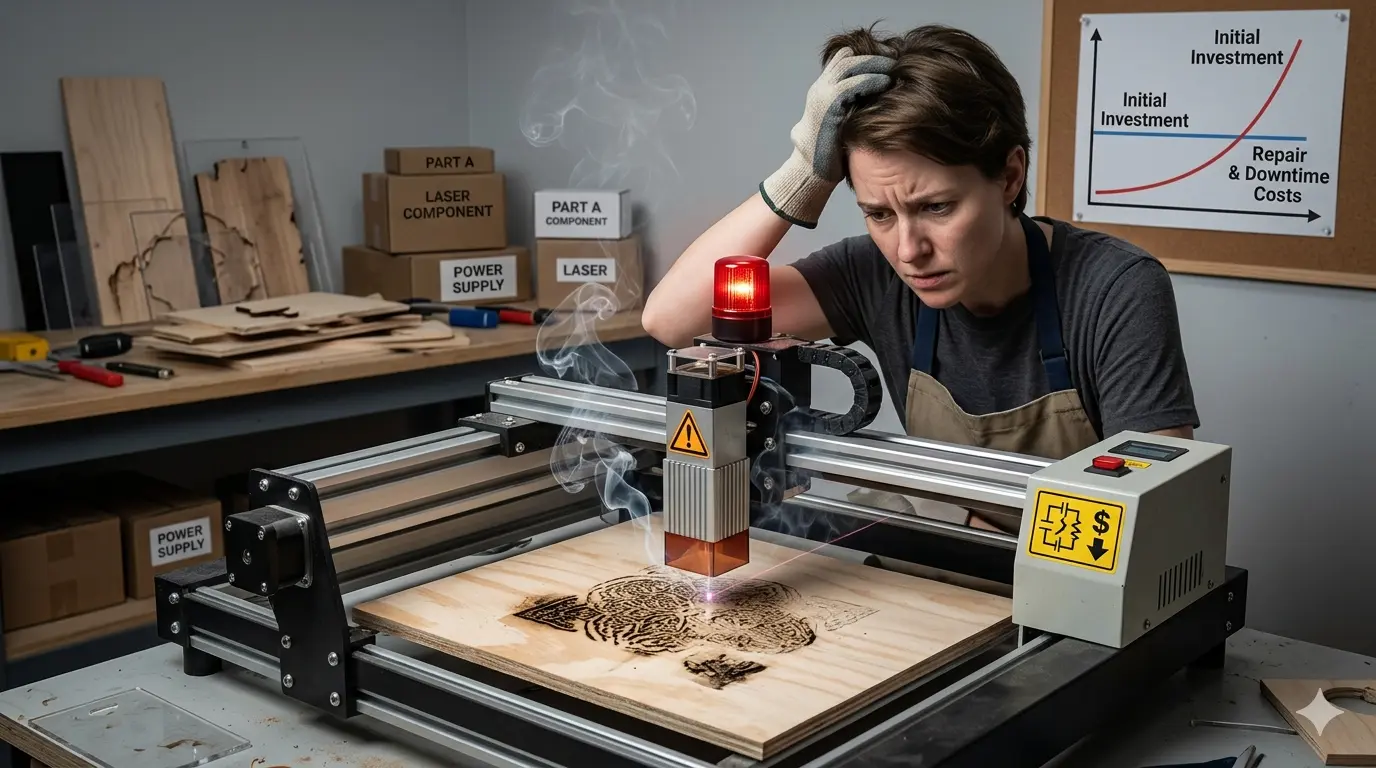
The lowest laser quote often looks efficient on paper. In practice, it can shift cost from the purchase order into the production floor, where the damage shows up as unstable quality, slower changeovers, more cleanup, and more operator intervention. That is why a cheap laser engraver is not automatically a low-cost decision.
For buyers comparing laser cutters and engravers for wood, acrylic, coated boards, and similar non-metallic applications, the real question is not whether the machine is affordable at purchase. It is whether the lower upfront price still supports acceptable output quality, manageable daily operation, and predictable workflow performance.
Why The Lowest Quote Often Misleads
Cheap pricing is attractive because it is easy to compare. Production risk is harder to see before installation.
One supplier may quote a basic machine only. Another may include extraction-related equipment, commissioning, workflow setup, or better job-control support. A third may appear more expensive simply because more of the real operating scope is visible in the proposal.
That is why the lowest number is often the least complete buying signal. Commercial buyers do not lose money because a quote is low. They lose money when a low quote hides the conditions required to run the machine with stable results.
Where Lower Price Usually Comes From
Lower pricing is not always a problem. Sometimes it reflects a simpler workload, a smaller operating scope, or a less demanding production role. But in many cases, the price drops because something important has been reduced, excluded, or left undefined.
Common examples include:
- Bare-Machine Pricing Without Full Installed Scope
- Limited Workflow Control For Repeat Jobs
- Less Clarity Around Maintenance Access Or Service Support
- Minimal Commissioning, Training, Or Process Standardization
- Performance Shown Through Samples Rather Than Repeatable Shop-Floor Testing
None of those points automatically disqualifies a machine. The risk appears when buyers assume the lower quote will behave like a more complete production-ready solution.
The Main Risks Behind A Cheap Laser Engraver
The operational problem with a low-cost machine is rarely one dramatic failure. More often, it is a collection of small frictions that reduce usable output over time.
| Low-Cost Signal | What It Often Means | Production Risk |
|---|---|---|
| Bare machine quote | Supporting items or setup scope may be outside the proposal | Installed cost rises after purchase and rollout takes longer |
| Strong demo sample only | Performance may be shown under ideal conditions rather than normal job variation | Quality drift appears during repeated work or across different table positions |
| Heavy manual setup between jobs | More operator judgment is required to keep output consistent | Changeovers slow down and operator-to-operator variation increases |
| Unclear service path | Troubleshooting and parts support may be harder to plan | Downtime becomes more disruptive when issues appear |
| Price chosen before workload is defined | The machine may not match the actual material mix or finish standard | Rework, missed deadlines, or poor application fit become more likely |
In other words, cheap machines do not become risky because they are inexpensive. They become risky when the lower price is achieved by stripping out the factors that protect consistency.
Cheap Usually Becomes Expensive Through Rework And Delay
Most factories do not measure loss in terms of purchase price alone. They feel it through repeated correction work.
When a laser engraver is not stable enough for the workload, the cost tends to appear in several places at once:
- More Test Pieces Before Jobs Are Released To Production
- More Cleanup Time On Customer-Facing Parts
- More Operator Checks During Longer Runs
- More Variation Between Early-Run And Late-Run Parts
- More Unplanned Pauses When Settings Do Not Translate Cleanly From One Job To The Next
- More Scrap Or Rework When Appearance Standards Are Tight
These losses are especially important in shops where engraved parts are visible to customers, where artwork changes frequently, or where batches must be repeated with predictable quality.
When A Cheap Laser Engraver Can Still Make Sense
A low-cost machine is not always the wrong choice. It can make sense when the production risk is genuinely low and the application is operationally forgiving.
A cheaper buying position is often more defensible when:
- The Workload Is Light Rather Than Daily High-Utilization Production
- The Material Mix Is Narrow And Stable
- Finish Standards Are Practical Rather Than Premium
- The Jobs Are Simple And Do Not Require Constant Recipe Changes
- The Buyer Understands That Throughput And Repeatability Expectations Must Stay Modest
This is the honest tradeoff. If the business only needs light engraving capacity, occasional customization, or low-volume internal work, a cheaper system may be acceptable. If the machine is expected to support repeated customer-facing production, the risk profile changes quickly.
Define The Workflow Before You Approve The Price
The best defense against a bad low-cost purchase is not skepticism. It is better definition.
Before comparing quotes, buyers should lock down a few operational facts:
- Which Materials Will Consume Most Weekly Machine Hours?
- Is The Main Need Engraving Only, Or Engraving Plus Contour Cutting?
- How Sensitive Are Finished Parts To Residue, Contrast Variation, Or Edge Cleanliness?
- How Often Will Operators Switch Between Files, Materials, Or Job Types?
- Is The Machine Supporting Prototyping, Short-Run Custom Work, Or Repeated Batch Production?
If those answers are not clear, the quote comparison will stay distorted. Buyers will end up comparing prices without comparing risk.
If the plant is still deciding whether laser processing is the right route at all, reviewing the broader Pandaxis product catalog can be more useful than comparing low-cost laser options in isolation.
How To Compare Low-Cost Options Without Guessing
Buyers do not need to reject every low quote. They need to test low quotes more carefully.
A stronger evaluation process usually includes:
- Running A Real Production File Instead Of A Generic Demo Pattern
- Testing More Than One Part Position If Work-Area Consistency Matters
- Checking Cleanup Burden, Not Just Visible Engraving Speed
- Comparing Repeatability Across More Than One Job Cycle
- Asking Exactly What Is Included In Installation, Training, And Support
- Separating Bare-Machine Price From Full Operating Scope
This method changes the buying conversation. Instead of asking, “Which machine is cheapest?” the buyer starts asking, “Which machine reaches acceptable output with the least hidden friction?”
That is a much safer commercial question.
The Higher Risk Is Usually Management Risk, Not Just Machine Risk
Cheap equipment often creates a second problem: internal expectation mismatch. Management approves the machine because the price looks efficient, but production teams still expect industrial consistency, easy job recovery, and smooth daily operation.
When the machine was never truly priced for that role, the gap turns into operational conflict:
- Operators Spend More Time Stabilizing Jobs Than Running Them
- Supervisors Carry More Scheduling Uncertainty
- Procurement Thinks The Cost Target Was Met While Production Absorbs The Losses
- The Business Starts Planning A Replacement Earlier Than Expected
This is why lower-cost machinery decisions should be treated as workflow decisions, not just purchasing wins.
Practical Summary
A cheap laser engraver only stays low-cost when the workload is light, the process is forgiving, and the buyer understands the operational limits in advance. Once the machine is expected to deliver repeatable quality, stable changeovers, and reliable daily production, the lowest upfront price can quickly become the highest-risk option.
For industrial buyers, the safer path is to compare low-cost machines by installed scope, workflow fit, repeatability, and support clarity rather than by quote total alone. That does not automatically lead to the most expensive machine. It leads to the machine that is least likely to create hidden cost after it reaches the shop floor.