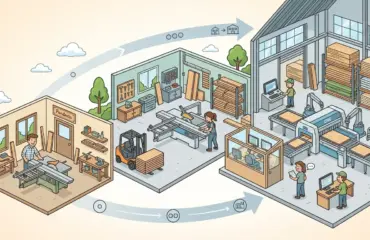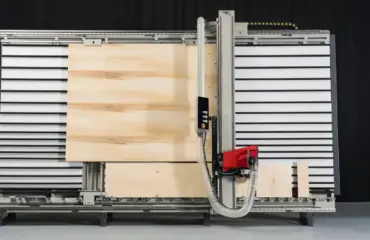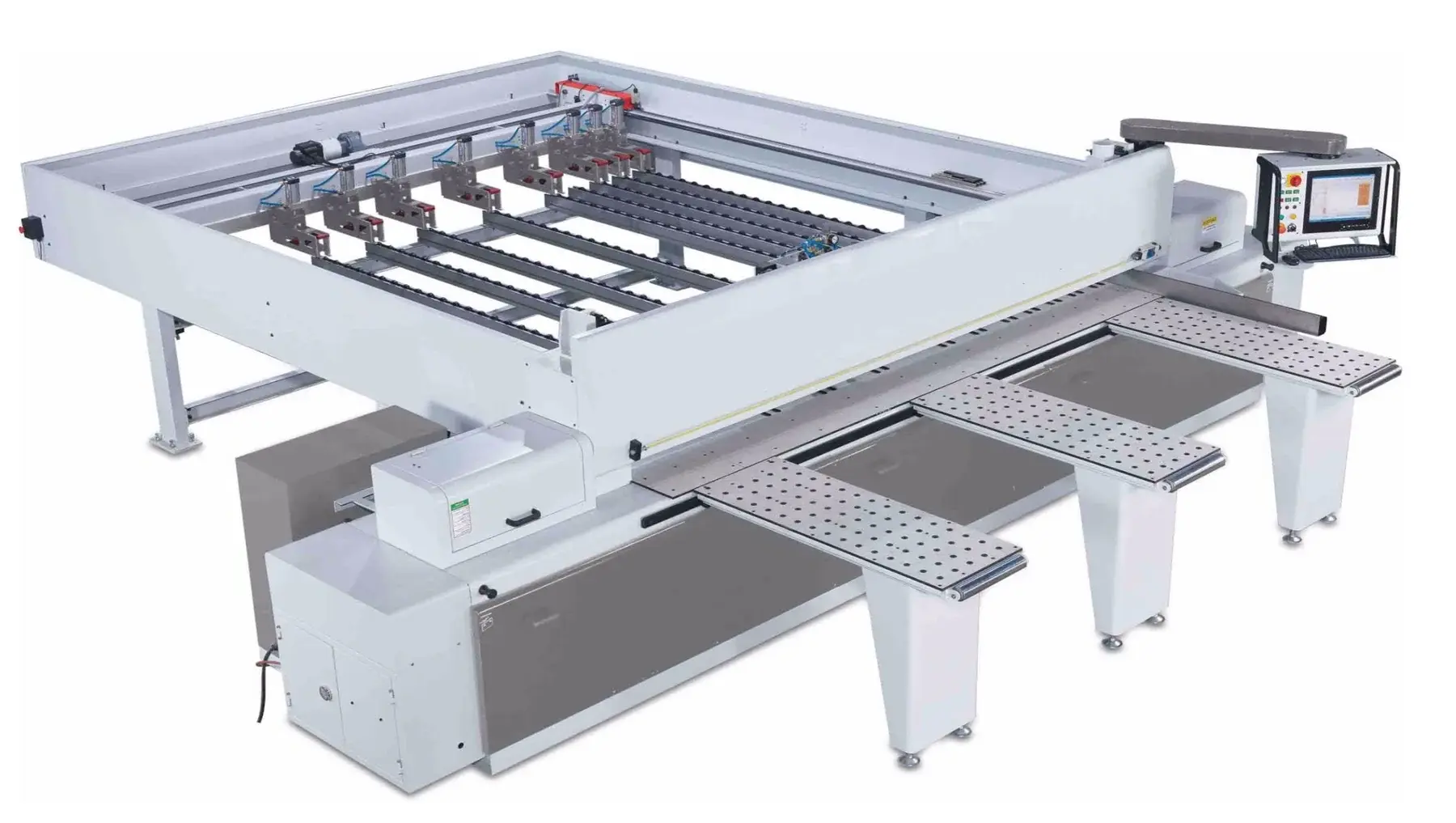
In furniture manufacturing, cutting accuracy is not just a saw-room concern. A small size deviation at the panel-cutting stage can show up later as an uneven edge, a misaligned drilling pattern, a cabinet box that pulls out of square, or a batch of parts that no longer fits the assembly plan cleanly.
That is why many factories treat panel cutting as a control point rather than a rough first step. For production lines built around repeated rectangular parts, dedicated panel saws are commonly used to make panel sizing more repeatable, less dependent on individual operator technique, and easier to keep consistent across an entire batch.
Why Cutting Accuracy Affects More Than The First Operation
In furniture production, accuracy accumulates or degrades from one station to the next. If the first cut is inconsistent, downstream processes spend time correcting variation instead of adding value.
That matters in common workflows such as:
- Cabinet side, top, and bottom panels that must assemble square without forcing
- Wardrobe components that need consistent reveals and clean alignment
- Shelves, doors, and partitions that depend on reliable edge preparation
- Flat-pack furniture parts that must fit hardware and assembly points without rework
When panel dimensions vary from part to part, the problem usually spreads. Operators re-measure, re-sort, or re-cut material. Edge processing becomes less predictable. Drilling alignment becomes harder to trust. Assembly slows down because the line is compensating for dimensional drift introduced upstream.
Where Panel Saw Accuracy Actually Comes From
A panel saw improves accuracy less by one dramatic feature and more by controlling several sources of variation at the same time. In furniture manufacturing, that combined control is what gives the machine its value.
| Accuracy Factor | How A Panel Saw Helps | Workflow Outcome |
|---|---|---|
| Consistent Referencing | Panels are positioned from a stable datum before repeated cuts | Better part-to-part dimensional consistency |
| Stable Material Holding | The sheet is held more securely during cutting | Less movement-related variation during production runs |
| Repeatable Cut Sequencing | The same cut pattern can be repeated across batches | More predictable output for modular furniture lines |
| Reduced Manual Measuring | Fewer repeated mark-and-cut steps depend on operator judgment | Lower risk of cumulative human error |
| Better Batch Discipline | Cut lists and part groups can be processed in a more structured way | Easier sorting, labeling, and downstream handling |
In high-volume panel processing, this kind of repeatability is often more important than peak cutting speed by itself. A fast cut is useful only if the part arrives at the next operation with the expected size, squareness, and sequence.
How Better Accuracy Shows Up Downstream
The easiest way to understand panel saw accuracy is to look at what happens after cutting.
When parts move into edgebanders, more consistent panel sizing helps stabilize edge preparation and reduces the need for operators to compensate for panel-to-panel variation. That does not guarantee perfect edge quality on its own, but it gives the edge-banding process a more reliable starting point.
The same applies before boring and drilling machines. If the panel has already been sized consistently, hardware-hole positioning and joinery preparation become easier to keep aligned with the intended part geometry. In practical terms, that supports smoother cabinet assembly and fewer surprises when parts reach final fit-up.
Accuracy at the cutting stage also supports:
- Better Squareness In Cabinet Boxes
- Fewer Re-Cuts Caused By Size Mismatch
- Lower Manual Inspection Pressure Between Stations
- More Reliable Part Pairing For Left/Right Or Top/Bottom Components
- Cleaner Scheduling In Batch Production
This is why panel saw accuracy is really a workflow issue. The value is not limited to the cut itself. It shows up in how stable the rest of the line becomes.
Panel Saw Accuracy Versus More Flexible Cutting Methods
Accuracy is not only about the machine category. It is also about the production context.
For example, sliding table saws can deliver very good results in skilled hands, especially in custom shops and mixed-material work. But their accuracy consistency over time often depends more heavily on operator method, measurement discipline, and job complexity.
By contrast, a panel saw is usually strongest when the work is repetitive enough for process control to matter more than cutting flexibility.
| Machine Type | Where Accuracy Is Strongest | Main Tradeoff |
|---|---|---|
| Panel Saw | Repeated rectangular panel sizing in batch furniture production | Less suitable for irregular, shape-heavy, or highly custom work |
| Sliding Table Saw | Flexible cutting with direct operator control in smaller or mixed workflows | Consistency can depend more on operator technique and pace |
| CNC Nesting Machine | Integrated cutting of shaped or nested parts in customized production | May be more process system than needed if straight panel sizing is the main issue |
That does not mean one machine is universally more accurate in every scenario. It means the most stable accuracy usually comes from matching the machine to the job structure.
Where The Accuracy Gains Are Most Visible
Panel saw accuracy tends to matter most in factories with the following characteristics:
- Repeated Cabinet Or Wardrobe Components
- Large Volumes Of Rectangular Sheet-Based Parts
- Standardized Modular Furniture Programs
- Tight Downstream Coordination Between Cutting, Edge Processing, Drilling, And Assembly
- Production Targets That Depend On Predictable Batch Flow
In these environments, the cut cell is not just making parts. It is feeding a chain of dependent operations. The more stable the first step becomes, the easier it is to keep the rest of the line running without correction work.
The benefit may be less dramatic in workshops where most jobs are one-off, highly customized, or dominated by irregular shapes. In those cases, cutting flexibility may matter more than the structured repeatability that makes a panel saw so effective in factory-style furniture production.
What Panel Saws Do Not Fix By Themselves
It is important to stay realistic. A panel saw can improve cutting accuracy, but it does not remove every source of dimensional error from the plant.
Factories still need to control:
- Blade Condition And Cut Quality
- Machine Calibration And Ongoing Maintenance
- Material Flatness And Panel Quality Variation
- Cut-List Accuracy And Production Data Discipline
- Part Sorting, Labeling, And Handling After Cutting
If those areas are weak, even a well-matched machine will not deliver the full accuracy benefit the workflow is capable of. The strongest results usually come when the saw is part of a disciplined production system rather than treated as a standalone fix.
Practical Summary
Panel saws improve accuracy in furniture manufacturing by making panel sizing more repeatable, more stable across batches, and less dependent on manual variation. That accuracy matters because it supports better edge processing, more reliable drilling alignment, cleaner assembly, and lower rework across the line.
For furniture factories built around repeated rectangular parts, the accuracy advantage of a panel saw often shows up not as one dramatic improvement at the cutting station, but as a steadier and more predictable production flow overall. For custom, shape-heavy, or lower-volume work, another cutting method may still be the better fit. But where batch panel processing drives the business, a panel saw is often one of the clearest ways to protect dimensional consistency from the first cut forward.