In panel furniture manufacturing, drilling problems usually do not look dramatic at first. A hole row shifts slightly, connector positions need checking again, hinge hardware takes longer to fit, or cabinet parts reach assembly with just enough variation to slow everything down. The cost shows up later as rework, slower fitting, and operators compensating for panels that should already be production-ready.
That is why drilling should not be treated as a minor support step. In a real furniture workflow, it affects hardware fit, cabinet squareness, drawer consistency, and how smoothly parts move into final assembly. For factories evaluating dedicated boring and drilling machines for panel work, the main question is not simply whether the machine can make holes. It is whether it improves the repeatability of the whole production flow.
Why Drilling Becomes A System Issue In Panel Furniture Production
Panel furniture depends on repeated part relationships. Side panels must align with shelves. Connector holes must match opposing parts. Hardware preparation has to remain consistent from batch to batch. In cabinet, wardrobe, office, and modular storage production, even small drilling variation can create avoidable friction across the rest of the line.
This matters especially when the factory works with melamine-faced board, MDF, particleboard, plywood, or similar panel materials that move through a structured sequence of cutting, edge processing, drilling, hardware fitting, and assembly. If hole placement drifts, the problem rarely stays at the drilling station. It spreads into:
- Slower Hinge And Fitting Installation
- More Manual Checking Before Assembly
- Greater Risk Of Mismatched Cabinet Parts
- Rework On Connector, Dowel, Or Shelf-Support Positions
- Less Predictable Throughput In Final Box Assembly
In other words, drilling accuracy is not just a machining issue. It is a workflow issue.
Typical Applications For CNC Drilling Machines In Panel Furniture Manufacturing
The value of a CNC drilling machine becomes clear when the factory is producing repeated panel components that depend on accurate hole positioning and steady batch consistency.
Common applications include:
- Cabinet Side Panels With Repeated Hardware Or Shelf-Support Patterns
- Horizontal Panels Such As Tops, Bottoms, And Fixed Shelves
- Wardrobe And Closet Components With Repeated Connector Layouts
- Office Furniture Panels Requiring Consistent Assembly-Hole Placement
- Drawer Components Or Related Parts That Need Stable Joinery Preparation
- Modular Furniture Programs Built Around Standardized Hole Systems
The specific hole pattern depends on the product design, hardware choice, and assembly method. But the production logic is similar across most panel-based furniture lines: holes must be in the right place, on the right reference, and repeated reliably enough that downstream fitting does not become a manual correction exercise.
| Application Area | What The Drilling Process Needs To Deliver | Why It Matters Downstream |
|---|---|---|
| Cabinet Side Panels | Consistent rows and repeatable reference positions | Supports reliable shelf, connector, and hardware fit |
| Shelves, Tops, And Bottom Panels | Stable alignment with mating components | Reduces fitting problems during carcass assembly |
| Wardrobe And Storage Panels | Repeatability across larger batches of similar parts | Helps maintain assembly speed and part interchangeability |
| Drawer-Related Components | Accurate joinery and hardware-hole positioning | Improves drawer fit and reduces manual correction |
| Customized Modular Orders | Faster changeover between programmed part types | Helps mixed production stay organized without layout drift |
Where CNC Drilling Machines Add The Most Value
Not every factory needs the same level of drilling automation. The strongest case usually appears when production is large enough, repetitive enough, or accuracy-sensitive enough that manual marking, repeated setup, or operator-dependent positioning starts limiting output.
In practical terms, CNC drilling machines tend to create the most value when the factory needs:
- More Reliable Hole Positioning Across Repeated Batches
- Less Dependence On Manual Layout Or Operator Judgment
- Faster Preparation Of Panels Before Hardware Fitting
- Better Alignment With Standardized Cabinet Construction Systems Such As 32 Mm-Based Workflows
- Cleaner Handoffs Into Assembly With Fewer Stops For Checking Or Sorting
This is why drilling equipment is often justified less by headline cycle claims and more by what it prevents. If the machine helps eliminate repeated checking, fitting corrections, and inconsistent part preparation, its contribution can be larger than the drilling station alone suggests.
Dedicated CNC Drilling Vs. Integrated CNC Processing
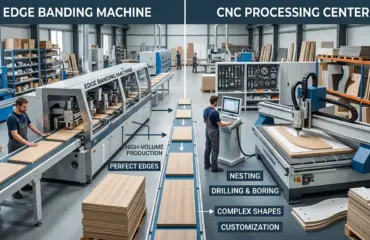
Factories do not always need the same solution. Some need a dedicated drilling station. Others are better served by a broader CNC workflow that combines cutting and drilling in one front-end process.
For example, when the main need is high-volume, repeatable hole preparation on already-sized panels, a dedicated drilling or boring machine often makes more sense. When the factory is also trying to combine cutting, routing, and drilling in one coordinated process, CNC nesting machines may be the stronger fit.
| Workflow Option | Best Fit | Main Strength | Main Tradeoff |
|---|---|---|---|
| Manual Or Semi-Automatic Drilling | Smaller volumes or less structured output | Lower system complexity and more flexibility for occasional work | More operator dependence and less repeatability at scale |
| Dedicated CNC Drilling Machine | Repeated panel parts with strong accuracy requirements | Faster, more consistent hole preparation on standardized work | Adds a dedicated station that still depends on upstream part control |
| Integrated CNC Cutting And Drilling Workflow | Mixed processing where cutting and drilling must be coordinated | Combines multiple operations into a more unified digital process | May be more system than needed if the bottleneck is mainly drilling |
This comparison matters because buyers sometimes solve the wrong problem. A factory with stable cutting but weak drilling consistency may need a dedicated drilling solution, not a broader system rebuild. A factory with disconnected front-end processing may need more than a stand-alone drilling station.
Upstream Panel Quality Still Shapes Drilling Results
Even the best drilling process depends on stable incoming parts. If panels arrive with size variation, poor referencing, or inconsistent edge condition, drilling accuracy becomes harder to protect in real production.
That is why drilling performance should be evaluated together with upstream preparation. Panel sizing, part identification, and edge condition all influence how reliably a panel can be referenced and processed. In a disciplined panel furniture line, drilling works best when the previous stations already support dimensional consistency and orderly batch flow.
This does not mean every factory needs the most automated front end possible. It means drilling quality improves when the line is organized so parts arrive correctly sized, correctly identified, and ready for repeatable positioning.
What Buyers Should Evaluate Before Expanding Drilling Capacity
The most useful evaluation is usually operational, not cosmetic. Instead of asking only which machine looks more advanced, factories should ask where drilling errors or delays are currently appearing.
Key questions include:
- Are Assembly Teams Losing Time Because Hole Positions Need Rechecking?
- Is The Current Process Too Dependent On One Skilled Operator Or One Shift?
- Does Part Repetition Justify A Dedicated Drilling Workflow?
- Are Mixed Orders Creating Setup Friction That Programming Could Reduce?
- Will Better Drilling Consistency Improve Hardware Fitting, Drawer Preparation, Or Cabinet Assembly Enough To Matter Financially?
- Is The Real Constraint Drilling Alone, Or A Wider Disconnect Between Cutting, Drilling, And Part Flow?
These questions usually lead to better decisions than focusing only on general automation language. In panel furniture manufacturing, the value of a drilling machine is tied directly to repeatability, part fit, and how much downstream instability it removes.
When A CNC Drilling Machine May Be Less Critical
A dedicated CNC drilling investment may be less urgent when:
- Production Volumes Are Low And Product Types Change Constantly
- Drilling Is Not The Real Bottleneck In The Plant
- Upstream Part Variation Is So High That A Better Drilling Station Alone Will Not Stabilize Output
- The Factory Still Depends More On Flexible General-Purpose Work Than On Repeated Panel Programs
This is an important discipline point. A CNC drilling machine is not automatically the next logical upgrade just because the factory wants more automation. It becomes the right investment when drilling consistency, throughput, and repeatable hardware preparation are clearly limiting overall production quality.
Practical Summary
CNC drilling machines matter in panel furniture manufacturing because panel assembly depends on repeatable relationships, not just individual hole-making capability. When cabinet sides, shelves, wardrobe panels, and drawer-related parts need consistent hardware and joinery preparation, drilling accuracy directly affects fit, assembly speed, and rework levels.
The best application fit appears in factories producing repeated panel components where operator-dependent drilling is no longer stable enough. In those environments, a dedicated CNC drilling solution can help standardize hole positioning, improve hardware fit, and create smoother handoffs into assembly. But the investment should still be judged in workflow terms: not by whether it drills faster in isolation, but by whether it makes the rest of the line easier to run.