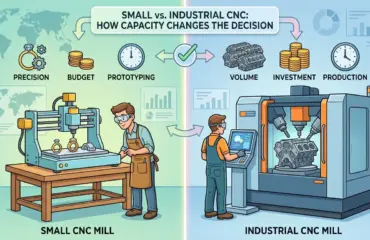
Controller choice determines far more than whether a machine moves. It shapes how the machine is commissioned, how it recovers from faults, how it integrates with drives and I/O, how clearly alarms and machine state are presented, and ultimately how much operational uncertainty the owner is expected to absorb. That is why GRBL and industrial CNC controllers should not be compared as if they were simply cheaper and more expensive versions of the same idea. They belong to different expectations of machine ownership.
GRBL-class stacks are popular because they are accessible, low-cost, and well understood in the small-machine and maker world. Industrial CNC controllers are chosen because they are built to support more accountable machine behavior, more integrated safety and I/O structure, and stronger production expectations. The real choice is not “open versus closed.” It is who owns reliability when money, schedule, and liability are attached to the machine.
This is the lens that makes the comparison useful. If the machine is a project, a learning tool, or a lightly commercial personal asset, GRBL may be exactly right. If the machine is infrastructure, shared equipment, or part of a production promise, the controller conversation changes completely.
Start With The Machine’s Job, Not With The Controller Brand Or Philosophy
Many controller debates go wrong because buyers start from preference language instead of job language. They ask whether GRBL is good, or whether industrial controllers are worth the money, before defining what the machine is actually expected to carry. That reverses the logic.
The better opening questions are operational. Is this a compact router or mill for learning and prototyping? Is it a DIY platform that one technically engaged user will manage? Is it a machine that must survive multiple operators, scheduled output, alarm recovery, and tighter integration with peripherals? Is downtime inconvenient, or is downtime revenue loss?
These questions matter because the controller is not only a motion source. It is also an accountability layer. Once the job of the machine changes, the right controller often changes with it.
GRBL’s Real Strength Is Not Industrial Equivalence. It Is Accessible Machine Ownership.
GRBL became common because it lowers the barrier to CNC control. It gives small-machine users a workable control path without demanding industrial capital or an enterprise-grade machine environment. That is its real power. It is accessible enough that a compact machine can become usable for learning, experimentation, and modest real work without the control system itself becoming the largest barrier.
That makes GRBL especially sensible for:
- Entry-level routers and mills.
- DIY or educational builds.
- Compact machines where control simplicity matters more than deep integration.
- Owners who are willing to manage configuration, recovery, and documentation themselves.
The value of GRBL is not that it secretly replaces industrial control. The value is that it makes small-scale CNC ownership possible and understandable for a broader group of users.
Industrial Controllers Are Purchased For Accountability, Not Only For Features
Industrial CNC controllers are often misunderstood because buyers reduce them to a list of higher-end features. Features matter, but that is not the core reason they are purchased. They are purchased because the machine has to behave like part of a dependable operating system. That includes not just motion quality, but fault handling, I/O structure, safety logic, tool management, recovery paths, documentation, and operator confidence under pressure.
Buyers tend to move toward industrial control when the machine is no longer a mostly personal platform. It may now support customer deliveries, repeated output, multiple operators, servo systems, probing, tool-change logic, or more complex peripheral coordination. In that environment, the controller becomes part of the machine’s commercial credibility, not merely its electronics stack.
That is the crucial shift. Industrial controllers do not just move axes. They reduce ambiguity around machine behavior when ambiguity becomes expensive.
The Best Short Comparison Is About Ownership Burden
| Decision Area | GRBL-Class Control | Industrial CNC Control |
|---|---|---|
| Main value | Accessibility and low entry cost | Integrated reliability and production readiness |
| Best-fit machine role | Small DIY, educational, prototyping, and light-duty systems | Commercial machines and higher-consequence workflows |
| Configuration burden | More often owned by the user or builder | More often embedded in a vendor-supported machine package |
| Fault recovery | Often workable but more user-managed | Usually more formal, structured, and better documented |
| I/O and peripheral growth | Good for modest systems | Better for complex motion, automation, and integration |
| Knowledge transfer | Strong when one skilled owner stays close to the machine | Stronger when many people must operate or service the machine |
This table helps because it keeps the conversation grounded in operating reality. The better question is not which controller is “more powerful” in theory. The better question is which one matches the machine’s actual burden of ownership.
Reliability Is Not Only About Whether The Machine Moves Correctly On A Good Day
GRBL can be reliable in the right context. Many compact machines run very effectively on it. The mistake is assuming that reliable motion on a small personal machine automatically translates into reliability on a more complex or commercially important platform.
Industrial controllers are not valuable only because they may offer smoother interpolation or more advanced control structure. They matter because they reduce uncertainty around faults, restarts, machine state, offsets, tool logic, alarm handling, and repeat behavior across longer operating life. When the cost of confusion is small, user-managed recovery can be acceptable. When the cost of confusion includes missed deliveries, scrap, or safety exposure, it often is not.
That is why the word “reliability” should be used carefully. In personal or experimental CNC, reliability can mean “the machine generally works when I use it.” In production, reliability often means “the machine behaves in a recoverable, documented, repeatable way across people and shifts.” Those are not the same standard.
I/O And Integration Usually Force The Control Decision Before Motion Quality Does
One of the clearest reasons buyers move beyond GRBL is that the machine stops being only about axis motion. As machines grow more integrated, the control decision becomes about everything the machine must coordinate: tool changing, probing, spindle logic, sensors, interlocks, operator signals, vacuum or dust-related automation, and other peripherals.
At a certain point, the issue is no longer whether GRBL can move the axes acceptably. The issue is whether the whole machine behavior still feels coherent under the chosen control stack. A controller selected for accessibility can become strained when asked to own a machine class it was never really meant to govern at full industrial expectation.
That is where industrial control becomes easier to justify. Not because the open stack suddenly became “bad,” but because the machine outgrew the ownership model the open stack was chosen for.
Safety Integration Changes The Conversation From Convenience To Liability
This is where many casual controller comparisons stay too shallow. Once a machine carries real power, repeated output, or shared operational responsibility, safety behavior is no longer an informal preference. It becomes part of the machine’s liability profile. Interlocks, emergency stop logic, controlled recovery, documented alarm states, and known operator behavior matter differently once the machine stops being a personal experiment.
Industrial controllers usually earn part of their cost here. They are often chosen because they fit more naturally into documented machine packages where safety and fault handling are expected to be structured rather than improvised. That does not mean small GRBL machines are inherently unsafe. It means the burden of safe integration often sits differently.
The buyer therefore needs to ask a hard question: is this a machine where safety logic is being engineered into a system, or a machine where safety remains heavily dependent on one knowledgeable owner’s habits? The answer does not always force one control path, but it changes how honest the control decision needs to be.
The Human Model Often Reveals The Right Controller Faster Than The Feature List Does
GRBL often works best when one informed user understands the machine deeply. Industrial controllers are often easier to defend when multiple operators, technicians, or shifts need a more consistent and transferable experience. That difference matters because machine knowledge rarely stays concentrated forever.
A control platform that depends on one person’s memory can work very well in a garage, lab, or tightly held small-shop environment. The same arrangement can become fragile when the machine becomes shared infrastructure. Once more people must run, recover, or maintain the machine, the value of formal alarm behavior, structured setup logic, predictable post behavior, and vendor documentation rises sharply.
This is why buyers should ask practical staffing questions rather than only technical ones:
- Who will run the machine day to day?
- Who will troubleshoot it when something goes wrong?
- How easily can knowledge transfer between people?
- How costly is a misunderstanding around control state or recovery?
These answers often determine the right class of control more clearly than raw specification language does.
Cost Should Be Evaluated As Risk Allocation, Not Only As Electronics Pricing
GRBL is cheaper to start with. Industrial controllers are more expensive. That part is obvious. The less obvious issue is the cost of operational uncertainty. If the machine is primarily for learning, prototyping, or low-risk small work, owner-managed troubleshooting is part of the value proposition. If the machine must support repeated business output, then the cost of unclear recovery, integration friction, post quirks, and alarm ambiguity can exceed the savings of a cheaper controller.
That is why controller decisions should be evaluated like risk allocation. What are you saving at the start, and what risk are you taking ownership of in exchange? In personal or development use, that may be a perfectly rational trade. In production, it may be false economy.
This is also why buyers should be wary of treating “free” or low-cost control options as if they are only cheaper versions of the same final system. Sometimes they are not cheaper. They are simply pushing finishing work, integration work, and recovery responsibility back onto the owner.
CAM Posts And Workflow Stability Matter More Than Controller Debates Usually Admit
Another hidden part of this decision is postprocessing stability. A control stack is not just a box on the machine. It sits inside a chain that includes CAM software, post behavior, setup habits, and recovery logic. Open control paths can be inexpensive to start and frustrating to finish if the post environment, probing logic, or I/O behavior creates repeated small disruptions that the owner must constantly manage.
Industrial stacks can feel expensive up front and then prove cheaper operationally because the post behavior and motion kernel are tied to a more stable vendor-supported logic. This is especially valuable when the machine is not an isolated experiment but part of a schedule that must hold.
That is why controller review should include the whole file-to-motion chain. A controller is only as useful as the workflow it stabilizes.
When GRBL Is Exactly The Right Answer
Choose GRBL when the machine is compact, light-duty, and user-managed. It fits best when the owner is comfortable configuring and maintaining the system, the work is educational or experimental, and simplicity plus low cost matter more than formal integration. In these cases, GRBL can be practical, effective, and fully appropriate.
It is especially strong where operator presence is assumed, the risk envelope is controlled, and the goal is to learn or make light commercial progress without pretending the machine is already factory infrastructure. There is nothing lesser about this if the machine role is defined honestly.
GRBL is not a compromise when the machine is a project and the owner knows they are also choosing to own more of the system behavior directly.
When Industrial Control Is The Honest Choice
Choose industrial control when the machine is commercially important, when process recovery must be handled formally, when I/O and peripheral coordination are growing, and when the business needs stronger support and operator transferability. It is also the more honest choice when the controller is part of a broader equipment strategy rather than a self-contained experiment.
This often becomes obvious at exactly the moment buyers resist admitting it. They are no longer asking how to make a machine move. They are asking how to make a machine dependable across handoffs, alarms, service events, and schedule pressure. That is industrial-controller language whether they realize it or not.
For buyers comparing self-managed control stacks with larger factory equipment decisions, related Pandaxis reading on factory-direct machinery buying: pros, risks, and what to verify before you commit and the broader Pandaxis machinery lineup helps keep support boundaries explicit instead of treating every machine decision as a purely technical hobby question.
The Fastest Honest Test Is To Ask Whether The Machine Is A Project Or Infrastructure
This may be the most useful shortcut in the whole comparison. If the machine is fundamentally a project, GRBL is often a sensible path. If the machine is infrastructure, industrial control is usually the safer one. The reason this test works is that it captures responsibility, not just features.
Projects tolerate learning, troubleshooting, experimentation, and owner-managed recovery. Infrastructure is expected to survive operator changes, maintenance handoffs, and commercial pressure. Once that distinction is made honestly, many controller arguments become much less philosophical.
This same discipline also prevents the wrong kind of ecosystem debate. For example, if the broader production conversation is really about process family rather than control philosophy, Pandaxis’s guidance on laser machine versus CNC machine: which one fits your production workflow may be more useful than another round of controller religion. Sometimes buyers are arguing about control stacks inside the wrong machine category entirely.
Match The Controller To The Cost Of Failure, Not To The Loudest Forum Opinion
GRBL and industrial CNC controllers fit different machine expectations. GRBL is strong when accessibility, low cost, and small-machine flexibility matter most. Industrial controllers are strong when the machine must support integrated, repeatable, higher-consequence work with clearer safety, recovery, and accountability expectations.
The right controller is the one that matches the machine’s role, the operator model, and the cost of failure. If the machine is a project, GRBL can be exactly right. If the machine is infrastructure, industrial control is usually the better decision. That is the real dividing line. Not hobby versus professional pride, not open versus closed ideology, but who owns reliability when the machine is no longer allowed to be ambiguous.