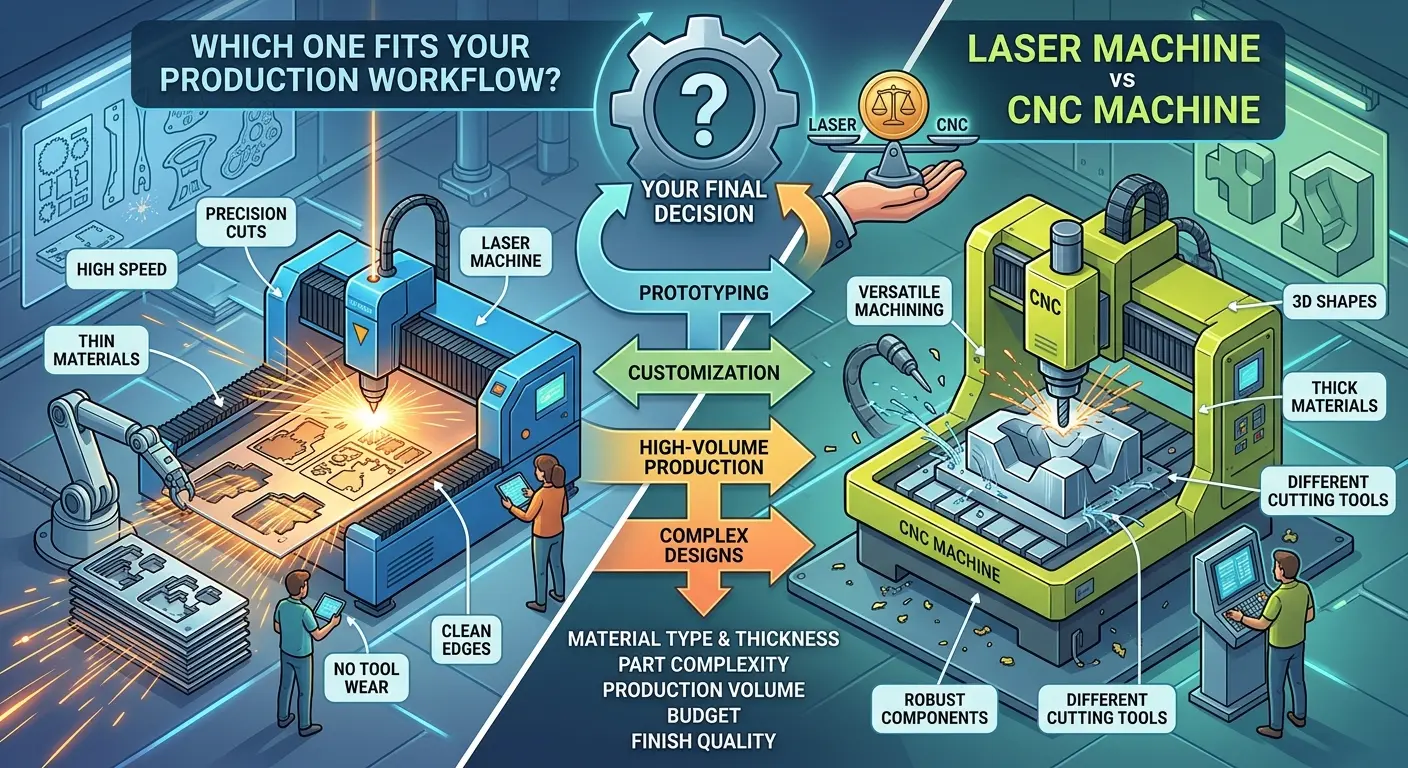
Many industrial and commercial buyers compare laser machines and CNC machines because both can cut shapes, improve repeatability, and reduce manual work. The problem is that they do not solve the same production bottlenecks in the same way. A shop that chooses based only on headline machine type can easily end up with the wrong process for its material mix, part geometry, and downstream workflow.
The better question is not which technology sounds more advanced. It is which process fits the work you actually need to run every day. In Pandaxis terms, that usually means comparing laser processing for wood, acrylic, and similar non-metallic materials against CNC routing and nesting workflows used for panel processing, drilling integration, and production-scale part preparation.
The Core Difference Is Process, Not Just Machine Category
A laser machine removes material with concentrated light and heat. That makes it well suited to detailed cutting, engraving, and shape work where contact-free processing and fine geometry matter. In commercial production, this is often attractive for acrylic parts, decorative wood components, signage elements, and other applications where clean detailing is a priority.
A CNC machine removes material with a physical cutting tool. That changes the production logic immediately. CNC equipment is often chosen not only for cutting, but also for routing, grooving, drilling, pocketing, and integrated panel processing. In other words, it is usually part of a broader manufacturing workflow rather than a single shaping process.
That is why many shops do not decide between the two based on technology alone. They decide based on which process removes more downstream labor, reduces more rework, and aligns better with the finished part.
Laser Machine vs CNC Machine at a Glance
| Decision Factor | Laser Machine | CNC Machine | What It Means in Production |
|---|---|---|---|
| Primary Strength | Fine cutting and engraving on suitable non-metal materials | Cutting combined with routing, drilling, and machining operations | Laser favors detail work, while CNC favors multi-step part preparation |
| Material Focus In This Comparison | Wood, acrylic, and similar non-metallic substrates | Wood panels, sheet goods, solid material routing, and nested part production | The right choice depends heavily on your actual material mix |
| Part Geometry | Strong for intricate outlines, engraving, and decorative detail | Strong for structural parts, slots, pockets, drilling patterns, and machined features | Complex detail and integrated machining are not the same requirement |
| Contact With Material | Non-contact process | Tool-based contact process | This affects edge behavior, hold-down needs, and secondary finishing |
| Workflow Integration | Best when the main job is cutting or engraving | Best when one setup needs multiple operations | CNC often reduces handoffs in cabinet and furniture production |
| Typical Bottleneck It Solves | Precision detail, engraving, and shaped non-metal cutting | Throughput, repeatability, nested cutting, and downstream assembly preparation | Buy based on the bottleneck you need to remove |
This is the practical difference most buyers need to understand. A laser can be the better cutter for one part family and still be the wrong machine for the factory’s core workflow.
Choose a Laser Machine When Detail and Material Fit Matter Most
A laser machine is usually the stronger choice when the job depends on precision detailing, engraving, or shaped cutting in materials that respond well to laser processing. In many shops, that means decorative or branded parts, acrylic components, lightweight panel details, display pieces, custom patterns, and similar work where intricate geometry matters more than routing, drilling, or machining depth.
Laser processing tends to make the most sense when you need:
- Fine Cut Geometry And Small Internal Features
- Engraving As Part Of The Finished Product
- Clean Decorative Processing On Suitable Non-Metal Materials
- Less Mechanical Contact During The Cutting Process
- A Workflow Centered On Shape, Marking, Or Visual Detail Rather Than Multi-Operation Machining
For shops evaluating laser cutters and engravers as part of a production upgrade, the key is to judge the machine by application fit. If the work is primarily visual, shaped, engraved, or material-sensitive within the brand’s current non-metal laser scope, laser processing can be a strong match.
Choose a CNC Machine When the Job Includes More Than Cutting
If the part needs routing, drilling, pocketing, grooving, or nested optimization in addition to cutting, a CNC machine is usually the better production tool. This is especially true in furniture, cabinetry, and panel-based manufacturing, where the real value often comes from preparing parts for hardware, joinery, edging, and assembly in a more integrated way.
CNC is often the stronger choice when you need:
- Cutting Plus Drilling Or Routing In One Workflow
- Repetitive Panel Processing With High Part Consistency
- Better Material Utilization Through Nesting Logic
- Structural Parts That Need Machined Features Beyond Outer Profile Cutting
- A Production Flow That Connects Directly To Edge Banding, Boring, And Final Assembly
For factories focused on cabinet parts, panel furniture, and production-scale routing, CNC nesting machines are typically evaluated not just as cutters, but as workflow machines that reduce handoffs and improve repeatability across the line.
Material and Finished-Part Requirements Should Drive the Decision
Many buying mistakes happen because a shop starts with the machine category instead of the part requirement. A laser machine may be excellent for acrylic display work, surface engraving, or detailed decorative components, but it will not automatically replace a CNC workflow that needs holes, slots, routing paths, or nested panel optimization.
Likewise, a CNC machine may be the right answer for structural panel parts and machining-heavy workflows, but it may not be the most efficient path when the part value depends on fine engraved detail or visually clean shaped cutting in laser-friendly materials.
In simple terms:
- If The Finished Part Is Primarily Defined By Detail, Engraving, Or Decorative Shape, Laser Often Has The Advantage
- If The Finished Part Is Primarily Defined By Machined Features, Joinery Preparation, Or Panel Workflow Integration, CNC Usually Has The Advantage
- If Your Product Mix Spans Both, One Technology May Not Realistically Replace The Other
This is why the best investment decision often starts with a real job-family review instead of a machine brochure comparison.
Look at the Full Workflow, Not Just the Cut
Production decisions should include what happens before and after the machine cycle. A laser machine may produce the required shape efficiently, but the overall workflow can still be weak if the part later needs separate drilling, routing, or other machining. A CNC machine may take on more operations in one setup, but it may still not match laser processing where engraving and fine decorative detail are central to the product.
Useful workflow questions include:
- What Materials Represent The Largest Share Of Your Weekly Output?
- Do Your Parts Need Only Cutting, Or Do They Also Need Routing And Drilling?
- Is Decorative Detail Or Engraving A Core Part Of The Product Value?
- Are You Trying To Reduce Setup Time, Manual Handoffs, Or Secondary Operations?
- Does The Shop Need One Primary Production Machine Or Two Complementary Processes?
Once those questions are answered honestly, the better technology choice usually becomes much clearer.
In Many Factories, the Right Answer Is Not Either-Or
It is common for buyers to ask whether laser or CNC is better, but many real factories use both because each process covers a different production role. A panel furniture operation may rely on CNC for nested structural parts while using laser equipment for acrylic inserts, decorative panels, labeling elements, or custom branding work. A custom fabrication shop may use CNC for machined geometry and laser for fine detail work that would be less efficient as a routed process.
That is why a broader review of the Pandaxis product catalog can be useful when the buying decision is really about line design rather than a single machine purchase. The question may not be which machine wins. It may be which process should sit at the center of production and which one should support it.
Practical Buying Logic for Industrial and Commercial Shops
If you are making the decision now, the fastest way to narrow it down is to match the machine to the part family and the bottleneck.
- Buy A Laser Machine If Your Competitive Advantage Depends On Detailed Cutting, Engraving, And Visual Precision In Suitable Non-Metal Materials
- Buy A CNC Machine If Your Competitive Advantage Depends On Routing, Drilling, Nested Efficiency, And Better Integration Into Panel Or Machining Workflows
- Consider Both If Your Shop Produces Structural Parts And Decorative Parts That Call For Different Processes
This keeps the purchase grounded in production reality instead of generic claims about which technology is more advanced.
Conclusion
Laser machines and CNC machines solve different manufacturing problems. Laser processing is typically the better fit when detail, engraving, and shaped cutting on suitable non-metal materials drive the job. CNC is usually the better fit when cutting is only one step in a larger workflow that also includes routing, drilling, nesting, and downstream assembly preparation.
If you choose based on material fit, finished-part requirements, and workflow bottlenecks, the decision becomes much more practical. That is also the most reliable way to avoid buying a machine that performs well in theory but does not match how your shop actually makes money.