
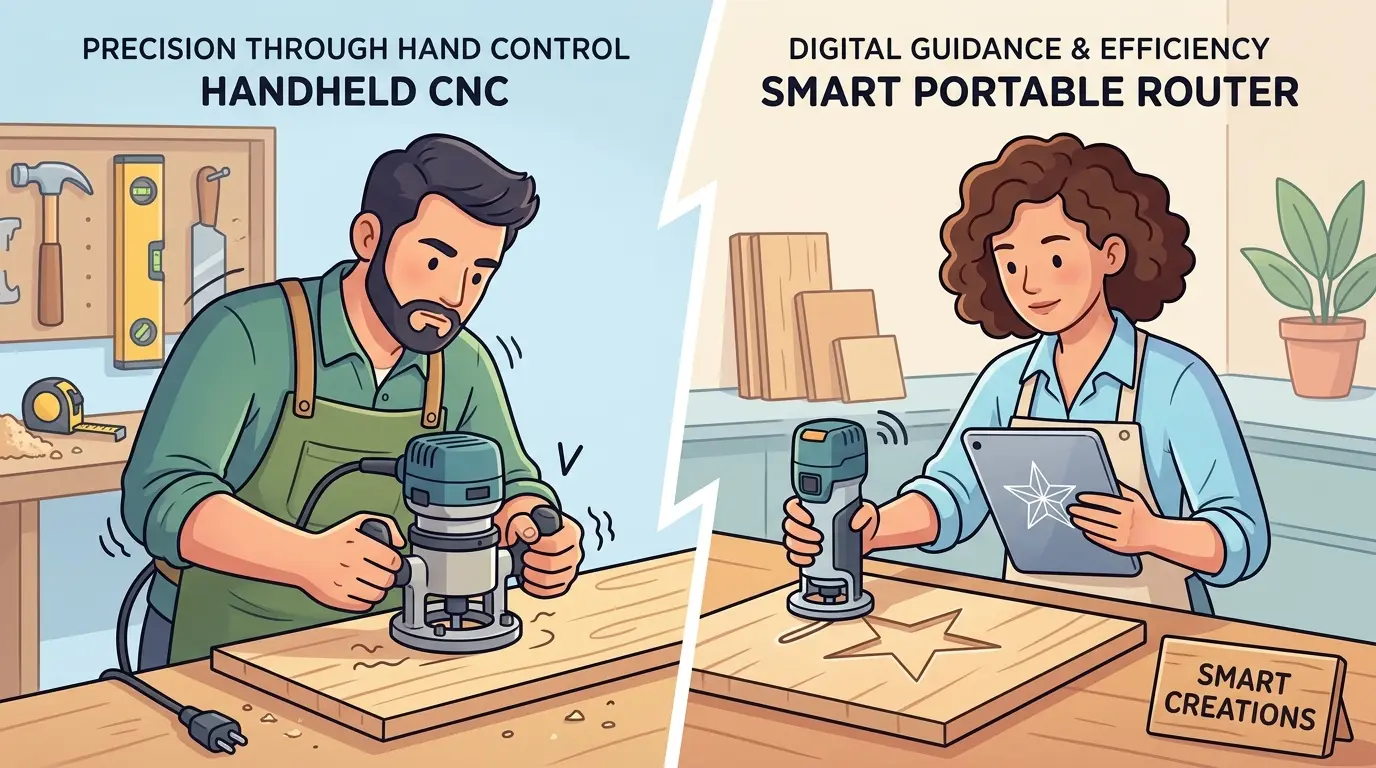
The first mistake in this comparison is assuming both tools solve the same production problem. They do not. A handheld router is still an operator-led cutting tool even when it works with templates, guide rails, or edge fences. A smart portable router tries to add programmed motion, repeatable positioning, and digital path control without forcing the workpiece back to a fixed machine. That sounds similar in marketing language, but on a real jobsite or in a small workshop the difference is operational. One tool rewards skilled hands, quick adaptation, and very low setup overhead. The other rewards repeat jobs, controlled geometry, and better traceability of how the cut was produced.
If you are choosing between them, the real question is not which tool looks more advanced. The real question is which one removes the larger source of waste in your actual workflow. On some jobs, human judgment at the cut is the fastest and safest way forward. On other jobs, hand-guided routing becomes the reason fit drifts, templates pile up, and assembly variation spreads downstream.
Start With The Bottleneck, Not With The Tool Category
Buyers often approach this comparison backwards. They begin by admiring the portability or intelligence of the tool and only later ask where time and quality are actually being lost. A better starting point is to identify the bottleneck first.
Are jobs being slowed down because an experienced operator still has to manually recreate the same cutout again and again? Are fitting errors appearing because site adjustments are different from one technician to the next? Are jobs highly variable, with each installation condition forcing fresh judgment and local trimming? Or is the problem that large workpieces are awkward to move to a fixed router, but still need geometry that hand tools do not repeat well enough?
The answer changes everything. Handheld routing excels when the real bottleneck is responsiveness. Smart portable routing earns its keep when the real bottleneck is inconsistency.
A Handheld Router Keeps Judgment At The Cut
With a handheld router, the operator controls the cut in real time. Feed feel, entry path, local pressure, and line tracking all live close to the hands and eyes of the person running the tool. Templates and jigs can reduce variation, but the quality of the result still depends heavily on visibility, support, experience, and how the operator reacts to the actual condition of the workpiece.
That is exactly why handheld routers remain valuable. They are strong for fit-up, hinge recesses, localized trimming, edge profiling, repair work, and one-off site adjustments. They allow a technician to respond immediately when the wall is out, the panel is slightly oversized, or the installed condition differs from the drawing. In those moments, a handheld router is not primitive. It is appropriately direct.
This matters especially in environments where the work is messy in a practical sense. Renovation work, exhibition fitting, repair jobs, custom cabinetry installation, and ad hoc field modifications often reward a tool that can move with the operator and adapt without a digital setup sequence before every new cut.
A Smart Portable Router Moves Skill Upstream
With a smart portable router, the machine governs more of the path. The operator still establishes the work zone, sets reference, checks support, manages dust control, and monitors the cut, but the geometry itself is carried by programmed motion rather than by hand guidance. That changes the skill profile.
Many buyers assume this reduces skill dependence altogether. In reality, it changes where the skill sits. Hand-guided routing demands steady physical control and visual tracking during the cut. Smart portable routing demands more disciplined setup, file control, zeroing, and verification before the cut. The machine may handle the path, but someone still has to create a trustworthy environment for that path to mean anything.
That shift is important. Shops sometimes buy portable CNC-style systems believing they are buying freedom from operator variability, and later discover they have only moved the variability upstream into referencing, support, job prep, and recovery logic. If your team is strong at disciplined setup and weak at repeated manual geometry, that trade can be worth it. If the opposite is true, the machine can feel slower and more fragile than the handheld tool it was supposed to replace.
Real-Use Differences Show Up Faster On The Jobsite Than In The Shop
The gap between these two tools becomes obvious very quickly once the work leaves a controlled bench. On a jobsite, access changes, support surfaces are imperfect, extraction is awkward, and the operator is often working around installed components. In that environment, a handheld router benefits from being genuinely immediate. It can be lifted, placed, guided, stopped, and repositioned without a larger choreography.
A smart portable router can still be valuable there, but it asks more from the surrounding setup. The workpiece has to be supported predictably. Travel has to be clear. Reference has to make sense. Cables, hoses, or battery conditions must not interfere with the motion logic. In other words, portability does not mean carelessness. Portable automation still wants a controlled situation, even when that situation exists on a floor, slab, or installed panel rather than on a factory bed.
That is why the practical difference is not “manual versus automatic.” The real difference is “immediate human correction versus repeatable process discipline.”
Where Handheld Routing Still Wins Decisively
A handheld router wins when flexibility matters more than geometric repeatability. It is also stronger when the cut itself is relatively simple but the local conditions change too often to justify a full setup routine.
Typical situations include:
- Site carpentry and installation adjustment.
- Local recessing, trimming, and fit correction.
- Edge treatment where the profile matters more than digital path reuse.
- Jobs where the next piece is unlikely to match the last one closely enough to reuse a program.
- Environments where carrying support equipment for smart routing becomes its own burden.
It also wins on simplicity. Handheld routers are mechanically simpler, easier to replace, and less exposed to software or referencing problems. When a crew needs a rugged, familiar tool that can be handed to trained staff quickly, simplicity creates real uptime. Many buyers underestimate how much productivity comes from tools that do not need calibration rituals or digital troubleshooting before every shift.
Where Smart Portable Routing Starts To Create Better Economics
A smart portable router begins to make more sense when human guidance becomes the bigger source of waste. This usually appears in repeated cutouts, panel features, shaped openings, hardware locations, or edge details that must align across many parts. Once the geometry repeats often enough, manually recreating the same path stops feeling flexible and starts feeling expensive.
The machine can also earn its place when accuracy matters because of what happens after the cut. If the opening controls hinge placement, insert fit, hardware alignment, mating geometry, or decorative consistency across a project, then small manual variation can multiply into rework at assembly or installation. A digitally controlled portable cut reduces that variation if the setup is trustworthy.
Template reduction is another real advantage. Shops that carry plywood, MDF, acrylic, or composite templates know the hidden burden: storage, labeling, wear, revision control, and the risk of an old template returning to use. A digital file is not automatically safer, but it is usually easier to revise, archive, and reuse than a physical pattern library. That alone can justify portable programmed routing in custom manufacturing, signage, interiors, and repeated installation work.
Setup Discipline Is The Price Of Portable Automation
Portable programmed routing sounds efficient until the setup environment is poor. Uneven support, weak hold-down, poor dust extraction, limited access around the workpiece, or a rushed zeroing routine can erase the theoretical advantage quickly. Unlike a handheld router, which can sometimes survive a rougher environment because the operator compensates in real time, a smart portable router depends on the work zone being predictable enough for the programmed path to remain meaningful.
If the panel shifts, the sheet is under-supported, the reference is wrong, or the travel area is compromised, digital precision becomes digital confidence applied to a bad setup. That is the hidden failure mode of this entire category.
This is why job planning matters more than many buyers expect. The machine may be portable, but the process cannot be casual. You still need stable support under the material, sensible hose or battery management, safe extraction, and a reliable method for referencing every new part. The real price of portable automation is not only the hardware invoice. It is the discipline required to make the portable work zone behave like a controlled process often enough to justify the machine.
Quality Is About More Than The Path Being Repeated Correctly
Some buyers assume programmed motion guarantees a better edge. It does not. Quality in routing is never only about the path. Cutter geometry, chip evacuation, support under the workpiece, climb versus conventional strategy, local feed behavior, and material condition all matter. A handheld router in capable hands can leave excellent visible edges. A smart portable router can create excellent repeat geometry. Those are different strengths.
If the cutter is wrong, the material is poorly supported, or extraction is inadequate, the programmed machine simply repeats the same defect more consistently. Likewise, a skilled operator can save a handheld cut with local judgment that a rigid file-based routine cannot.
This is why the comparison should not be framed as “rough manual tool versus precise digital tool.” The real distinction is “judgment-rich tool versus setup-rich system.” Good results are possible with both when the rest of the process supports them.
The Human Factor Does Not Disappear, It Changes Shape
The human factor remains central in both routes. Handheld routing rewards tactile judgment, visibility, and the ability to react immediately when the material or site condition is not ideal. Portable programmed routing rewards the ability to prepare a job cleanly, verify references, manage digital files, and trust only what has been checked.
The better choice often depends on what kind of mistakes your team is more likely to make. If they are strong at hand-guided fitting but weak at disciplined digital setup, the handheld route may remain safer and cheaper. If they are careful with files and repeat routines but are losing time to manual variability, then the smart portable route can reduce rework.
Inspection patterns change too. When a shop runs digitally repeated cuts, it becomes easier to see systemic drift because the target geometry stays fixed. Manual routing errors are often more random and therefore harder to diagnose. That matters when work must be documented, repeated later, or transferred between crews.
A Practical Comparison Table For Real Buyers
Use the table below as a workflow filter rather than as a scorecard.
| Decision Factor | Handheld Router | Smart Portable Router |
|---|---|---|
| One-off trim and fit work | Usually stronger | Often more setup than the job needs |
| Repeated complex geometry | Limited by templates and operator skill | Stronger if setup stays stable |
| On-site mobility | Very strong | Good, but with a larger support burden |
| Training emphasis | Manual control and safe handling | Referencing, file control, and verification |
| Template dependence | Often high | Usually lower |
| Tolerance for rough environments | Higher | Lower |
| Upfront cost and replacement simplicity | Usually lower | Usually higher |
| Traceability and repeat-job reuse | Limited | Better |
| Dust and support structure | Significant | Significant and more procedural |
The pattern is straightforward. The more the job depends on adaptability, direct visibility, and quick reaction, the more a handheld router remains attractive. The more the job depends on repeated geometry, reusable files, and reduced operator variation, the more a smart portable router begins to justify itself.
Material, Dust, And Support Conditions Often Decide The Winner More Than The Tool Name Does
These tools do not operate in a vacuum. Material behavior matters. Thin panels, awkward oversized pieces, soft composites, laminated boards, and brittle finishes each respond differently to support quality and extraction. A handheld router can sometimes navigate those realities because the operator feels local resistance and adjusts immediately. A smart portable router is more dependent on the entire support field being prepared correctly before the cut begins.
Dust control is equally important. Buyers often compare portability while underestimating extraction. Fine MDF dust, laminate debris, acrylic chips, and wood splinters do not become less serious because the machine is portable. In many cases, the smarter the portable system becomes, the more buyers should think like process engineers, not only like tool owners.
If the support surface, dust routing, or access path are weak, the real-life advantage of the handheld tool rises sharply.
When Portable Stops Being The Right Question
There is a point where neither portable choice is ideal. If your work is moving from occasional shaping into steady panel processing, repeated cabinet components, or production-level routing, you are no longer solving a handheld-versus-portable question. You are solving a throughput and workflow question.
At that point, a fixed routing system often becomes the better comparison because it integrates cutting accuracy, hold-down strategy, and downstream process planning in a way portable tools cannot. If your operation is starting to look less like field work and more like repeated sheet processing, it is worth comparing the current portable workflow against CNC nesting machines or reviewing how portable CNC trade-offs play out over time.
This does not mean everyone should jump to fixed automation early. It means you should notice when your portable process is generating recurring waste through setup repetition, manual handling, or inconsistent downstream fit. Once those costs become routine, portability may no longer be the core value.
Choose By Failure Mode, Not By Marketing Language
The purchase price is only the visible part of the decision. The real cost sits in training time, setup repetition, cutter wear from bad support, dust control effort, remakes, and the labor wrapped around each cut. A cheaper handheld router can become expensive if repeated manual work creates fitting variation. A more advanced portable router can become expensive if programming and setup consume the time it was supposed to save.
Risk differs too. With a handheld router, the main risk is operator-dependent variation. With a smart portable router, the main risk is false confidence: the cut feels controlled because it is automated, but the reference or support logic is wrong. In both cases, the correct comparison is not between brochures. It is between failure modes.
That is the cleanest way to decide. Choose a handheld router when the work is varied, site-driven, and dependent on technician judgment more than file reuse. Choose a smart portable router when repeated geometry, lower template dependence, and better digital control will remove meaningful waste from the process. Do not expect either option to compensate for poor support, weak extraction, or casual setup habits.
If the work increasingly looks like production rather than field trimming, stop comparing portable tools and start comparing routing systems. The best tool is not the one with the strongest marketing narrative. It is the one that fits the material flow, the tolerance risk, and the way your team actually works every week.