In panel furniture production, edge banding is often where a part first starts to look finished. It is also where small process weaknesses become visible very quickly. A panel that looked acceptable after cutting can suddenly show a weak bond, a visible glue line, chipped corners, or a mismatched edge once PVC banding is applied.
That is why PVC edge banding should not be treated as a narrow material choice. It is a workflow decision involving the edge material itself, the panel substrate, the adhesive strategy, the machine configuration, and the condition of the cut edge arriving at the banding station. This guide explains what to evaluate, how different machine setups change the result, and which problems most often create rework.
What PVC Edge Banding Is Expected To Do
PVC edge banding is commonly used to finish exposed panel edges in cabinets, wardrobes, office furniture, retail fixtures, and other panel-based products. In practical terms, it has to do more than cover the core.
In a production setting, good PVC edge banding helps deliver:
- Better Visual Consistency Between The Panel Face And The Finished Edge
- Improved Resistance To Routine Bumps, Abrasion, And Daily Handling
- A Cleaner, More Saleable Appearance For Exposed Cabinet Parts
- Less Manual Edge Cleanup Before Assembly Or Packing
- More Predictable Downstream Quality Control
When the process is unstable, the same edge banding station can become a source of repeated corrections instead of a finishing upgrade.
Which Material Variables Matter Most
Factories sometimes talk about PVC edge banding as if it were one simple input. In reality, the result depends on how several material decisions work together.
| Material Variable | What It Changes In Production | Common Fit | Risk If It Is Chosen Poorly |
|---|---|---|---|
| Banding Thickness Level | Affects the visual weight of the edge, impact tolerance, and trimming behavior | Standard cabinet parts, exposed shelves, higher-wear components | The edge can look too light for the application or become harder to finish cleanly |
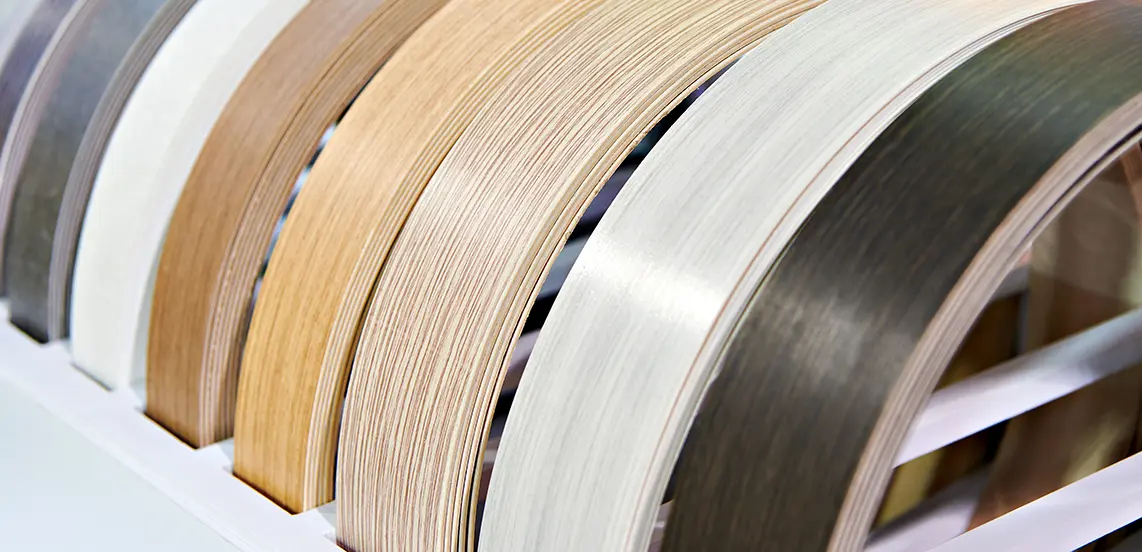
| Surface Finish And Decor Match | Controls how naturally the edge blends with melamine, veneer-look, or painted panel faces | Color-matched carcasses, wardrobes, office furniture, display fixtures | The finished part looks mismatched even when the bond is technically sound |
| Flexibility And Formability | Influences how well the material handles slight radii, corner finishing, and trimming | Straight panels, softened edges, decorative parts with more visible finishing requirements | Stress marks, corner defects, or poor visual continuity |
| Back Coating And Adhesive Compatibility | Affects bond stability with the adhesive system used on the line | Continuous production using a defined glue process, whether EVA-based or PUR-based | Weak adhesion, lifting, or an inconsistent glue line |
| Panel Substrate Condition | Changes how reliably the banding can bond to MDF, particleboard, plywood, or laminated board edges | Stable, well-prepared panel edges coming from a controlled cutting process | Dusty, chipped, or porous edges reduce bond consistency before the machine can recover them |
The practical point is that a PVC roll does not work in isolation. The edge material, adhesive process, and panel condition all have to support one another.
How Machine Choice Changes The Result
For factories evaluating edgebanders, the important question is not simply whether the machine can apply PVC. The more useful question is which machine configuration matches the finish standard, panel condition, and production volume of the line.
| Machine Type | Best Fit | Main Advantage | Main Tradeoff |
|---|---|---|---|
| Automatic Edgebander | Straightforward panel production with stable material flow and standard finish expectations | Improves consistency over heavily manual edge finishing and supports repeatable line work | If upstream cut quality is unstable, the machine still receives a weak starting edge |
| Pre-Milling Edgebander | Factories that need cleaner edge preparation before glue application | Removes minor edge irregularities and helps stabilize bond appearance | Adds another process stage that must stay correctly adjusted |
| Corner-Rounding Edgebander | Product lines where finished edge appearance matters and manual corner cleanup is costly | Reduces post-process handwork and helps the part leave the machine looking more complete | Strongest value appears when the product mix justifies the extra finishing step |
No machine type is automatically better in every case. A simpler machine can be the right fit for stable, price-sensitive production. A more fully equipped line earns its value when visible finish quality, rework reduction, and labor consistency matter more than minimum process complexity.
Upstream Conditions Still Control Edge Quality
One of the most common buying mistakes is expecting the edge banding station to correct problems that really begin earlier in the workflow. PVC banding performs best when the incoming panel edge is already reasonably clean, square, and consistent.
Several upstream factors strongly affect the final result:
- Cut-Edge Quality From The Saw Or Nesting Process
- Dust Load Or Loose Fiber On The Panel Edge
- Panel Squareness And Part Consistency Across The Batch
- Surface Temperature Stability In The Work Area
- Storage And Handling That Prevents Banding Rolls Or Panels From Becoming Distorted
If the line receives chipped, fuzzy, or contaminated edges, the operator may blame the glue pot, trimming unit, or pressure settings when the real problem started at panel preparation.
Common PVC Edge Banding Problems And What Usually Causes Them
Most edge-banding defects are not random. They usually point to a mismatch between material choice, panel condition, machine adjustment, and process discipline.
| Problem | What It Usually Looks Like | Common Cause Pattern | First Area To Check |
|---|---|---|---|
| Weak Bond Or Edge Lifting | The banding loosens at the edge, end, or corner during handling or later use | Dirty edge surfaces, unstable heat, poor pressure balance, or mismatch between material and adhesive process | Panel-edge preparation and glue-process stability |
| Visible Glue Line | The edge looks heavy, uneven, or cosmetically inconsistent | Rough incoming edges, poor pre-milling, excess adhesive, or poor color coordination between glue and edge material | Edge cleanliness, edge prep, and glue application balance |
| Chipped Ends Or Poor End Trimming | The part leaves the machine with damaged edge ends or rough trimming marks | Cutter wear, unstable feed, poor support, or material behavior that does not suit the finishing setup | Trimming-unit condition and support through the machine |
| Corner Whitening Or Edge Stress Marks | The edge looks strained or visually broken at corners or tight finishing areas | Material too stiff for the finish expectation, unstable corner finishing, or excessive mechanical stress | Banding flexibility and corner-finishing setup |
| Surface Scratching Or Gloss Damage | High-gloss or decorative faces lose appearance during transport or finishing | Dirty contact points, handling marks, or poor cleanliness around pressure and trimming zones | Machine-contact cleanliness and panel handling |
| Color Or Finish Mismatch | The edge is securely bonded but still looks wrong against the face panel | Poor decor match, gloss mismatch, or weak stock control between panel and banding rolls | Material-selection and batch-control discipline |
The useful lesson is that troubleshooting should stay process-based. Replacing PVC stock alone rarely fixes a defect that is really coming from poor edge preparation, worn tooling, or inconsistent daily setup.
Where PVC Edge Banding Usually Fits Best
PVC remains a common choice because it balances finish flexibility, broad decor availability, and practical production processing for many furniture lines. It is often well suited to:
- Cabinet Carcasses And Shelving
- Wardrobe And Closet Components
- Office Furniture Panels
- Retail Fixtures And Display Units
- General Panel Furniture With Repeated Straight Edges
That does not mean it is always the only sensible option. Some buyers also compare PVC with other edge materials when they want a different environmental profile, a different high-gloss appearance, or a different feel in premium visible surfaces. The right decision depends on the product category, finish standard, and how demanding the edge will be in real use.
Questions To Ask Before Standardizing On PVC Edge Banding
- What Level Of Visual Finish Does The Product Need At Normal Viewing Distance?
- Are Incoming Panel Edges Clean Enough, Or Is Pre-Milling Needed To Stabilize Results?
- Does The Line Need A Basic Automatic Process, Or A More Finished Output With Corner Rounding?
- Is The Adhesive Strategy Matched To The Product Environment And The Plant’s Process Discipline?
- Are PVC Rolls Controlled Well By Decor, Finish, And Application Instead Of Mixed Too Freely On The Floor?
- Is The Real Problem At The Edgebander, Or Earlier In Cutting, Panel Preparation, Or Material Handling?
Those questions usually produce a better decision than focusing on one isolated defect or one machine feature.
Practical Summary
PVC edge banding works well when the material choice, adhesive process, panel condition, and machine setup all support the same finish objective. In many cabinet and furniture lines, it remains a practical solution because it can deliver a clean, durable edge with good visual consistency when the process is stable.
Most recurring defects come from system mismatch rather than from PVC itself. If the panel edge arrives rough, if the machine setup is drifting, or if the banding stock does not match the finish target, rework becomes predictable. The strongest results usually come from treating edge banding as part of the whole panel-processing workflow rather than as a last-step cosmetic add-on.