Factories do not really buy “a CNC machine.” They buy a process. The acronym only tells you that motion is controlled numerically. It does not tell you whether the machine removes metal with a spindle, turns bar stock around a spindle axis, cuts sheet with heat, profiles stone with flood-cooled tooling, or sizes furniture panels for the next station in the line. That is why a generic search for CNC machines creates so much confusion. The same label covers technologies that solve very different production problems.
The first expensive mistake usually happens before the quotation stage. A buyer asks the wrong machine family to solve the right problem. A router gets compared with a machining center because both travel in X, Y, and Z. A turning center gets ruled out because the buyer is thinking about the drawing as a flat shape instead of a rotational part. A laser looks attractive because the sample edge is clean, even though the workflow actually needs drilled features, routing depth, or different material behavior. The result is not just a bad shortlist. It is a bad mental model.
The fastest way to make CNC machine types understandable is to stop classifying them by brand or by the number of axes first. Start with the part, the material, and the bottleneck. Once those are clear, most CNC machine families stop looking interchangeable.
Start With The Part, Not With The Acronym
The right first question is simple: what kind of workpiece are you trying to make? If the dominant geometry is round, turning equipment deserves attention early. If the part is prismatic, pocketed, drilled on multiple faces, or built from solid stock, milling usually moves to the front. If the work starts as full sheets of wood, acrylic, laminate, foam, or other panel material, routers, beam saws, nesting systems, or lasers may make more sense than a metalworking mill ever will.
This matters because CNC categories are built around physical problems, not around generic automation. Rotational parts want one kind of kinematics. Flat sheet processing wants another. Decorative or low-contact thermal cutting wants another. Finishing and ultra-tight surface control want another again. The more honestly you define the physical problem, the less likely you are to compare unlike machines.
That is also why the best equipment buyers talk first about material entry form, dominant geometry, surface requirements, and downstream handoffs. They do not begin by asking which brand has the most impressive demo video.
Question One: Is The Work Rotational, Prismatic, Or Sheet-Based?
This one question removes a surprising amount of confusion.
If the part is mainly shafts, bushings, threaded fittings, sleeves, or other rotational work, lathes and turning centers should be considered first. They are built to spin the part and machine concentric features efficiently.
If the part is mostly blocks, plates, housings, pockets, faces, drilled patterns, or multi-face machined features, mills and machining centers usually belong at the center of the discussion.
If the work starts as large sheets or boards, the decision often shifts away from classic mills and toward routers, nesting systems, beam saws, panel saws, laser systems, or punching and sheet-processing equipment, depending on the material and geometry.
This sounds basic, but many costly shortlist mistakes happen because companies skip it. They know they need CNC, but they do not stop to identify what kind of motion and tool engagement the part is really asking for.
Question Two: Are You Removing Material Mechanically, Thermally, Abrasively, Or By Erosion?
The next useful divide is process physics. CNC is only the control layer. The actual cutting or shaping method changes the economics dramatically.
Mechanical removal includes milling, turning, routing, drilling, and sawing. These processes rely on cutting tools and spindle-driven engagement.
Thermal removal includes laser and plasma systems. These processes use heat to separate or shape material and therefore bring different edge conditions, assist systems, and material rules.
Abrasive systems, such as waterjet in the broader market, cut differently again and are often chosen when heat-affected zones or tool forces become undesirable.
Electrical discharge machining belongs to a separate specialist category because it removes conductive material through spark erosion rather than conventional cutting.
Grinding, although still numerically controlled in many factories, is usually chosen when finish, flatness, or dimensional control exceed what ordinary milling or turning can deliver economically.
Why does this matter? Because buyers often compare machine travel and ignore the physics of the cut. But process physics is where edge quality, burr behavior, heat input, tool wear, and downstream finishing burden really come from.
Mills And Machining Centers Serve Prismatic Work Best
Milling machines and machining centers are usually the right family when the part is not primarily round and must hold multiple machined features in a controlled coordinate system. They handle pockets, faces, steps, bores, tapped holes, slots, contours, and multi-side machining in a way that general cutting systems cannot.
Within this family, however, the buying question does not stop at “mill.” A lighter CNC mill, a bed mill, a toolroom-style platform, and a full vertical machining center may all appear under broad milling language while serving very different production expectations. One may be ideal for toolrooms and short-run work. Another may be built for sustained production, automatic tool handling, coolant containment, and tighter process repeatability.
That is why a mill is not just a machine class. It is a range of process packages. Buyers who need more context on the metalworking side often benefit from stepping from the generic family label into a more precise comparison such as how CNC mills differ from more production-oriented machining centers.
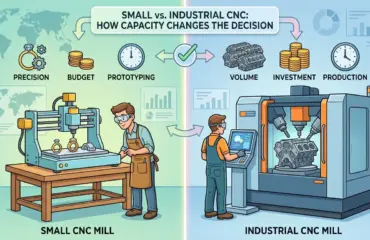
The same family also branches by scale. Small, bench-scale mills solve a very different problem from heavier industrial machines even when both are technically CNC milling platforms. That capacity ladder matters as much as the family label itself.
Lathes And Turning Centers Exist Because Round Parts Punish The Wrong Machine Choice
If the part is mainly rotational, a lathe usually deserves priority because it puts the part geometry in the machine’s natural motion pattern. Diameters, shoulders, grooves, threads, tapers, and concentric surfaces are where turning equipment earns its living. Buyers who force round work onto mills often pay in cycle time, fixturing complexity, and unnecessary setup effort.
That does not mean every round part belongs on the same lathe. Basic CNC lathes, slant-bed machines, turning centers with live tooling, sub-spindles, or Swiss-type equipment all sit under the turning umbrella while solving different production problems. But the family logic is still clear: if concentric geometry dominates, turning equipment usually creates the better economic starting point.
For teams still deciding whether the work should be thought of as turning first or machining in a more general sense, it helps to anchor the discussion in what CNC lathes actually do best in modern manufacturing. Once that part-geometry fit is clear, the secondary selection choices become easier.
Routers, Nesting Machines, And Panel Saws Solve Flat-Material Throughput Problems
Flat stock processing is where many newcomers to CNC classification get lost. A router table may look like a giant mill, but its priorities are different. It typically cares more about sheet handling, vacuum hold-down, dust extraction, spindle speed range, nested part yield, and broad table coverage than about the metal-cutting rigidity expectations of a machining center.
That difference matters enormously in furniture, cabinetry, signage, composites, foam, and general panel work. If the production problem starts with full sheets that must be cut, drilled, slotted, and sometimes labeled efficiently, routing and nesting platforms usually deserve attention far earlier than classic metalworking mills.
And even inside flat-stock processing, the right family depends on geometry. If most parts are irregular and must be nested for yield, a router-based nesting system often creates the better workflow. If most work is repetitive rectangular sizing at higher volume, a beam saw or panel saw may be the stronger choice because the process is about fast panel breakdown rather than flexible contour cutting.
That is why panel-processing buyers should not stop at the word router. They should ask whether the plant needs a flexible cut-any-shape cell, a high-throughput sizing station, or a more connected line. For cabinetry and furniture plants, that often means comparing CNC nesting systems against panel saw workflows rather than assuming one general CNC family will cover both equally well.
Laser Systems Matter When Tool Contact Becomes The Wrong Method
Laser machines belong in the broader CNC conversation because they are numerically controlled and often compete for the same budget as routing or cutting systems. But they solve a different physical problem. Instead of relying on a cutting tool touching the work, they use a focused beam and therefore create a different edge, different speed behavior, different safety and extraction demands, and a different range of material-fit rules.
In the broader industrial market, lasers cover both metal and non-metal applications. In the currently verified Pandaxis category language, the laser family is positioned around wood, acrylic, and similar non-metallic processing. That distinction matters. It is perfectly reasonable to explain laser systems as a machine family in general industrial terms, but it is not reasonable to use Pandaxis category pages as proof of metal-laser scope when the verified catalog language does not say that.
Within that verified scope, laser cutters and engravers make the most sense when detailed contours, decorative work, engraving, or cleaner low-contact processing of suitable non-metal materials matters more than the cut-depth and tool-force logic of a router. A buyer who only sees “precision” in both laser and router demos will miss the fact that the economics and material fit can be completely different.
Stone CNC Machines Are Their Own Production World
Stone processing sometimes gets lumped into routing because the machines often have moving heads and programmable paths. That comparison is only useful at the most superficial level. Quartz, marble, granite, and related materials bring their own tooling demands, coolant needs, feed discipline, edge-finishing expectations, and handling requirements. A machine that works beautifully for wood or acrylic does not automatically translate into a good stone-production platform just because it has axes and software.
This is why stone machinery deserves to be treated as its own CNC family in practical buying conversations. Routing, edging, profiling, sink cutouts, carving, and polishing coordination matter differently in stone than they do in wood or plastics. Shops working in countertops, architectural surfaces, or fabricated stone parts should therefore frame the decision around the dedicated stone CNC machine category rather than around generic router thinking.
Once again, the lesson is that the acronym CNC is too broad to be useful on its own. The material system changes the machine logic.
Specialist CNC Families Exist For Problems Ordinary Cutting Cannot Solve Efficiently
Not every CNC decision belongs to mills, lathes, routers, lasers, or stone machines. Many factories also encounter EDM, CNC grinding, hobbing, spring coiling, tube bending, and other specialist platforms. These machines matter because they usually appear when a factory has already learned that general-purpose cutting is not enough.
EDM enters when conductivity and geometry make conventional cutting awkward or impossible. Grinding becomes necessary when surface finish, flatness, or dimensional accuracy exceed the practical reach of standard machining. Gear hobbing equipment exists because gears are not merely round parts with teeth drawn on them. Spring coiling machines exist because wire forming does not behave like ordinary turning or milling.
The useful rule here is simple: when a process has its own repeatable geometry logic, force pattern, and downstream quality standard, it often creates its own CNC family. That family should be short-listed on its own terms rather than treated as a variation of general machining.
A Shortlisting Matrix Prevents The Worst Category Mistakes
| Machine Family | Natural Starting Material Or Part Form | Best Fit | Common Buyer Mistake |
|---|---|---|---|
| Mills and machining centers | Solid stock, plates, blocks, castings | Prismatic parts, pockets, faces, drilled patterns, multi-face machining | Comparing them with sheet-processing systems just because both use XYZ motion |
| Lathes and turning centers | Bar, slug, preforms, round castings | Rotational parts, diameters, threads, concentric geometry | Forcing round work onto mills because the drawing looks simple |
| Routers and nesting machines | Full sheets, boards, composites, plastics | Irregular flat-part cutting, nesting, drilling, slotting, panel workflows | Judging them by metal-mill standards instead of sheet throughput needs |
| Panel saws and beam saws | Large rectangular panels | High-volume panel sizing and batch breakdown | Expecting them to replace flexible contour cutting |
| Laser systems | Suitable sheet or plate depending on system scope | Detailed low-contact cutting and engraving where thermal processing fits | Treating clean laser edges as proof that laser is best for every material |
| Stone CNC machines | Stone slabs and workpieces | Profiling, routing, edging, and fabrication of stone products | Treating them as generic routers without material-specific planning |
| Specialist systems like EDM or grinding | Process-specific workpieces | Geometry, finish, or precision beyond standard cutting efficiency | Ignoring them until a general-purpose machine has already failed commercially |
This matrix is not meant to replace detailed specification work. It is meant to stop the biggest shortlist errors before they become budget errors.
The Pandaxis Catalog Covers Part Of The CNC Landscape, Not All Of It
This is an important point for buyers using Pandaxis content as part of a broader machinery research process. The wider CNC landscape includes many machine families, especially on the metalworking side, that may be relevant to your plant even when they do not sit inside the currently verified Pandaxis category structure. Pandaxis’ current verified category emphasis is strongest in woodworking machinery, panel processing, non-metallic laser applications, and stone CNC workflows.
That does not make the broader metalworking discussion irrelevant. It simply means buyers should use Pandaxis articles for what they do best: clear industrial comparisons, workflow thinking, and category-aware guidance, then map the relevant verified categories to the parts of the plant they actually serve. If your project includes cabinetry automation, panel sizing, non-metal laser processing, or stone fabrication, the broader Pandaxis machinery lineup is the right place to connect the article logic back to category-level product discovery.
This separation helps keep research honest. Use the broader industrial explanation to understand the full CNC field. Use the verified Pandaxis categories to understand where Pandaxis currently fits inside that field.
Build The First Shortlist Around Bottlenecks, Not Around Machine Prestige
The right shortlist does not begin with the most impressive machine in the budget. It begins with the station that is underperforming in the real workflow. Is the plant wasting time breaking down panels? Is concentric part work taking too many setups? Are irregular flat parts creating poor yield from sheet stock? Is finishing driving material choice toward a non-contact process? Are heavy stone jobs suffering from inconsistent profiling and edge quality?
When the shortlist starts from the bottleneck, the machine family becomes clearer. When the shortlist starts from prestige or demo appeal, buyers drift toward technologies that are impressive in isolation but mismatched in operation.
That is the most useful way to understand CNC machine types. Do not memorize them as a catalog of automation names. Understand them as different answers to different production problems. Mills answer prismatic machining problems. Lathes answer rotational ones. Routers and nesting systems answer flexible sheet-processing problems. Beam saws answer repetitive panel sizing problems. Lasers answer specific low-contact cutting and engraving problems. Stone CNC systems answer fabrication problems that need stone-specific routing, edging, and finishing discipline. The more clearly the problem is named, the more obvious the right machine family becomes.