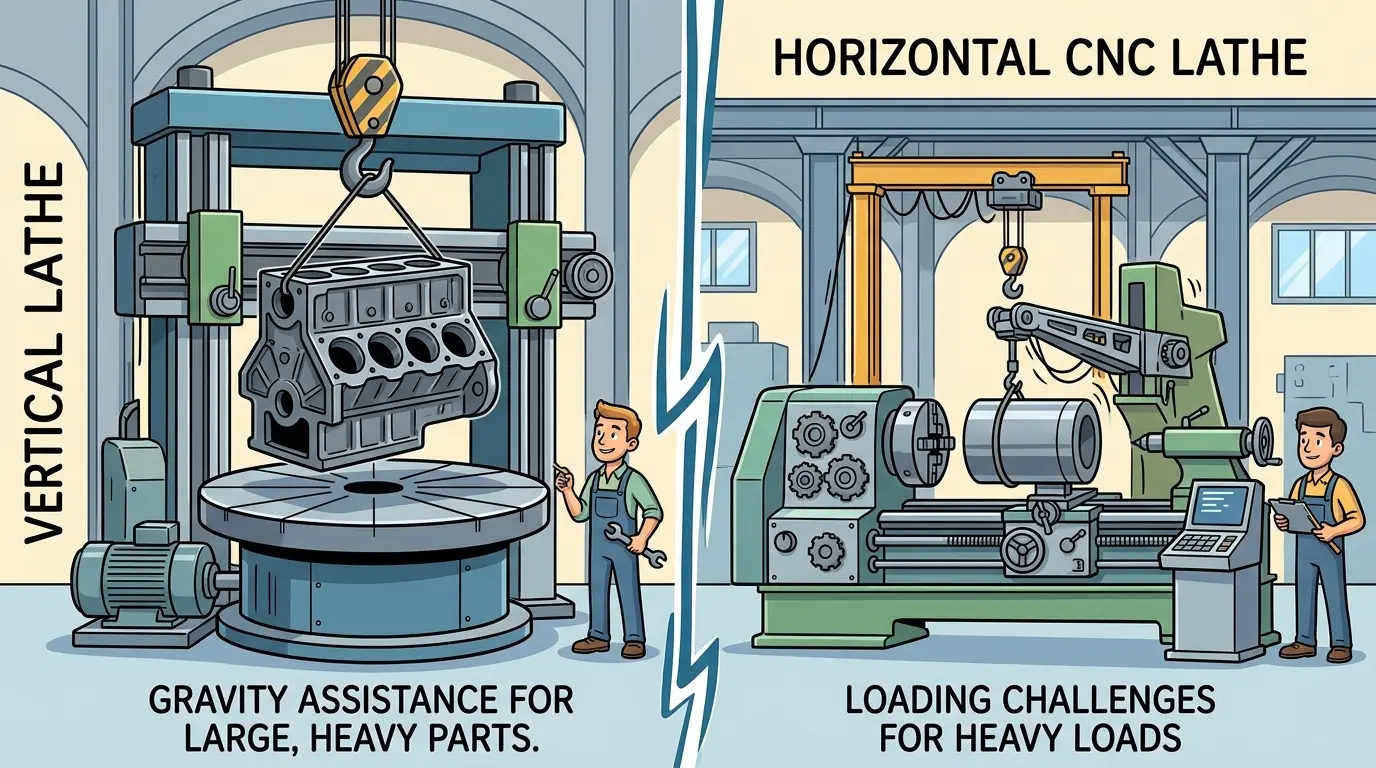
Heavy workpieces make gravity part of the machine decision. That is the simplest way to understand the difference between a vertical lathe and a horizontal CNC lathe for large, dense, awkward parts. Once the workpiece becomes heavy enough, wide enough, or difficult enough to support, orientation stops being a preference and becomes a production variable. Loading risk changes. Workholding logic changes. Deflection behavior changes. Even the way the operator experiences the setup changes.
This is why buyers who treat the choice as an ordinary lathe comparison often get it wrong. The question is not only which machine can technically cut the part. The question is which orientation lets the shop load, seat, clamp, machine, inspect, and unload that part with the least strain on accuracy, safety, and cycle stability. A heavy part that technically fits on a horizontal machine can still be a poor horizontal job if the loading and support logic are working against it.
That is where vertical turning earns its place. It does not replace horizontal lathes universally. It solves a different handling problem. The sooner buyers frame the decision that way, the less likely they are to confuse physical size with process fit.
The Decision Starts With The Load Path Before It Starts With The Cut
On smaller turning work, buyers often think first about spindle power, tooling, swing, and cycle time. On heavy work, the first real decision often happens before cutting begins. How will the part be brought to the machine? How will it be seated? What happens if the part’s weight creates awkward support during chucking? How much crane coordination does each orientation require? Where is the risk during setup, not just during machining?
This is where vertical machines immediately make sense for certain part families. Large rings, discs, housings, flanges, wheel-like components, and heavy castings often want to sit rather than hang. A vertical machine lets gravity help seat the part onto the table or chucking surface. A horizontal machine may still be able to hold the same work, but it often asks the shop to manage weight, balance, and alignment differently during setup.
That one difference shapes the whole workflow. If loading is calmer and more repeatable, the cut usually becomes calmer and more repeatable too.
Start With The Part Family, Not With The Machine Type The Shop Already Prefers
Many factories begin with the machines they know rather than the work they are trying to stabilize. A shop with strong horizontal-turning habits naturally tries to keep new work in that lane. That can be efficient if the part family still fits horizontal logic. It becomes expensive when the work has quietly shifted toward larger diameters, heavier castings, or shapes that are awkward to support horizontally.
The cleanest way to avoid that bias is to classify the heavy work by geometry first.
- If the parts are mostly shafts, rollers, long cylindrical components, or bar-derived work, horizontal turning often remains the natural answer even when the pieces are substantial.
- If the parts are primarily large-diameter but relatively shorter in axial length, such as rings, hubs, flanges, wheels, housings, and many cast or forged forms, vertical turning often deserves serious attention.
This is not because vertical turning is somehow inherently more advanced. It is because the part’s weight and center of gravity change the economics of support.
Vertical Turning Wins When The Part Wants To Sit, Not Hang
The great strength of the vertical lathe in heavy-part work is simple: the workpiece sits on the machine rather than being held sideways against gravity. That reduces some of the support and sag concerns that become more pronounced on large, heavy diameters. It also changes the emotional character of setup. Riggers and operators usually feel the difference immediately. Lowering a part into place can be calmer than side-loading and aligning it into a horizontal hold, especially when size and weight increase.
This is why vertical turning often makes sense for large-diameter components with modest axial length. The machine orientation aligns naturally with the way the part wants to be handled. It can simplify clamping logic, reduce awkward repositioning, and create a more stable starting condition before the first pass.
That does not mean every heavy part belongs on a vertical machine. It means vertical turning often wins when loading security and seating confidence dominate the decision.
Horizontal Lathes Still Own A Large Share Of Heavy Work
It is easy to overcorrect and assume vertical turning is automatically the premium answer for anything large. That is not true. Horizontal CNC lathes remain the better fit for many heavy parts, especially when the geometry is shaft-like, elongated, or naturally suited to support between centers or through more conventional horizontal workholding. Heavy rollers, long stems, drive components, and similar parts often stay in the horizontal lane because the form itself still matches that architecture.
Horizontal machines also continue to make sense when the factory’s handling system, tooling practice, and staffing are already optimized around that orientation. If the shop has the right supports and the part family still behaves well horizontally, switching to vertical just because the work is heavy can be unnecessary.
The mistake is not choosing horizontal. The mistake is choosing it by habit after the part geometry has already moved outside the zone where horizontal setup remains elegant.
Loading And Chucking Usually Decide The Economic Answer Faster Than Cutting Specs Do
For heavy turning work, the loading event often determines the whole machine choice. Buyers should ask exactly how the part gets onto the machine, what surfaces establish its reference, how the part is centered, and how much crane time, rigger judgment, or operator intervention the setup requires. Small differences in loading routine become big differences when parts are expensive and heavy.
Vertical machines often reduce some of the alignment stress because the part is lowered into place. Horizontal machines may require more careful side loading and support control depending on the geometry. In one shop, that may be routine and highly manageable. In another, it may be the difference between calm setup and repeated risk.
This is why a machine demonstration that ignores loading is incomplete. If a supplier only talks about spindle capacity and never shows how the part is actually introduced and seated, the evaluation is missing the most important stage of the job.
Deflection, Balance, And Force Direction Change With Orientation
Heavy parts do not only challenge the machine during setup. They also challenge it during cutting. Deflection, imbalance, and support stability all affect finish, tolerance, tool life, and confidence in more aggressive passes. The wrong orientation can amplify these issues.
Vertical turning often improves the situation for large-diameter parts because weight is supported downward in a way that feels more natural for those forms. Horizontal turning remains excellent for parts whose lengthwise geometry is better suited to that axis arrangement. The right question is not which machine is stronger in the abstract. The right question is which orientation makes the specific part easier to hold steady through the cut.
This is why buyers should compare part behavior, not just machine specifications. Heavy turning decisions are won or lost in the relationship between geometry, support, and force path.
Inspection Access, Tool Reach, And Chip Behavior Also Matter
Orientation affects what happens after the tool touches the work. Chip flow, coolant behavior, access for measurement, and operator visibility all change with machine layout. On some heavy components, vertical layouts make it easier to inspect important faces or diameters. On others, horizontal access remains more intuitive because the features are arranged along a shaft-like form that matches conventional tool reach and operator expectations.
This is not a side issue. Shops sometimes choose a machine based on loading logic and then discover that inspection access or chip accumulation is less convenient than expected. The strongest evaluations map the full cycle: load, clamp, cut, inspect, unload. Any one of those stages can undermine the decision if it is ignored.
That is why operators, quality staff, and rigging personnel should all have input. The orientation that looks fine in a brochure can feel awkward inside a real inspection routine.
Throughput In Heavy-Part Cells Is Often A Handling Rhythm Problem
With heavy workpieces, throughput is often constrained less by spindle speed than by handling rhythm. How long does the crane wait? How long does the operator spend aligning the part? How often does the team stop to verify seating or support before the cycle starts? How much of the day is consumed by careful but slow setup because the part feels risky to hold?
This is where vertical turning can create major value. It may not always cut dramatically faster, but it can make the whole handling sequence calmer. That turns into more predictable cell behavior, which is often the real bottleneck in heavy-part departments. Horizontal machines can still win if the handling rhythm is already mature and the part family fits that orientation naturally. But when throughput problems are really setup and support problems in disguise, the orientation decision matters far more than buyers initially expect.
Heavy work punishes fragmented thinking. The part must be judged as a cell problem, not just as a cutting problem.
Use Mixed Part Families To Decide Whether One Orientation Is Enough
Some plants do not really have an either-or choice. They have two valid turning families living under one roof. One clearly belongs on horizontal lathes. Another clearly benefits from vertical turning. Trying to force both onto one platform may reduce machine count while increasing setup compromise, crane difficulty, and handling waste.
This is common in plants that handle shafts, rollers, flanges, hubs, cast housings, and valve bodies in the same department. All of that is “turning,” but it does not all ask for the same orientation. When that is true, the smarter investment logic is to divide the workload honestly rather than chase a single machine class that is acceptable at everything and ideal at nothing.
That is a more mature way to think about heavy workpieces. Orientation is not only a machine choice. It is a workload-design choice.
Compare Orientation Logic Before You Get Distracted By Brand Logic
If the part family is drifting toward large-diameter, awkward, or gravity-sensitive work, buyers should compare orientation logic before they get lost in brand comparisons. That is especially important when the team is still trying to solve every part with standard horizontal assumptions even though the job increasingly resembles classic vertical-turning territory.
At that point, it helps to review when vertical turning machines make more sense instead of forcing the conversation back into a generic horizontal frame. The important thing is not whether the machine is labeled VTL, vertical lathe, or vertical turning machine. The important thing is whether vertical loading and support reduce risk and stabilize the work.
That comparison should happen early, before the shop spends months solving an orientation problem with increasingly elaborate workholding on the wrong platform.
Choose The Orientation That Makes The Heavy Part Easiest To Trust
For heavy workpieces, the vertical-lathe versus horizontal-lathe decision is really a question of trust. Which machine lets the part be loaded, seated, clamped, cut, and inspected with the least strain on accuracy and the least tension in the cell? Vertical lathes often win when large-diameter and awkward heavy forms want to sit rather than hang. Horizontal CNC lathes continue to win when long or shaft-like parts still fit conventional turning logic naturally.
The smartest buyers do not treat this as a prestige contest between machine types. They watch the load path, the support condition, and the operator behavior around the part. Heavy workpieces tell you very quickly which orientation they prefer. The right machine is the one that makes that preference commercially calm, repeatable, and scalable.