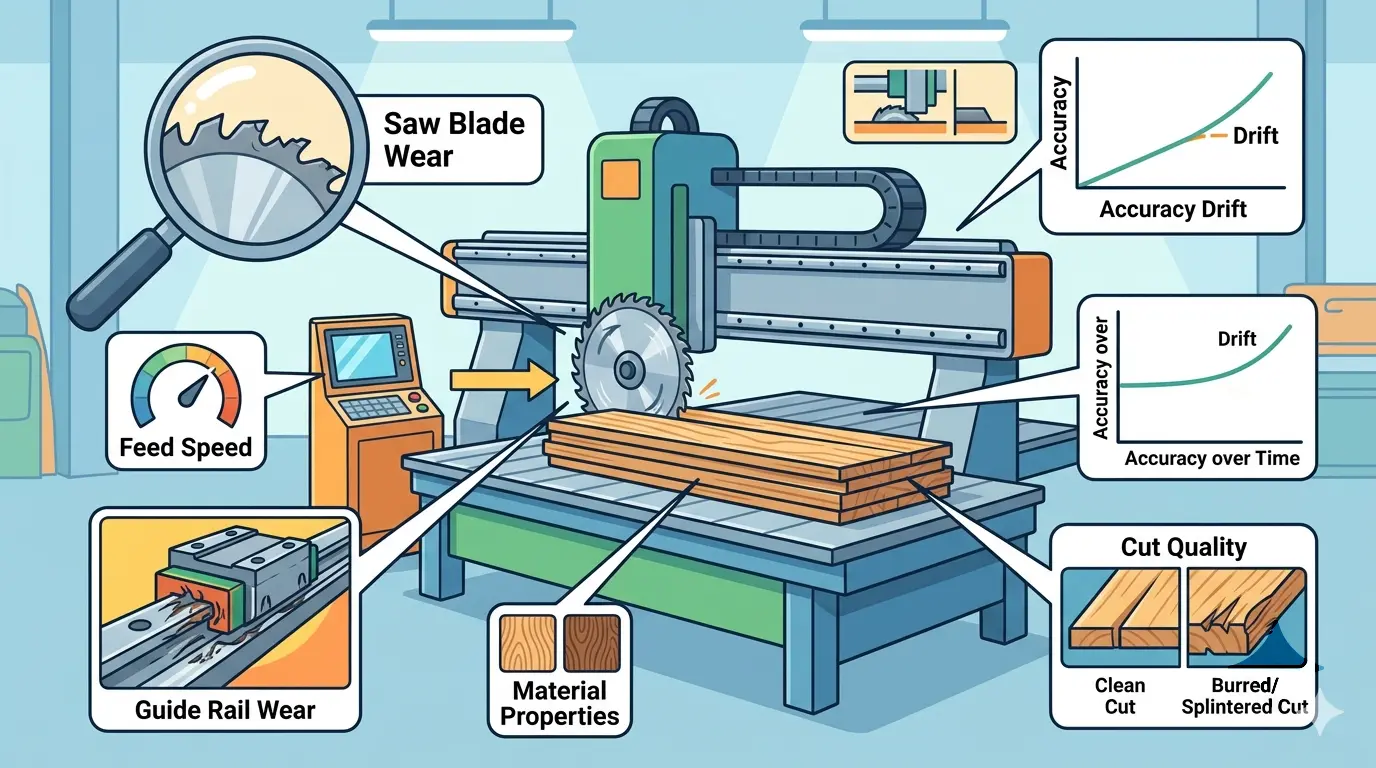
In batch panel production, beam saw accuracy rarely disappears in one obvious breakdown. Cut quality usually changes through smaller shifts in blade condition, referencing stability, clamping consistency, contamination, material behavior, and machine wear. By the time operators notice more chipping, slightly inconsistent sizes, or rougher edges, the problem is often already affecting edge processing, drilling, and assembly.
For factories using panel saws to keep rectangular panel cutting repeatable, the practical question is not only whether the saw is still running. It is whether the process is still holding the same cut quality it held a week, a month, or a quarter ago.
Why Cut Quality Usually Drifts Instead of Failing All at Once
Beam saw performance depends on several conditions staying stable at the same time:
- Blade Condition
- Clean And Consistent Material Support
- Reliable Referencing
- Stable Clamping Or Pressure
- Repeatable Machine Movement
- Suitable Material Quality
If only one area weakens slightly, the line may still produce acceptable parts for a while. When two or three variables drift together, the symptoms become much more visible. That is why cut quality problems often feel gradual. Shops may first see a little more edge damage on laminated panels, then slight size variation in repeated parts, then more adjustment work downstream.
The Main Factors That Change Beam Saw Cut Quality Over Time
| Factor | Typical Symptom at the Saw | Workflow Impact Later |
|---|---|---|
| Blade wear and, where used, scoring balance | More edge chipping, rougher cut faces, higher cutting stress | More finishing correction, lower visible quality, more re-cuts |
| Clamping and referencing consistency | Slight movement, unstable sizing, less predictable squareness | Harder edge banding, drilling mismatch, slower assembly |
| Dust, chips, and support-surface contamination | Panels do not sit or travel as consistently | Variation between repeated parts and more quality checks |
| Wear in guide, drive, or positioning systems | Repeatability starts to slip before a major failure appears | Batch inconsistency and hidden labor cost |
| Material condition and stack handling | Good machine, inconsistent result across different sheets | Misdiagnosis of the root cause and unnecessary adjustments |
| Maintenance discipline and verification routines | Small deviations stay in production too long | Compounded variation across the full workflow |
Blade Condition Changes Faster Than Many Shops Expect
Blade condition is usually the first place to look when cut quality starts to fall. A blade does not need to be completely unusable before it starts affecting edge finish. Long before that point, it can create more heat, more resistance, and less consistent edge quality, especially on melamine-faced boards, veneered panels, or other surface-sensitive materials.
Where a scoring setup is part of the process, the relationship between the main cut and the scoring cut also matters. If that relationship starts to move out of balance, chipping and edge damage can increase even when the problem first appears to be only a blade-life issue.
The practical point is simple: shops should not wait for a dramatic failure signal. Beam saw cut quality often starts declining while output still looks acceptable enough to keep production moving.
Clamping and Referencing Stability Matter as Much as the Blade
Many cut-quality problems are blamed on tooling when the real issue is material control. If the sheet is not referenced from the same position each cycle, or if clamping pressure is not equally stable from cut to cut, part-to-part consistency can move even with a usable blade.
This kind of drift usually shows up in practical ways:
- Repeated parts do not stay as consistent as expected
- Squareness becomes less reliable across a batch
- Operators start making more small corrections during quality checks
- Downstream stations spend more time compensating for upstream variation
In a beam saw line, stable referencing and pressure are part of the accuracy system, not just part of the handling system.
Dust, Chips, and Support Conditions Create Hidden Variation
Small contamination problems often cause oversized diagnostic efforts because they look like mechanical faults. Chips under a panel, buildup on contact points, or dirty support and transfer surfaces can change how consistently the material sits, moves, or settles before the cut.
This matters more over time because contamination usually accumulates gradually. The saw may still seem operational, but the panel is no longer being supported under the same conditions as before. When that happens, slight dimensional variation and edge instability can start appearing without any single dramatic change in the machine itself.
High-volume shops see this more often because repetition makes small contamination issues repeatable too.
Mechanical Wear Usually Appears First as Repeatability Loss
Mechanical wear does not always announce itself as a shutdown event. More often, it first appears as a repeatability problem. That may mean the first part looks acceptable, but consistency across repeated cuts becomes harder to hold. It may also show up as slightly more vibration, more noise, or a general feeling that the machine is no longer cutting as smoothly as it did earlier in its service cycle.
When guide, drive, or positioning elements wear, the effect on cut quality is usually indirect at first. The cut may still happen, but not under the same stable conditions. Over a full production run, that difference can become expensive.
Material Condition Can Look Like a Machine Accuracy Problem
Not every cut-quality issue originates in the beam saw. Material flatness, internal stress, surface condition, damaged corners, and inconsistent stack handling can all affect the result. If one board type starts producing more tear-out or instability while another still cuts well under the same settings, the machine may not be the main source of the problem.
That is why a good troubleshooting routine separates machine condition from material behavior. If a shop changes both at once, the diagnosis usually becomes slower and less reliable.
How to Check a Beam Saw When Accuracy Starts to Slip
When cut quality changes, a structured check is usually more useful than a broad adjustment session.
- Isolate one material type and run repeated control cuts under stable conditions.
- Check blade condition first, and review scoring balance as well if the process uses it.
- Clean support, reference, and clamping contact areas before assuming a deeper fault.
- Compare repeated parts for both dimensional consistency and edge quality, not just one or the other.
- Separate material-related symptoms from machine-related symptoms by testing with known, stable stock.
- Escalate to alignment, repeatability, or service inspection if the drift remains after the basic variables are stabilized.
This sequence matters because it avoids two common mistakes: replacing usable components too early, or overlooking the simple conditions that are actually causing the variation.
Why Recurring Beam Saw Drift Feels Different from Operator-Led Variation
One useful way to think about beam saw accuracy is to compare it with output variation on sliding table saws. In sliding table saw workflows, daily variation is more often influenced by operator handling, measuring routine, and cut-by-cut judgment. In beam saw workflows, recurring drift is more likely to repeat across a whole batch because the issue sits inside the process conditions themselves.
That difference matters when diagnosing quality loss. If the same symptom appears again and again across repeated parts, shops should think less about isolated operator error and more about system stability: blade life, cleanliness, referencing, pressure consistency, repeatability checks, and maintenance discipline.
Practical Summary
Beam saw cut quality changes over time because accuracy is not created by one component alone. It comes from the combined stability of the blade, the material-holding conditions, the referencing system, the cleanliness of support surfaces, the mechanical repeatability of the machine, and the consistency of the material entering the cut.
The shops that protect beam saw accuracy best usually do not wait for a visible failure. They track drift early, isolate the symptom carefully, and treat repeatability as a process-control issue rather than only a repair issue. In batch panel production, that approach helps preserve cleaner cuts, steadier sizing, and less downstream correction work across the whole line.