When cabinet sides, shelves, and drawer parts start queueing in front of drilling, many factories ask for “more output.” But the real question is not which machine sounds faster on paper. It is how many correctly drilled parts leave the station without extra handling, repeated checks, or downstream fitting problems.
A single-row boring machine and a double-row boring machine can both support panel-furniture production. The better choice depends on how repetitive your parts are, how many hole groups each part usually needs, and how much time the team loses between drilling cycles. For buyers comparing dedicated boring and drilling machines for woodworking production, the row configuration should be judged by workflow fit, not row count alone.
The Real Difference Is Handling, Not Just Drilling
In most woodworking factories, drilling does not become a bottleneck because the spindle stops turning. It becomes a bottleneck because parts need to be turned, re-positioned, checked, or separated before they are ready for the next process.
That is why row configuration matters.
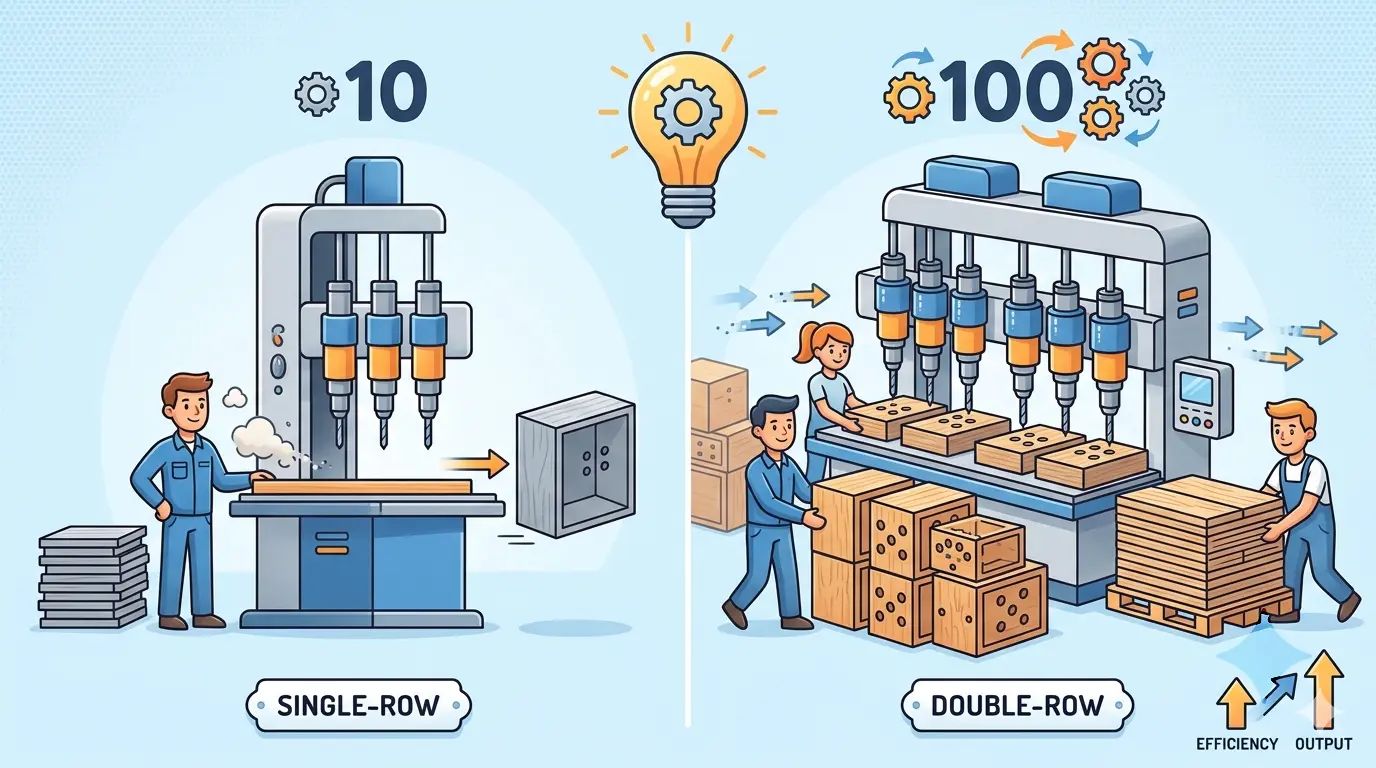
A single-row setup is commonly a good fit when the drilling logic is straightforward and the line can accept a more sequential workflow. A double-row setup is commonly a better fit when repeated parts need more hole groups completed with fewer stops. The practical difference is often less about theoretical machine capacity and more about how many handling steps stand between raw panel parts and assembly-ready components.
If a factory measures output only by cycle speed and ignores re-positioning time, it can easily overestimate what a more complex configuration will actually deliver.
Where Single-Row Boring Machines Usually Fit Best
A single-row machine is usually attractive when the workload is stable but not overly dense in hole groups. It can make sense for operations that want dedicated drilling without adding more machine complexity than the product mix can justify.
This configuration is often well suited to:
- Repeated Cabinet Parts With Simple Drilling Logic
- Smaller Or Mid-Sized Production Runs
- Shops That Can Accept Sequential Part Processing
- Workflows Where Operators Still Need Flexibility Around Part Order
- Factories Upgrading From More Manual Drilling Without Building A High-Output Drilling Cell
The main advantage is usually process simplicity. A straightforward drilling station can be easier to organize, easier to standardize, and easier to keep productive when the workload does not demand more drilling per cycle.
The tradeoff is equally practical. If each part requires several repeated hole groups, or if the line loses too much time to re-positioning, a single-row machine can protect accuracy but still leave output on the table.
Where Double-Row Boring Machines Usually Fit Best
A double-row configuration is commonly selected when the factory wants to reduce stops between repeated drilling sequences. In panel-furniture production, that often matters when cabinet sides, shelves, and similar parts move through the station in stable batches and the drilling pattern is repeated often enough to reward a more output-oriented setup.
A double-row format is usually stronger when the workflow needs:
- More Hole Groups Completed Per Part Cycle
- Fewer Re-Positioning Steps On Repeated Panels
- Better Rhythm In Batch Cabinet Production
- Less Waiting Between Drilling And Assembly Preparation
- Higher Daily Part Release From A Dedicated Drilling Station
In other words, double-row machines usually earn their place when the drilling area is expected to behave like a production accelerator, not just an accurate hole-making station.
The tradeoff is that added row capacity only pays off when the part family is repetitive enough to keep the machine fed efficiently. If orders change too often, if patterns vary constantly, or if upstream batching is weak, the extra configuration may not translate into cleaner output.
Side-By-Side Decision Table
| Decision Factor | Single-Row Boring Machine | Double-Row Boring Machine | Better Fit |
|---|---|---|---|
| Part Complexity | Better when each part follows a simpler repeated hole routine | Better when each part needs more drilling completed with fewer stops | Depends On The Part |
| Batch Stability | Works well in stable but moderate-throughput batches | Works best in stable, repeated batches that justify higher drilling output | Double-Row In More Repetitive Lines |
| Re-Positioning Sensitivity | More acceptable when extra handling does not hurt line flow much | Stronger when reducing handling steps materially improves part release | Double-Row When Handling Is Costly |
| Shop Simplicity | Often easier to standardize for straightforward drilling tasks | More worthwhile when the line can fully use the added configuration | Single-Row For Simpler Workflows |
| Daily Output Goals | Good when accuracy matters more than maximum drilling density | Better when the factory is pushing repeated panel parts through a dedicated drilling cell | Double-Row For Higher Repeated Output |
| Product Mix Variability | Usually more forgiving when jobs change more often | Less rewarding if changeovers or mixed patterns interrupt the cell | Single-Row In More Variable Work |
| Best Overall Use Case | Sequential drilling on repeated but less dense drilling work | Faster release of repeated parts with heavier drilling demand | Depends On Output Mix |
The key point is that double-row is not automatically better. It is only better when your real bottleneck is the amount of drilling completed per handling step.
Output Should Be Measured At The Next Station
Factories often talk about boring-machine output as if drilling ends at the machine. It does not. The true measure is what reaches hardware insertion, fitting, or assembly without delay.
If a double-row machine reduces drilling stops but the line still sends parts forward in mixed order, the gain may be smaller than expected. If a single-row machine drills accurately but forces too much turning or rechecking, the assembly area will still feel the delay. That is why the row decision should be evaluated against downstream effect, not just drilling time.
The most useful signs of real output improvement are usually:
- Fewer Part Handling Steps Before The Next Process
- More Consistent Hole Positioning Across The Batch
- Less Operator Re-Measurement Between Cycles
- Smoother Flow Into Hardware Fitting Or Assembly
- Fewer Drilling-Related Delays Later In Production
A machine that makes the drilling area look faster but does not improve the release of ready-to-assemble parts has not fully solved the problem.
Single-Row Often Wins When Output Is Mixed, Not Maxed Out
There are many factories where a single-row configuration is the more rational choice even when management wants more capacity.
That is commonly true when:
- The Product Mix Changes Often Enough That Maximum Row Efficiency Is Rarely Used.
- Each Part Does Not Need Dense, Repeated Hole Groups.
- The Drilling Cell Supports A Broader Flexible Workflow Rather Than A Dedicated High-Volume Line.
- The Main Problem Is Replacing Manual Inconsistency, Not Building A Near-Continuous Boring Station.
- Upstream And Downstream Processes Are Not Yet Organized Tightly Enough To Feed A More Output-Focused Setup.
In these cases, a single-row machine can still deliver major gains through repeatability and better process control without forcing the factory to pay for capacity it cannot fully use.
Double-Row Usually Wins When The Line Is Already Structured
A double-row machine usually becomes easier to justify when the surrounding workflow is disciplined enough to benefit from it. Stable panel sizing, clear part orientation, repeated cabinet logic, and orderly batching all increase the value of a more output-oriented boring cell.
That usually includes factories where:
- Cabinet And Wardrobe Parts Repeat In Large Volumes.
- The Same Hole Logic Runs Across Long Batches.
- Assembly Performance Depends On Faster Release Of Drilled Components.
- Operators Lose Too Much Time Re-Positioning Parts In A Sequential Drilling Workflow.
- Management Wants The Drilling Area To Keep Pace With Faster Cutting, Edge Processing, Or Line Assembly.
In those environments, the decision is less about machine prestige and more about matching the boring station to the rhythm of the rest of the factory.
Ask These Questions Before You Choose
Before selecting a row configuration, buyers should define what “more output” actually means in their plant.
| Question | Why It Matters |
|---|---|
| How Repetitive Are The Part Families? | Repetition determines whether a double-row format will stay efficiently utilized. |
| How Many Hole Groups Does Each Part Commonly Need? | Denser drilling needs usually increase the value of reducing re-positioning. |
| How Much Time Is Lost Between Drill Cycles? | Handling, turning, and checking time often matter more than drill time alone. |
| Does Assembly Wait For Drilled Parts? | If downstream teams are delayed, row configuration should be judged by released parts, not isolated machine speed. |
| How Often Do Jobs Change During A Shift? | Frequent pattern changes can reduce the practical advantage of a more output-oriented setup. |
| Is The Workflow Already Structured Enough To Feed Higher Capacity? | Extra row capability only pays off when batching, orientation, and part flow are controlled. |
These questions usually produce a better buying decision than simply comparing one-row and two-row machines as if the difference were universal.
When Row Count Is Not The Real Issue
Some factories compare single-row and double-row boring machines when the deeper issue is not row count at all. The real problem may be that the drilling workload is becoming too variable for a dedicated repeated-pattern station, or that the factory expects one machine to absorb too many different part types.
If the product mix has moved toward frequent design changes, shorter runs, or more digitally driven part variation, the better question may be whether a more programmable drilling approach is needed. But if the work still revolves around repeated cabinet and furniture parts, then the row decision remains highly relevant because it directly affects how efficiently those parts move through the drilling cell.
The mistake is choosing a higher-output configuration to solve a flexibility problem, or choosing a simpler configuration when the factory already runs stable batches that need more drilling completed per cycle.
Practical Summary
A single-row boring machine is usually the better fit when drilling is repeated but relatively straightforward, when the line can accept a more sequential process, and when the factory values simplicity and stable hole accuracy more than maximum boring density. A double-row boring machine is usually the better fit when repeated cabinet parts need more drilling completed with fewer stops, and when the surrounding workflow is structured enough to turn that reduced handling into real daily output.
The practical rule is simple: if your output is limited mainly by re-positioning and repeated handling on stable batches, double-row configuration is often the stronger answer. If your output is mixed, your drilling logic is simpler, or your workflow still benefits from a more straightforward station, single-row may match your production better.
Choose the row configuration that releases more correct parts into the next process, not the one that only looks faster in isolation.